Showing posts with label Jacobean. Show all posts

Sunday, March 29, 2026

Beverley, East Yorkshire


Friars and their successors

Anyone alighting from the train at Beverley station should find it easy enough to locate the remains of the medieval Dominican friary in Friars Lane – we stumbled on them straight after arriving in the town. The friars followed a teaching and preaching vocation and so their friaries are generally sited in towns and cities and this fact means that most of them have disappeared because of property development in the centuries after Henry VIII dissolved them in the 16th century. So standing friary buildings are scarce and, in my book, worth a look. At Beverley, the friary church has long gone (its foundations are in part buried beneath the nearby railway), but there is a substantial remaining building that may have originally housed the friars’ dormitory and library.*

The surviving buildings became a house after the dissolution, and its owners, the Warton family, preserved and enhanced them. One glimpse into their world is a series of fragments of wall painting visible in the surviving rooms. Some of this decoration (inscriptions on trefoil-shaped backgrounds surrounded by twining foliage, below) may in fact date to the time of the friars. But some particularly delightful, if now flaking, floral paintings (above), are post-Reformation. The geometrical pattern of bands in which the flowers are set have a Jacobean (i.e. 17th-century) look about them.

It’s good to be reminded that coloured decoration in the early-modern period was not limited only to the grand houses of the super-rich, with their coats of arms and mythological subjects. Here in a Beverley side street is evidence of the floral sensibilities of a middle-class family, who enjoyed bringing images of nature inside their house. I wonder if they were enthusiastic gardeners.

- - - - -

* Today, the friary is a Youth Hostel. The building survives as a result of a campaign by preservationists when it was threatened by the expansion of a nearby factory that produced shock absorbers.

Sunday, December 21, 2025

Needham Market, Suffolk


Embarrassment of riches?

This is the magnificent railway station building at Needham Market, an impressive Jacobean revival design by Frederick Barnes, who designed numerous stations on the Ipswich and Bury Railway. It’s one of the most outstanding stations on the line, a visual feast of towers, gables and mullioned windows – I think only Bury St Edmunds competes with it in this neck of the woods. The impressive, partly diapered brickwork is enhanced by dressings in Caen stone, a material sometimes found in medieval English cathedrals. Needham Market station closed in the great station cull of the 1960s, but by 1971 it had opened again, although this building had been let to tenants. It is, after all, on the large side for a small town.*

When the station was built – during the railway boom, in 1846–7 – it was still more magnificent than it is today. The square end towers had curvaceous ogee roofs and the three gables were in the Dutch style, also with multiple curves. At some point in the station’s history, these features were modified, giving the end towers crenellated parapets and the gables straight sloping edges. It’s not clear exactly when these alterations were made. Gordon Biddle, in his book Britain’s Historic Railway Buildings, cites a photograph of 1912, which shows the station in its original form. An Aerofilms image of 1928 shows it the way it looks today, so the changes were made long before the station’s short-lived closure.

Whatever the reason the building was altered, it’s still worth noticing. It speaks of a time when a station was not something that was thought best to hide away behind other buildings. Frederick Barnes and the Ipswich and Bury Railway did Needham Market proud.

- - - - -

* The most recent census put the population at around 5,000.

Sunday, August 17, 2025

Chastleton, Oxfordshire


A spirit of place and time

I have visited Chastleton House before, but the other week the Resident Wise Woman and I decided that it was time for a revisit, so once again we found ourselves parking in the designated car park and walking along the path across the field and past the dovecote, to arrive in front of one of the most perfect of English Jacobean country house facades. As I’ve shown this front before in a previous post, I want this time to dwell on the interior, its unique contents, and the unusual way in which the National Trust has preserved it all. When the house came to the National Trust in 1991, it was remarkable not just for its architecture of 1607–12, but also for the fact that many of the 17th-century contents were still in place, and nothing substantial had been altered. None of the inhabitants had been rich, so there were no makeovers, and no money for anything but the most basic necessary repairs. The effect was not much different from that described in a Country Life article of 1919: ‘one of those rare things that once seen can never be forgotten…for the retention of its ancient furniture, fittings, pictures, pewter, glass and tapestries…it stands out as a wonderful survival’.*

What the curators at the National Trust saw when they took over in 1991 was something very similar – but with an added element. The house was also testimony to the owners who had hung on, living in the house but doing very little with it. The evidence of their lives was all around them – recent inhabitants had included an art critic and a scientist – the cups and plates they used every day, boxes of chocolates, the books and magazines they read, the glasses they wore while reading them. The place was a time capsule, but evocative of two eras: the early-17th century and the mid-20th. How to preserve this legacy?

The Trust decided not to restore the building to what it might have been like in the Jacobean heyday, but to preserve it very much as it was in 1991 when they took over. They adopted the minimal of alteration, only the most necessary repair, to lay, as Mark Drury put it, ‘as light a hand as possible on Chastleton, to arrest 150 years of progressive decay with an almost imperceptible tightening of the reins’. So no wholesale repainting or regilding of surfaces, just touching up here and there, while retaining the overall feeling of flakiness; no new curtains but gentle repair of what was there; and so on. And in addition, retaining the marks of a life lived in the house – magazines left open on the bed or table; a teapot waiting to be poured; a half-empty decanter, old guidebooks to Oxfordshire and the Cotswolds in a rack near the entrance.

The approach has always been controversial. There are some who believe that a place as beautiful as this deserves a more interventionist approach, to take it some way back towards its 17th-century glory; one good friend of mind calls the Trust’s approach at Chastleton ‘brilliantly wrong’. There are indeed ways of doing this without wholesale restoration and the SPAB and those who follow its tents have established best practice for conservation. But I’m more sympathetic. I love the way the house pays homage to both its original builders and its 20th-century owners. I also admire the way the house’s custodians can keep something so fragile in this precarious state indefinitely. But I’m also aware of the problems of doing this. All conservation is difficult, expensive, and painstaking; keeping this fragile place just so must be even more so. And as I stroll around the house with other visitors, our feet pounding the floor and staircases, our breath changing the humidity, our hands leaving marks on banisters, I realise that I and all the other visitors are ourselves part of the problem, a strain on the building, while also providing funds for its upkeep. And yet at moments, when one is alone in a room, there is an atmosphere, a spirit of place and time, like nowhere else in the world.

- - - - -

* Quoted in The Art Newspaper, 1 December 1991
Chastleton house, teatime tableau


Tuesday, July 23, 2024

Nantwich, Cheshire

Resurrection

Readers who would like to see some older timber-framed architecture, after two posts on half-timbered buildings of the 19th and 20th centuries, look no further.

Equally at the top of my list of priorities when visiting a town that’s new to me are historic buildings and local bookshops. Here in Nantwich then was nirvana: a bookshop in a historic building – the Nantwich Bookshop and Coffee Lounge. For the refreshments, I can forgive the fact that part of the lovely 17th-century facade is obscured by the tented gazebo out front – customers of the Coffee Lounge need to be accommodated and there were plenty on the day we were there. We could still revel in the dazzling patterns of the posts, beams, struts and braces of both the bookshop and the premises to the right. The ornate design of the timberwork is typical of the region, as are the front-facing gables that protrude over the street, the transition between the two surfaces made by a plaster cove. What’s more, there’s a delightful hand-made quality to all this, which, together with a hint of a little structural movement here and there, confirms that this is a building of the 16th or 17th century, not a Victorian imitation.

This is a jazzy building, a bit like a three-dimensional 17th-century equivalent of the paintings of Bridget Riley, and would have cost a lot of money to produce. The owner of the bookshop part when it was built was Thomas Churche, linen merchant, nephew to the still more prosperous William Churche, who built the portion to the right, and who was also the owner of the large Churche’s Mansion in Hospital Street in Nantwich. Both of the buildings in my photograph were almost certainly rebuilt after the great fire that destroyed much of the town in 1585. Investigations when the building was restored found that there had been some structural movement, probably soon after construction, and samples of the earth beneath the shop were taken. These revealed unconsolidated soil to a depth of 7 feet, and stretching back some 15 feet from the front of the shop. It’s suspected that the building was erected over the former castle moat.*

Another surprising discovery during the restoration was that the rear of the building is actually older than the front portion, and apparently by a different carpenter. Could this be because part of the structure escaped the fire? Or because the rebuild was done in two phases, perhaps as money became available?

While I was occupied in pondering these and other matters, the Resident Wise Woman got talking to a member of the shop staff. As a result I was permitted to climb the stairs into the attic (not normally open to the public) to inspect the substantial roof timbers of those impressive gables. On the way up, I passed through the middle floor (UK first floor, US second floor), where I saw Jacobean panelling on the walls and a beautiful piece of decorated plaster ceiling (see the photograph below).

Finding such interest and beauty on the inside as well as the outside of a building made my day, and I felt all the better because this had happened in a bookshop. I can say with the politician and writer Michael Foot that some of my happiest moments have been spent in bookshops.† This one was no exception. Thank you to the staff of the Nantwich Bookshop and Coffee Lounge for hospitality and coffee. And yes, of course I bought a book while I was there.

- - - - -

* I’m indebted to a report by the architect Jim Edleston, a copy of which is available for consultation in the bookshop.

† Michael Foot (1913–2010), Labour politician, journalist, and author of books on Jonathan Swift, H. G. Wells, and Lord Byron, among many others.
Detail of plaster ceiling, Nantwich Bookshop


Saturday, March 2, 2024

Hereford

Aid for the industrious

Wondering along an unfamiliar street in Hereford, I came across this arch, looking like a Jacobean relic stranded in the modern city. A little research soon revealed that it’s neither Jacobean nor stranded. It’s actually Victorian – the Victorians revived virtually every earlier British style of architecture, Jacobean included and they knew that the flattened arch, scrolls, finials, curvaceous gable and pediment would evoke the kind of architecture popular on grand country houses and other buildings from around the year 1600.

The arch makes a grand entrance to a cemetery, and its grandeur is to commemorate a once-famous Hereford man, whose charitable works helped the city’s poor. Rev. John Venn was vicar of a parish in an impoverished part of the city. Working with his sister Emelia, he founded the Society for Aiding the Industrious. Among the Venns’ and the Society’s projects were a soup kitchen to feed the hungry, a dispensary, and allotments enabling people to grow their own food. They founded a school and a children’s home, and their initiatives to provide employment included a corn mill and a model farm.

The arch harks back to a time – the Tudor and Jacobean periods – which the Victorians saw as a period of British greatness. It was the era when British explorers laid the foundation of the empire that brought the Victorians much of their wealth. So much the better that they recognised the work of a couple who focused on helping those who accrued no wealth or power from the empire, bringing education, nourishment, useful work, and better living conditions to people who needed them most.

Thursday, August 31, 2023

Muchelney, Somerset

A glimpse of the heavens

En route across Somerset, I decided to stop at Muchelney, where I’d not been for years. I planned to revisit the medieval abbey, but was also drawn to the adjacent but quite separate parish church of Saints Peter and Paul. The church is late-15th century, like so many in Somerset, but what I most wanted to see again was a later embellishment, the 17th-century ribbed and boarded ceiling of the nave, with its wonderful painted panels of angels looking down from the clouds.

I have not seen anything else quite like this ceiling (the angels in the church ceiling at Bromfield, Shropshire, come closest, but I’d say they are slightly later and in a different style). Each panel at Mucheleny is edged with clouds, which swirl like cotton wool or whipped cream, but are edged in darker shades. English clouds, of course, often combine the hopeful white with the threatening grey, but not quite in the stylized way of these ceiling paintings, and the stylization is part of their charm, which is easier to appreciate if you click on the image to enlarge it.

I find the angels charming too. They stand behind the clouds, and look down through the gaps between them; behind each figure is blue sky dotted with tiny stars, suggesting the angels are in a heavenly realm far above the clouds, farther still from us earthbound humans. They’re a far cry from medieval angels of any kind; neither are they like chaste Victorian angels. They have boldly painted faces, shoulder-length hair, and perky wings and they are are clothed in something like Elizabethan or Jacobean dresses, but in what Pevsner describes as ‘extreme décolletage’. The contours of their breasts vary – some look markedly rounded and suggest the human female form, some are less so. Those who feel compelled to explain such things suggest that their revealing costumes suggest their innocence, which sounds like a modern explainer trying very hard to justify what they see as inappropriate. Authorities such as Pevsner and the people who wrote the listing description for the church, avoid explanation altogether. I’d say anything that purports to be an explanation is at best informed guesswork.

The messages spoken by the angels, written on scrolls that they hold, are clear enough. ‘Good will towards men’, ‘Wee praise thee O God’, ‘All nations in the world…praise the Lords Name’, and so on. The sun, a golden roundel set at the intersection of four panels, looks on approvingly. From the floor below, I look up with similar approval at the whole ceiling – with more than approval indeed and with pleasure at another example of how the art of English churches can be colourful, unexpected, and full of joy.

Friday, September 15, 2017

Bristol


Sledgehammered

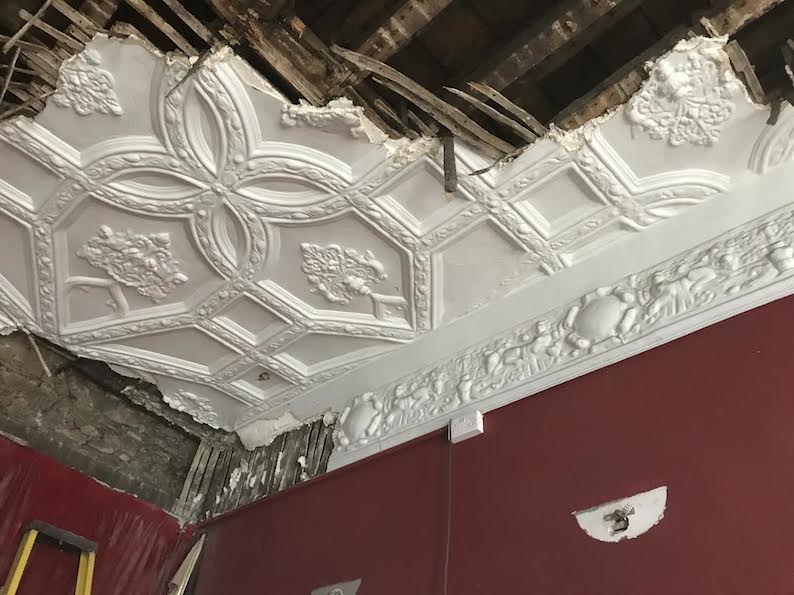
I was saddened to read about the demolition of a Jacobean plaster ceiling in a building in Bristol the other day. This beautiful piece of craftsmanship, which was neatly 400 years old, was in a building in Small Street which had been a bar and which a developer is converting into student flats. The removal of the ceiling was quite legal, but an application had been made to protect the building by listing it and the destruction of the plasterwork was carried out before the listings officers from Historic England had been able to inspect the building and carry out their assessment.

This sort of thing is not unusual. My mind went back to one of the most famous cases, the Firestone factory in West London, which was bulldozered over a Bank Holiday weekend in 1980, hours before a listing was due to come into force. The Bristol case is different – even if they’d had the chance to look at it, the inspectors may have decided not to list the building – but just as deplorable: 400 years of history gone with a few strokes of the sledgehammer.

There is a way of making pre-emptive demolition more difficult: introducing interim protection of buildings while the listings assessment takes place. Such a system already operates in Wales and in the opinion of many it’s time it did in England too. A petition, supported by groups such as the C20 Society, has been started to urge the government to bring in such a measure. I’d encourage readers who can do so to sign the petition here.

- - - - -

The picture above comes from the SAVE Britain's Heritage website, where there is more about the ceiling here

Tuesday, September 2, 2014

Yarnton, Oxfordshire


The real thing

After Jacobean revival doorway of the previous post, here’s an example of a genuine Jacobean manor house. It’s Yarnton Manor, not far from Oxford, and it was built in around 1611 by Sir Thomas Spencer, altered in later centuries, and restored in 1895. The facade that’s visible today is restrained – curvy gables,* but quite small ones, projecting bays that don’t project very much, minimal classical detailing around the doorway – but lovely. It looks an attractive, welcoming house, without aspiring to the grandeur or extravagance of the great ‘prodigy houses’ of the 16th century.

The building was not always home to lords of the manor. By the 19th century it was a farmhouse and it then passed through various owners, institutional and individual. One owner well known around Oxford in the mid-20th century was George Alfred Kolkhorst, university Reader in Spanish, who moved in after he came into his family fortune, having previously lived in rooms in Oxford itself, where he famously entertained students at Sunday-Morning salons. Kolkhorst was known to generations of undergraduates as ‘Colonel’, though he held no such rank: the name was probably applied ironically because he was the least martial of men. The writer and cartoonist Osbert Lancaster, in his autobiographical book With An Eye To The Future, recalls his time at Oxford, when he attended Kolkhorst’s salons in the Oxford rooms, which were full of questionable antiques, or, in Lancaster’s words, ‘objects of dubious virtue’. Lancaster goes on to say that when the ‘Colonel’s’ father died, Kolkhorst ‘moved into what he hoped was a Jacobean manor house’. Clearly, in spite of the later modifications, the hopes were justified.

After Kolkhorst died in 1958, the house was used as a dormitory by a local school before becoming the home of Oxford University’s Postgraduate Centre for Hebrew Studies. The Hebrew Studies centre is now relocating, and the manor house was put on the market earlier this year. In its quiet setting, so near the city but removed from it, it looks good for another 400 years.

- - -

* Some sources say that these are the result of later remodelling.

Friday, August 29, 2014

Northampton


A ‘sort of Jacobethan’

This doorway in the middle of Northampton, sandwiched between two shops, is easy to miss. Easy to miss, that is, until you look up, when you realise that it’s part of quite a large corner building full (above the modern shopfronts) of big windows, banded masonry, and curvy gables. But what kept my eye engaged, and my mind boggling, was the busy collection of carved stone motifs above the doorway. Pevsner describes this 1902 structure as being ‘in a sort of Jacobethan manner’ and notes that the architect was J P Sharp of Birmingham.

The architect certainly threw the kitchen sink at this entrance. The carved crosses, roundels, and nail-heads certainly seem to be straight out of the pattern-book of standard Tudor-Jacobean patterns – but perhaps you’d be as likely to see them around a 17th-century fireplace as framing a doorway. There are classical motifs too and some of these, like the little Ionic capitals, are highly ornate, again in the manner of Jacobethan builders, who got their classicism as much from Renaissance buildings in France as from Greece or Rome. Put all these elements together and you have a very ornate, turn-of-the-century sort of Jacobethan.

This is confirmed by the lettering, which has eccentric touches (the bulbous lower portion of the B, the rather oddly proportioned M) that don’t look Jacobean at all. These forms are very much of their time: not quite Art Nouveau, but very nearly. This, and the curious cornice above, which comes to a sharp point but does not quite turn into a pediment, are the crowning touches – eccentric, to be sure, but offering a welcome bit of visual incident amidst the more commonplace shop fronts on either side.

Tuesday, August 12, 2014

Ludlow, Shropshire


Local colour

On a somewhat unproductive day, I thought I'd go through my photographs of some of the places I've visited recently and was quickly reminded of Ludlow. The Feathers, a dazzling timber-framed house turned inn, is a building I've written about before and admired on many occasions. However often I go past, I always take a look at its carved timberwork, but what raised my spirits this time was the display of hanging baskets. I suppose if you'd asked me beforehand, I'd have said that the Feathers, in all its jazzy Jacobean glory, hardly needed baskets of flowers to add to its attractions. Isn't all that carved oak enough on its own? Well, at one level it is, but at another, a few splashes of colour do complement the monochrome patterns of the woodwork. The building's carvings (mustachioed faces, scrolls, leaves, miniature arches), patterned glazing bars, and lozenges of golden glass are set off wonderfully by this floral display.

Monday, March 4, 2013

Eyton on Severn, Shropshire


Rooms with a view

Rounding a bend in a lane in Shropshire, I caught a sudden glance of a small pointed roof and stopped to find this little tower, apparently stranded on its own next to a tall garden wall. It is stranded because it is the last remaining fragment of Eyton Hall, the home of Shropshire grandee Sir Francis Newport, who rebuilt his house in the 1590s and early 1600s. The tower was one of a pair, standing at either end of a bowling green, and its artful plan (based on two conjoined octagons), diaper-patterned masonry, and ogee-capped roof are typical of the more ornate style of English architecture at the end of the Elizabethan period.

The building was what was known as a banqueting house. The tradition was for those enjoying a grand meal to take the last course – fruit, comfits, dessert wine – in a garden pavilion or tower, where they could enjoy a view across the garden. It was perhaps the closest they got to al fresco eating, an architectural concession to the English climate akin to Elizabethan long galleries, which enabled Tudor and Jacobean ladies to enjoy a walk without going outside to face the elements. Some of the grandest of country houses, such as Longleat, had banqueting houses in the form of towers on the roof, but  pavilions like this one at Eyton did the job just as well, while also maintaining a closer connection with the garden.

It's possible to enjoy this little tower not merely as I did, as a passer-by, but more intimately. It is in the care of the Vivat Trust, who let it out as a holiday home. The details, together with more historical information about the building and its history, are here.

Monday, February 18, 2013

Bosbury, Herefordshire


On-street irregular

In contrast to the rather grand timber-framed houses in my previous posts, here's a more modest example from Herefordshire. This pair of houses in Bosbury are probably 17th century, although they have been much altered (for example, with the fitting of new window frames) in the 20th century. They have white-painted brick infill between the timbers of the rather irregular frame and the somewhat rustic-looking irregularity, with a frame consisting of different sized rectangles, timbers of varying widths, and features such as half-dormers, adds up to a kind of building quite often seen among the villages and farms of Herefordshire and the west of England more generally.

Another common feature of the timber-framed houses in this part of England is the large stone chimney stack at the end of the building, positioned to keep the heat of the fire away from the vulnerable timbers. It would perhaps originally have contained a very large fireplace but now, of all things, there's a window in one side of the stack and there must be a relatively small fireplace with a diagonal shaft running up to the brick chimney above.

Sunday, February 10, 2013

Ludlow, Shropshire


Dazzler

One of my readers asked me, in response to the previous post about a building in Buckinghamshire, whether I had any thoughts on regional variations in timber-framed buildings. Just a few, so I thought I'd do a group of posts about such structures in different parts of England.

One of the most rewarding places to look at this type of building is in the west Midlands and the counties that mark England's border with Wales. In this area Shropshire and Cheshire in particular stand out: one of the features of the local architecture here is a tendency towards highly ornate timberwork in which the frame is made up of many small square sections, themselves embellished with additional woodwork in the form of a multitude of diagonal braces, quatrefoils, small arches and the like. Carved bargeboards, brackets, and ornamental heads add to the effect on the most elaborate buildings. A town in which all these details can be seen is Ludlow, and perhaps the most magnificent timber-framed building in Ludlow is The Feathers, built in 1619 as a house for a Welsh lawyer, Rees Jones, and as dazzling a display of conspicuous wealth as you'll see on an English street. The building became an inn in about 1670.

This is high-status architecture. There are many buildings in this region with much plainer woodwork. But for rich merchants, lawyers, and landowners who wanted houses that stand out on a crowded street, Shropshire's carpenters had the skill to fit the bill.

- - -

I've posted before about Shropshire's dazzling timberwork here and here.

Sunday, October 14, 2012

Lydney, Gloucestershire


A glimpse of gables

After a short walk around the restored docks at Lydney when I watched mist lift from the River Severn, I walked back towards the industrial estate under a virtually cloudless sky. Glancing up a potholed road past silent factories (whitewashed brick, shuttered concrete, blanked-out windows, lots of chain-link fencing and barbed wire) I caught sight of an old gable. I followed the chain-link fence until I left it behind and, beyond a field, a view opened up of a gabled sandstone house of the 17th century.

This is Naas House, built for the Jones family (William Jones was founder of the Haberdashers' Company in London) probably in the early-17th century. It's a big house – this is just one end – and the mullioned windows, string courses, and parapeted gables are very much of the period, as are the false windows in the gables. The central turret, though, with its lead-covered cupola, is a sophisticated touch. From here the owners could walk out on to a viewing platform and look towards the River Severn (to the right) or towards Lydney and the Forest of Dean (to the left).

The Jones family upgraded the interior in the early 18th century, installing panelling in a number of rooms, but in 1771 Mary Jones, daughter of the owners, was murdered on her way home from a dinner at the rectory at Lydney. Soon after this the family moved to another house near Newnham on Severn. Although the family kept Naas House (a Rev Edward Jones lived there in 1839) it was no longer their main residence and this was probably why there were few further alterations and the house keeps its Jacobean character in its quiet backwater.

Friday, December 10, 2010

Chastleton, Oxfordshire


Stone, glass, and sunshine

The recent cold weather, which has clad the Cotswolds in ice and snow, has meant I’ve not been much out and about exploring buildings. But a trip to have a pub lunch with friends took me within a short distance of Chastleton House, an old favourite of mine, so I decided to slither along the icy lane to this early-17th century Oxfordshire marvel, and have a look through the gates.

The picture shows the entrance front as one sees it from the lane, its limestone walls and mullioned windows not much changed since the house was built between 1607 and 1612. The first owner was Walter Jones, a lawyer and MP, and the house went down through his family, from father to son, and uncle to cousin, until it passed into the care of the National Trust in 1991.

My observant readers will already have noticed that there is no visible entrance on this entrance front. That’s because the doorway is concealed in one of the protruding bays that flank the centre of the facade – you climb the short flight of steps and the door is right there, on your left. What you find when you enter is an interior not much altered since the Jacobean era – the family never had money for alterations or makeovers, and lived a life apart from the world of fashion. Oak panelling, tapestries, and wonderful plaster ceilings abound, together with some ornate fireplaces and carved oak furniture.

Because there had never been much money to renovate, repairs had been done on a rather ‘make do and mend’ basis and the policy since 1991 has been to keep up this tradition with ‘minimal repair and almost no modification’. The result inside the house is in places oddly tatty, a lived-in look for a house that is no longer lived in. Some find this jars, and I can understand their reservations – and those of people who think a house like this should be lived in rather than kept as a museum. For what it’s worth I don’t share these misgivings. I think the way the house is maintained is sympathetic to the way it was kept by its owners and an education to those who come to see it – and those who come do come to see the house: there’s a minimum of add-on spend opportunities here.

But none of this was very relevant the other day as I stared in wonderment at the sun-drenched limestone of Chastelton’s walls and roofs and mullions. The craftsmanship, the rhythm of gables, windows, and towers, the quiet on this freezing morning when no one was out and about – all were as nourishing to me as the hare pie and bitter I was soon to consume.