Moved but not shaken
The Resident Wise Woman and I had not been in Beverley long before we started spotting interesting details and evidence of an enthusiasm for preserving the old structures in which this town abounds. As we walked along Eastgate, this brick doorway stood out, as did the fact that its historical context was helpfully explained on an accompanying iron plaque. It was originally a gateway in the perimeter wall of the nearby Dominican friary, a foundation of 1240 that lasted until Henry VIII closed it in 1539. The gateway itself, however, is not as old as the original friary. The plaque puts its date in the ‘early 16th century’, but I detect a hint of the ‘artisan mannerism’ of the 17th century about it. Whatever its age, it’s a striking design, with its flattened arch complete with an inner order of knobbly bricks, a triangular pediment and a studded door.
Apparently, the gateway was originally on the other side of the street, closer to the friary, and was moved in the 1960s when Eastgate was widened, a welcome bit of preservationism in an era notorious for knocking old buildings down. The wall in which it is now embedded is itself made of an interesting array of old materials – bricks, stone rubble, and better quality ashlar masonry. Anyone seeing this as they are walking around Beverley, if they’re interested in the history of the friary, should head to Friars Lane and look at what remains of the building itself. A couple of details from this structure will be the subject of a future post.
Showing posts with label Stuart. Show all posts
Tuesday, March 24, 2026
Wednesday, July 9, 2025
Hepple, Northumberland
Poor man’s tower
The pele tower of the kind featured in my previous post was not the only kind of fortified dwelling typical of the border country. There was also the bastle, or bastle house, a type of fortified farmhouse. Bastles (the name derives from the French bastille) usually had two (or sometimes three) storeys. The farmer’s livestock (or at least, the most valuable animals) occupied the ground floor. Above this were the owner’s living quarters, separated from the room below by either a wooden or stone-vaulted ceiling. The walls were usually thick (about a metre) and there were only a few small windows. This simple arrangement has led to some dubbing the bastle the ‘poor man’s tower’, though it is not strictly a tower at all. More than one thousand bastles were built in the border region between 1500 and 1700.
Many bastles fell into disuse after life got easier with the reduction in border raids during the 17th century. Some fell into ruin, some were adapted to make more comfortable dwellings; their solid construction has ensured that they survive well. Woodhouses Bastle, near the village of Hepple, has been preserved in something close to its original form. It’s a simple stone building that would be easy for the casual passer-by to mistake for a barn. The lower room is stone-vaulted, reducing the risk of the bastle being successfully attacked using fire. It sits on a hillside, commanding a broad view from three sides through tiny windows. The largest window on the side in my photograph is protected by bars
The building bears a date stone, carved with some initials and the date 1602. The initials include W.P., probably for the landowner, William Potte. The date may well be the year modifications were made or fortifications completed, since the building itself was probably put up in the 16th century. Soon after 1602, the Stuart king James VI and I set measures in progress to reduce the danger of border raiding. While a secure home remained a valuable asset in remote areas, the heyday of the fortified farmhouse would soon be coming to an end.
The pele tower of the kind featured in my previous post was not the only kind of fortified dwelling typical of the border country. There was also the bastle, or bastle house, a type of fortified farmhouse. Bastles (the name derives from the French bastille) usually had two (or sometimes three) storeys. The farmer’s livestock (or at least, the most valuable animals) occupied the ground floor. Above this were the owner’s living quarters, separated from the room below by either a wooden or stone-vaulted ceiling. The walls were usually thick (about a metre) and there were only a few small windows. This simple arrangement has led to some dubbing the bastle the ‘poor man’s tower’, though it is not strictly a tower at all. More than one thousand bastles were built in the border region between 1500 and 1700.
Many bastles fell into disuse after life got easier with the reduction in border raids during the 17th century. Some fell into ruin, some were adapted to make more comfortable dwellings; their solid construction has ensured that they survive well. Woodhouses Bastle, near the village of Hepple, has been preserved in something close to its original form. It’s a simple stone building that would be easy for the casual passer-by to mistake for a barn. The lower room is stone-vaulted, reducing the risk of the bastle being successfully attacked using fire. It sits on a hillside, commanding a broad view from three sides through tiny windows. The largest window on the side in my photograph is protected by bars
The building bears a date stone, carved with some initials and the date 1602. The initials include W.P., probably for the landowner, William Potte. The date may well be the year modifications were made or fortifications completed, since the building itself was probably put up in the 16th century. Soon after 1602, the Stuart king James VI and I set measures in progress to reduce the danger of border raiding. While a secure home remained a valuable asset in remote areas, the heyday of the fortified farmhouse would soon be coming to an end.
Sunday, June 22, 2025
Wichenford, Worcestershire
Local colour
Monuments like this – a large 17th-century altar tomb commemorating four members of the same family – make me smile. I find them delightful because they’re colourful (and parish churches often lack colour, aside from the stained glass which not all churches have anyway) and because of the way that they connect us with the people of the past. The people in this case are John Washbourne, whose effigy is placed above that of his father, Anthony, and beneath those of his two wives, Mary (née Savage) and Eleanor (née Lygon). I do not pretend that these rather stylised portraits by a presumably local artist capture the subjects’ features with great precision – only those rich enough to hire a top-rank London sculptor could expect that, the rest had to make do with something more approximate or stylised. But the monument does tell us something about how they wished to be remembered, or more exactly how John Washbourne, who commissioned the monument when he was 84 years old, wanted them to be remembered. The delineation of the armour and the women’s clothes, as well as of their faces, has been done with care and the formality or stiffness of the figures is very much of its time.
So is the decoration – the array of foliate motifs, scrollwork, and strapwork. The bright colour is restored but must come near to the original. Very much of its time too is the heraldry. The arms of at the upper centre of the monument are of the Washbourne family. Lower down and also in the centre are the same arms quartered with those of two other related families, Poer and Dabitot. To the left these arms are combined with (or impale, to use the heraldic term) those of Savage on the left and Lygon on the right. Portraits and visual identifications and ornamentation combine to make an effect I find both impressive and charming. True, you had to be rich and powerful to have a monument like this and to be allowed to occupy quite a large part of a small church with it. But personally I don’t grudge them the space.
Monday, June 2, 2025
Burford, Oxfordshire
Street-facing
When you turn into the Oxfordshire town of Burford from the A40, you descend the High Street, the first part of which is called The Hill, towards the centre of town and the shops, the Tolsey (the market house and also, now, the town’s museum), and the parish church. The Hill is lined with houses of various dates, and one that I admire is Glenthorne House, the one on the left in my first photograph. This has a handsome 18th-century front with sash windows arranged in pairs, each window with a prominent keystone, each pair surrounded by a raised band of stone. There’s a central door with a pedimented surround and above it a blocked window, and the whole front is book-ended by stone quoins and topped with a plain parapet. It’s as pleasant a Cotswold-stone late-18th century composition as you could wish for and one might suppose that the whole house dates from the same period.
Perhaps the roof, however, is a bit of a giveaway. It’s not low-pitched and hidden behind the parapet, but higher and with an asymmetrical bow to its ridge that suggests something older. If you walk a little further up The Hill and look at the side of the house, the picture is very different. The building is emphatically not the symmetrical box implied by the street front. From the side, it can be seen how far back the house goes and how it has mullioned windows that suggest a rather earlier date – much of this probably represents a 17th-century remodelling of a medieval house. Pevsner reports that there’s a 14th-century stone archway inside the building. This side view also shows that the street front is an add-on, built against the house to present a once-fashionable Georgian face to the street.
Many house owners smartened up their street frontages like this. Often the position of the windows or proportions of the facade are incorrect, betraying a building of irregular or asymmetrical design behind. In this case, the proportions are just about right, and the makeover has been achieved with some style and grace. No doubt the house attracts as many admiring glances as it must have done in the 18th century. A few of the glancers, looking at the side elevation as well, will reflect that the human habit of responding to changing fashions has been around almost as long as architecture itself.
Monday, April 15, 2024
Totnes, Devon
Continuity and change
‘How old is that building?’ people ask. And the answer is often: ‘Various ages.’ Most buildings get altered over the years, as fashions, needs and uses change. So while one might be able to say that a structure was first built in a particular period, what we can actually see today is the result of many stages of alteration and renewal. Here are two neighbouring examples in the High Street at Totnes.
The building on the left with its black and white decoration bears a date, 1585, which no doubt marks its original construction. The N.B. whose initials also appear on the front was Nicholas Ball, a merchant, who was mayor of Totnes in 1585. Ball’s house rests on four stone columns at ground floor level. Originally these columns fronted an open loggia, with doors and windows set back – open colonnades are a feature of a number of buildings in this town. However, the open arches on this building were filled in with sash windows in the 19th century, when the door was also moved forward – although the wooden door itself, barely visible in the shadows in my photograph, is actually the original 16th-century one. Above the shallow arches of the ground floor are two further floors that were altered in the 18th century, when large sash windows fitted on both floors. The front was also heightened, probably at the time the upper windows were installed, as can be seen by the way the black uprights at either end stop far short of the cornice. So the building is a typical English mixture, showing alterations from the 16th to the 19th centuries, and is no worse for that.
Something similar can be said for the house on the right. This has an attractive pair of Georgian windows – a curvaceous bow window on the middle floor and a simple sash window on the top floor. The ground floor has what looks like a 20th-century shop window, although the black pilasters at either end and the panelled door to the left may well be older. The other striking thing about this front is that, in spite of the Georgian windows and quoins running up the sides, it’s jettied – in other words the upper floor sticks out. Jetties were a long-standing fashion from the late Middle Ages to the 17th century, and jettied buildings are timber-framed. So beneath the later plasterwork and fenestration is a wooden framework and a structure much older than it appears to the casual glance.
Thus do buildings trip us up when we make assumptions about their date, but also give us clues.
‘How old is that building?’ people ask. And the answer is often: ‘Various ages.’ Most buildings get altered over the years, as fashions, needs and uses change. So while one might be able to say that a structure was first built in a particular period, what we can actually see today is the result of many stages of alteration and renewal. Here are two neighbouring examples in the High Street at Totnes.
The building on the left with its black and white decoration bears a date, 1585, which no doubt marks its original construction. The N.B. whose initials also appear on the front was Nicholas Ball, a merchant, who was mayor of Totnes in 1585. Ball’s house rests on four stone columns at ground floor level. Originally these columns fronted an open loggia, with doors and windows set back – open colonnades are a feature of a number of buildings in this town. However, the open arches on this building were filled in with sash windows in the 19th century, when the door was also moved forward – although the wooden door itself, barely visible in the shadows in my photograph, is actually the original 16th-century one. Above the shallow arches of the ground floor are two further floors that were altered in the 18th century, when large sash windows fitted on both floors. The front was also heightened, probably at the time the upper windows were installed, as can be seen by the way the black uprights at either end stop far short of the cornice. So the building is a typical English mixture, showing alterations from the 16th to the 19th centuries, and is no worse for that.
Something similar can be said for the house on the right. This has an attractive pair of Georgian windows – a curvaceous bow window on the middle floor and a simple sash window on the top floor. The ground floor has what looks like a 20th-century shop window, although the black pilasters at either end and the panelled door to the left may well be older. The other striking thing about this front is that, in spite of the Georgian windows and quoins running up the sides, it’s jettied – in other words the upper floor sticks out. Jetties were a long-standing fashion from the late Middle Ages to the 17th century, and jettied buildings are timber-framed. So beneath the later plasterwork and fenestration is a wooden framework and a structure much older than it appears to the casual glance.
Thus do buildings trip us up when we make assumptions about their date, but also give us clues.
Thursday, August 31, 2023
Muchelney, Somerset
A glimpse of the heavens
En route across Somerset, I decided to stop at Muchelney, where I’d not been for years. I planned to revisit the medieval abbey, but was also drawn to the adjacent but quite separate parish church of Saints Peter and Paul. The church is late-15th century, like so many in Somerset, but what I most wanted to see again was a later embellishment, the 17th-century ribbed and boarded ceiling of the nave, with its wonderful painted panels of angels looking down from the clouds.
I have not seen anything else quite like this ceiling (the angels in the church ceiling at Bromfield, Shropshire, come closest, but I’d say they are slightly later and in a different style). Each panel at Mucheleny is edged with clouds, which swirl like cotton wool or whipped cream, but are edged in darker shades. English clouds, of course, often combine the hopeful white with the threatening grey, but not quite in the stylized way of these ceiling paintings, and the stylization is part of their charm, which is easier to appreciate if you click on the image to enlarge it.
I find the angels charming too. They stand behind the clouds, and look down through the gaps between them; behind each figure is blue sky dotted with tiny stars, suggesting the angels are in a heavenly realm far above the clouds, farther still from us earthbound humans. They’re a far cry from medieval angels of any kind; neither are they like chaste Victorian angels. They have boldly painted faces, shoulder-length hair, and perky wings and they are are clothed in something like Elizabethan or Jacobean dresses, but in what Pevsner describes as ‘extreme décolletage’. The contours of their breasts vary – some look markedly rounded and suggest the human female form, some are less so. Those who feel compelled to explain such things suggest that their revealing costumes suggest their innocence, which sounds like a modern explainer trying very hard to justify what they see as inappropriate. Authorities such as Pevsner and the people who wrote the listing description for the church, avoid explanation altogether. I’d say anything that purports to be an explanation is at best informed guesswork.
The messages spoken by the angels, written on scrolls that they hold, are clear enough. ‘Good will towards men’, ‘Wee praise thee O God’, ‘All nations in the world…praise the Lords Name’, and so on. The sun, a golden roundel set at the intersection of four panels, looks on approvingly. From the floor below, I look up with similar approval at the whole ceiling – with more than approval indeed and with pleasure at another example of how the art of English churches can be colourful, unexpected, and full of joy.
En route across Somerset, I decided to stop at Muchelney, where I’d not been for years. I planned to revisit the medieval abbey, but was also drawn to the adjacent but quite separate parish church of Saints Peter and Paul. The church is late-15th century, like so many in Somerset, but what I most wanted to see again was a later embellishment, the 17th-century ribbed and boarded ceiling of the nave, with its wonderful painted panels of angels looking down from the clouds.
I have not seen anything else quite like this ceiling (the angels in the church ceiling at Bromfield, Shropshire, come closest, but I’d say they are slightly later and in a different style). Each panel at Mucheleny is edged with clouds, which swirl like cotton wool or whipped cream, but are edged in darker shades. English clouds, of course, often combine the hopeful white with the threatening grey, but not quite in the stylized way of these ceiling paintings, and the stylization is part of their charm, which is easier to appreciate if you click on the image to enlarge it.
I find the angels charming too. They stand behind the clouds, and look down through the gaps between them; behind each figure is blue sky dotted with tiny stars, suggesting the angels are in a heavenly realm far above the clouds, farther still from us earthbound humans. They’re a far cry from medieval angels of any kind; neither are they like chaste Victorian angels. They have boldly painted faces, shoulder-length hair, and perky wings and they are are clothed in something like Elizabethan or Jacobean dresses, but in what Pevsner describes as ‘extreme décolletage’. The contours of their breasts vary – some look markedly rounded and suggest the human female form, some are less so. Those who feel compelled to explain such things suggest that their revealing costumes suggest their innocence, which sounds like a modern explainer trying very hard to justify what they see as inappropriate. Authorities such as Pevsner and the people who wrote the listing description for the church, avoid explanation altogether. I’d say anything that purports to be an explanation is at best informed guesswork.
The messages spoken by the angels, written on scrolls that they hold, are clear enough. ‘Good will towards men’, ‘Wee praise thee O God’, ‘All nations in the world…praise the Lords Name’, and so on. The sun, a golden roundel set at the intersection of four panels, looks on approvingly. From the floor below, I look up with similar approval at the whole ceiling – with more than approval indeed and with pleasure at another example of how the art of English churches can be colourful, unexpected, and full of joy.
Tuesday, December 13, 2022
Southwold, Suffolk
Going Dutch
We didn’t get the chance to go inside Southwold Museum on our recent visit to the town. But I spent a few minutes to admire its modest but lovely exterior, which was built as a house in the late-17th or early-18th century, and was converted to a museum in the 1930s. I have a weakness for this kind of thing: small buildings on which a bit of extra effort has been expended; curvy ‘Dutch’ gables; the combination of brick and pantile; odd-shaped windows.
By 1933, when the building was left to the town on the condition that it was made into a museum, this small house was in a dilapidated state. According to the museum’s website, much of it had to be rebuilt, and the brickwork of the walls does seem to be of various dates. The restorers maintained the overall design of the street front, with windows of the same size, shape and position, although the side windows got longer to give the interior more natural light. Structural strengthening was needed too – the ends of tie rods can be clearly seen on the street front and the side wall.
Today, the building is full of charm. It doesn’t worry me that that Venetian window is oddly proportioned, or that it interrupts the horizontal band of bricks that marks the eaves level. I’m happy that the building is there, and represents a small example of that kind of brick building, Dutch-inspired and curvy-gabled, that can be seen on the east coast of England, notably (for me) in my native county of Lincolnshire. It’s a bit of local distinctiveness that seems entirely right for a local museum. I hope my next visit is not in the winter so that the museum is open and I can look inside.
We didn’t get the chance to go inside Southwold Museum on our recent visit to the town. But I spent a few minutes to admire its modest but lovely exterior, which was built as a house in the late-17th or early-18th century, and was converted to a museum in the 1930s. I have a weakness for this kind of thing: small buildings on which a bit of extra effort has been expended; curvy ‘Dutch’ gables; the combination of brick and pantile; odd-shaped windows.
By 1933, when the building was left to the town on the condition that it was made into a museum, this small house was in a dilapidated state. According to the museum’s website, much of it had to be rebuilt, and the brickwork of the walls does seem to be of various dates. The restorers maintained the overall design of the street front, with windows of the same size, shape and position, although the side windows got longer to give the interior more natural light. Structural strengthening was needed too – the ends of tie rods can be clearly seen on the street front and the side wall.
Today, the building is full of charm. It doesn’t worry me that that Venetian window is oddly proportioned, or that it interrupts the horizontal band of bricks that marks the eaves level. I’m happy that the building is there, and represents a small example of that kind of brick building, Dutch-inspired and curvy-gabled, that can be seen on the east coast of England, notably (for me) in my native county of Lincolnshire. It’s a bit of local distinctiveness that seems entirely right for a local museum. I hope my next visit is not in the winter so that the museum is open and I can look inside.
Wednesday, October 5, 2022
Bretforton, Worcestershire
The old ways
Finding myself in the Worcestershire village of Bretforton at a few minutes past 12 noon, I decided to take a quick look in the local pub, The Fleece. It’s a pub I knew about already, because it is owned by the National Trust and very old. The timber-framed building was originally constructed in the 15th century as a farmhouse – online accounts call it a longhouse, that’s to say a traditional type of small farm house with accommodation for humans at one end and for animals at the other, although it could just as likely have been fully occupied by the farmer and his family. It’s not clear to me exactly when it became a pub, but it was enlarged in the 17th century and much of what remains dates to that time. The building was still in the same family, the Byrds, and their descendants remained there until the last of the family, Lola Taplin, left the inn to the National Trust in 1977. It was, I believe, the first working pub in the Trust’s care.
The building was nearly destroyed in 2004, when a spark set alight the thatch that then covered the roof. Such a fire can take hold very quickly and destroy a building with a wooden structure. However, no one was hurt in the blaze and a rapid response from six fire brigade crews, from the landlord, from locals who rallied quickly to remove most of the building’s precious contents, and from the staff of the National Trust, saved much of the building’s structure and many of the contents. It was restored, but with a tiled rather than a thatched roof, and hospitality, which had continued meanwhile in the adjacent barn, was restored too.
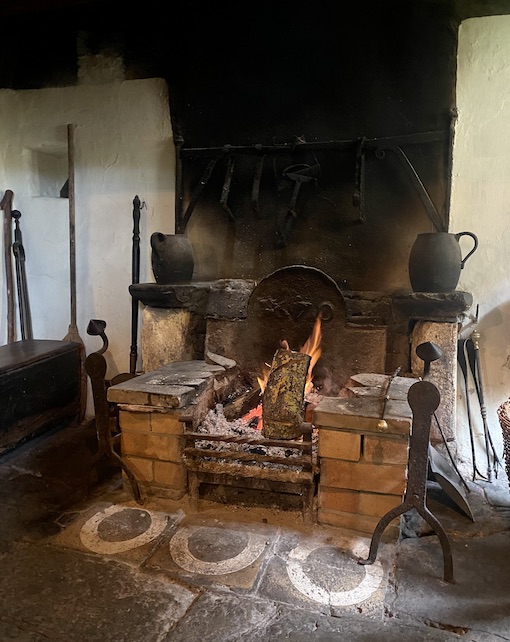
The building’s exterior still looks striking, with its simple old sign and ancient woodwork, but the interior is even more special. In many ways it doesn’t look as if it has changed much for a hundred years. There are open fires, old furniture including a marvellous curved settle, and a remarkable collection of old objects – copper jugs, pots, andirons, even a set of handbells. There’s also a fine array of 17th century pewter that reputedly belonged to Oliver Cromwell – he is said to have exchanged it on the way to the Battle of Worcester, but I’m inclined to treat such stories with a pinch of salt.
One extraordinary tradition that I’ve seen in no other pub has been kept up at The Fleece: that of chalking or painting white circles in front of the hearths, to protect the building from witches, who were said to enter down chimneys.* If this seems even more unlikely than the story about Cromwell, I can tell you that such beliefs were prevalent in earlier centuries and in rural areas old traditions died hard. I have a book from the 1940s showing a photograph of a woman adding more whitening to the circles in The Fleece – perhaps it’s Lola Taplin herself. As another drinker observed to me, with a humorous grin, ‘I’ve been coming to this pub for years and I’ve never seen a witch in here, so they must work!’
All in all, The Fleece is a lovely pub, a fine and unique place to while away a little spare time over a pint or I’m told, to come for an evening meal. I have a feeling I’ll be back soon.
- - - - -
* This kind of belief is, of course, a historical can of worms. Prejudice against women who were accused of being witches, often with no grounds at all, sometimes simply because they professed knowledge of traditional healing practices in times before modern, scientific medicine, was rife in earlier centuries.
Finding myself in the Worcestershire village of Bretforton at a few minutes past 12 noon, I decided to take a quick look in the local pub, The Fleece. It’s a pub I knew about already, because it is owned by the National Trust and very old. The timber-framed building was originally constructed in the 15th century as a farmhouse – online accounts call it a longhouse, that’s to say a traditional type of small farm house with accommodation for humans at one end and for animals at the other, although it could just as likely have been fully occupied by the farmer and his family. It’s not clear to me exactly when it became a pub, but it was enlarged in the 17th century and much of what remains dates to that time. The building was still in the same family, the Byrds, and their descendants remained there until the last of the family, Lola Taplin, left the inn to the National Trust in 1977. It was, I believe, the first working pub in the Trust’s care.
The building was nearly destroyed in 2004, when a spark set alight the thatch that then covered the roof. Such a fire can take hold very quickly and destroy a building with a wooden structure. However, no one was hurt in the blaze and a rapid response from six fire brigade crews, from the landlord, from locals who rallied quickly to remove most of the building’s precious contents, and from the staff of the National Trust, saved much of the building’s structure and many of the contents. It was restored, but with a tiled rather than a thatched roof, and hospitality, which had continued meanwhile in the adjacent barn, was restored too.
The building’s exterior still looks striking, with its simple old sign and ancient woodwork, but the interior is even more special. In many ways it doesn’t look as if it has changed much for a hundred years. There are open fires, old furniture including a marvellous curved settle, and a remarkable collection of old objects – copper jugs, pots, andirons, even a set of handbells. There’s also a fine array of 17th century pewter that reputedly belonged to Oliver Cromwell – he is said to have exchanged it on the way to the Battle of Worcester, but I’m inclined to treat such stories with a pinch of salt.
One extraordinary tradition that I’ve seen in no other pub has been kept up at The Fleece: that of chalking or painting white circles in front of the hearths, to protect the building from witches, who were said to enter down chimneys.* If this seems even more unlikely than the story about Cromwell, I can tell you that such beliefs were prevalent in earlier centuries and in rural areas old traditions died hard. I have a book from the 1940s showing a photograph of a woman adding more whitening to the circles in The Fleece – perhaps it’s Lola Taplin herself. As another drinker observed to me, with a humorous grin, ‘I’ve been coming to this pub for years and I’ve never seen a witch in here, so they must work!’
All in all, The Fleece is a lovely pub, a fine and unique place to while away a little spare time over a pint or I’m told, to come for an evening meal. I have a feeling I’ll be back soon.
- - - - -
* This kind of belief is, of course, a historical can of worms. Prejudice against women who were accused of being witches, often with no grounds at all, sometimes simply because they professed knowledge of traditional healing practices in times before modern, scientific medicine, was rife in earlier centuries.
Thursday, July 7, 2022
Meysey Hampton, Gloucestershire
I am under the weather at the moment, because the 21st-century plague has struck me at last. So here is a reprise of a post from some years ago, showing a church monument to a doctor, who lived at a period when plagues were a constant threat. If you click on the image it should appear in a larger and clearer form...
A practised classicism
According to the way the history of English church architecture is usually written, there were relatively few churches built between the point when Henry VIII dealt his knock-out blow to the old religion by breaking with Rome and the rise of Classical architecture, which, although it had a brief flowering under Inigo Jones in the Jacobean period, really only got going with Wren after the Great Fire of London in 1666. The churches that were built in the years in between these two watersheds are often in a kind of hybrid style that isn't always easy to classify – a mix of Gothic, Classical, and vernacular – that means they're not 'good examples' of any one style, and so they get overlooked or glossed over.But if there's not much church building, there's certainly a lot of church architecture from this period. How can this be? Because the architecture is not for the living but for the dead: it is the architecture of church monuments. Here's a wonderful example, from the church at Meysey Hampton in Gloucestershire – it's worth clicking on the picture to reveal some of the detail. It's the monument of James Vaulx (c. 1580–1625), a physician, and his two wives, Editha (on his right) and Philipe (a Jacobean Phillippa, presumably, on his left). The portraits of the three are charming – Vaulx in his doctor's gown and pointed beard, resting his arm on a skull and leaning towards his first wife, whose head is slightly inclined, in turn, towards him. Philipe stares ahead, by contrast, looking life in the face. She has no skull and carries a protective pomander: she survived her husband and lived to marry again. I find these figures rather moving and the nuances of pose that the sculptor allowed himself (or was allowed by eldest son Francis who commissioned the monument) very English in their restraint. Below them are tiny images of the children, Editha's twelve (how those women worked at childbirth) and Philipe's four; some, shown in bed, presumably died before their father. Above amongst the pediments at the top of the monument are figures of the virtues.
And then there is the architecture. Look at the way the sculptor has invoked the panoply of Jacobean classicism – pediments variously shaped, scrolls, composite columns, panels, keystones, cartouches, cherubim with winged heads, niches – to frame and display his subjects. He was able to add colour too, reminding us that even in the supposedly retrained phase of the English church, things were brighter and more vivid than we sometimes think. It all adds up to a grand monument but in a rough-hewn provincial manner. Perhaps this is right for its subject. Vaulx was eminent but didn't make it to the top job of royal physician. When King James asked him how he knew how to heal, the doctor replied that he had learned through his practice. 'Then by my saule thou hast killed money a man,' responded James. 'Thou shalt na'practise on me.'
Thursday, June 2, 2022
Wisbech, Cambridgeshire
The lion and the unicorn, 1
The practice of displaying the royal arms in churches became widespread during the reign of Henry VIII, after the king broke with the pope and the Roman church and appointed himself as the leader of the church in England. Royals arms were put up in churches (often under the chancel arch, where the Rood had formerly been) under Henry and his son Edward VI, although the Catholic queen Mary I ordered them to be removed. They were brought back under her successor Elizabeth I, often destroyed or removed under Oliver Cromwell, and restored once more with the restoration of the monarchy under Charles II. Many remain from these periods and from the later Hanoverian rulers, although generally not beneath the chancel arch but in some slightly less prominent place inside the church.
These coats of arms are often worth a good look. Though most are painted on boards, there are some on canvas, as well as carved wooden ones and examples moulded form plaster. Often they reveal work of character by a talented local artist (most are unsigned). The skill with which the animal supporters on either side of the shield are depicted is often telling – they’re heraldic beasts, so don’t have to be realistic, and the lions, especially, are often strikingly painted or carved. The artists could also show their skill in the depiction of the scrolls, leaves and flowers that are included.
My photograph shows one of my favourites. It is of carved wood and it is huge – it occupies the entire space beneath one of the curved arches between nave and aisle in the parish church at Wisbech. The arms are those of James I of England, who, as James VI of Scotland united the two kingdoms under one criown. His heralds added the Irish harp and Scottish single lion to the shield, in addition to the three lions that had been used on the English royal arms for several centuries. Since I first saw it, I’ve admired the characterful faces of the two beasts and the vigorous portrayal of their bodies. The scrolling foliage around their heads is also impressive.
The arms of James I are just one example of several that I have admired during my years of blogging. Those interested in such things might like to seek out my posts on the arms of James at Abbey Dore and those of Edward VII at Onibury. Together they are a timely reminder in this Jubilee year of the commitment of British monarchs to the church over a long timespan. Like the one at Wisbech, both of these are carved. I have a painted one in mind to post here soon.
The practice of displaying the royal arms in churches became widespread during the reign of Henry VIII, after the king broke with the pope and the Roman church and appointed himself as the leader of the church in England. Royals arms were put up in churches (often under the chancel arch, where the Rood had formerly been) under Henry and his son Edward VI, although the Catholic queen Mary I ordered them to be removed. They were brought back under her successor Elizabeth I, often destroyed or removed under Oliver Cromwell, and restored once more with the restoration of the monarchy under Charles II. Many remain from these periods and from the later Hanoverian rulers, although generally not beneath the chancel arch but in some slightly less prominent place inside the church.
These coats of arms are often worth a good look. Though most are painted on boards, there are some on canvas, as well as carved wooden ones and examples moulded form plaster. Often they reveal work of character by a talented local artist (most are unsigned). The skill with which the animal supporters on either side of the shield are depicted is often telling – they’re heraldic beasts, so don’t have to be realistic, and the lions, especially, are often strikingly painted or carved. The artists could also show their skill in the depiction of the scrolls, leaves and flowers that are included.
My photograph shows one of my favourites. It is of carved wood and it is huge – it occupies the entire space beneath one of the curved arches between nave and aisle in the parish church at Wisbech. The arms are those of James I of England, who, as James VI of Scotland united the two kingdoms under one criown. His heralds added the Irish harp and Scottish single lion to the shield, in addition to the three lions that had been used on the English royal arms for several centuries. Since I first saw it, I’ve admired the characterful faces of the two beasts and the vigorous portrayal of their bodies. The scrolling foliage around their heads is also impressive.
The arms of James I are just one example of several that I have admired during my years of blogging. Those interested in such things might like to seek out my posts on the arms of James at Abbey Dore and those of Edward VII at Onibury. Together they are a timely reminder in this Jubilee year of the commitment of British monarchs to the church over a long timespan. Like the one at Wisbech, both of these are carved. I have a painted one in mind to post here soon.
Tuesday, January 19, 2021
Dartmouth, Devon
For my final post in this short series about seaside buildings, here’s a very different structure on the Quay in Dartmouth. The hotel has been a vital feature of coastal towns since seaside holidays became popular in the 19th century, but many coastal hotels have a longer history, as stopping places for travellers and visitors alike. This one, far older than the 19th century, has the pale coloured walls of my previous coastal buildings, but there the resemblance ends.
The Royal Castle Hotel began life in 1639 as a pair of merchants’ houses. They had timber-framed fronts, although some of the cross walls are stone. By 1736 one of the houses was an inn, called the New Inn, and later during the 18th century the two houses were combined to form a single property, by now called the Castle. There was a major remodelling in 1840, with internal upgrades and a renewal of the front that faces the water. This was probably when the timber frame was plastered over – it’s still there underneath, as shown by the fact that the first and second floors both protrude slightly from the storey above, a fashion that was popular in 1639 but had died out by the following century. The elaborate faux fortification – crenellations and turrets – that make up the parapet may well date from the time of the remodelling and there may or may not have been something similar there when the inn was renamed the Castle.
At a quick glance, the Royal Castle Hotel looks very much of a piece – white facade, sash windows, battlements, gilded lettering. But it’s actually the creation of several separate phases of building and upgrading, over nearly 400 years. Like so many old buildings that look as if they’ve been the same for centuries, this one has been – in architectural terms at least – continuously changing to meet seaside and wider needs and fashions, metaphorically on the move.
Saturday, October 27, 2012
Monnington on Wye, Herefordshire
Hidden England
I left the main road behind and turned down one of those narrow, high-hedged Herefordshire lanes. Behind the hedges were cider apple orchards and somewhere near a motor was quietly humming as an elevator loaded apples into a deep trailer ready to be taken to Hereford to be pressed. With a few more bends the lane petered to a halt by a sign saying "Private" and a drive leading to a big house. There was no sign of the church, and nowhere else to go, apparently, so I pulled up on a verge, got out, and took my bearings. Then I saw another sign, smaller, shaded by trees, pointing up a green lane between two hedges: "To the church". Off I went, past trickling water and buzzing insects, as the path got less green, more muddy, then more tree-enclosed.
And then there was the tiny timber-framed lychgate, with its four gables and the church beyond. The church was almost entirely built in the late-17th century. Inside, sunlight poured through the mullioned, domestic-looking windows, on to white walls, wooden benches, a screen with barley-sugar-twisted uprights, a communion table, and a font, carved with the initials of the couple, Uvedale and Mary Tomkyns, who paid for the building in 1680. Oil-lamps hung from the plastered ceiling and the brightly painted arms of Charles II (the only brightly coloured object in the place) were displayed on the nave wall. Apart from a gaggle of Calor gas heaters, c 1980, it could almost have been 1680. A bit of hidden England that I shared for half an hour.
Wednesday, April 27, 2011
Round-up time
Some of you will have noticed that a new page link has appeared in the list headed PAGES in the right-hand column. This takes you to a short and selective history of English architecture in the 16th and 17th centuries and the few years on either side – roughly speaking, the Tudor and Stuart periods. As with the previous page on Medieval architecture, links within the page take you to relevant posts from this blog, to illustrate the development of the architecture. There are rather fewer links than in the previous page, which covers the vast sweep from the Saxon period to c 1500, but enough, to give a broad idea of some key developments.
Wednesday, May 28, 2008
Chesterton Windmill, Warwickshire

WESTERN WIND (1)
Windmills are much more common in the east of England, where they take advantage of the stiff easterly breezes that blow across Lincolnshire and East Anglia, than in the west. But travellers along the Fosse Way, the Roman road that connects Cirencester in Gloucestershire with Lincoln, are used to seeing one windmill on a hilltop at Chesterton in Warwickshire. It’s one of the most striking mills in England, making a strong silhouette that’s visible for miles around.
Most windmills were built without the help of an architect. They were put up by builders or millwrights who knew how to construct a piece of machinery that worked efficiently and weren’t much interested in architectural airs and graces. But Chesterton Windmill, which was built in 1632, is very unusual because it was obviously built to the designs of an architect who had imbibed the influence of the Classical style. It was one of those buildings that people used to attribute to the great Classical architect Inigo Jones, though there’s no evidence that Jones designed it. A more likely candidate is Jones’s pupil John Stone, who worked on the manor house nearby.
The other odd thing about the mill is that the man who probably commissioned it, local grandee Sir Edward Peyto, was an astrologer and astronomer, and there’s a tradition that the building was originally an observatory that he used to look at the stars – presumably the rotating top, turned by means of a hand winch, housed Peyto’s telescope. If so, it was probably converted to milling quite early in its history, with added sails covered in sailcloth that cost 9 old pence per yard. It's very windy on top of this Warwickshire hill – it certainly was on the day I visited recently anyway – and Chesterton Windmill harnessed this energy to grind corn until around 1910, and was restored in 1969. For more about the history of this building, go here.
Monday, February 4, 2008
Coughton Court, Warwickshire

Whenever I drive to or from Birmingham Airport, I see this building, set back from the A435. When its west-facing façade is warmed by the late-afternoon sun, it is the highlight of my journey.
Driving past, one gets the impression of an orange stone building set at the end of an avenue of trees in parkland – a perfect building and a unified composition in a very English landscape. Stop and look more closely, though, and the building is more complicated. Even the stunning 16th-century gatehouse at the centre can’t be all of a piece. At the ground-floor level the turrets are square, but they metamorphose into octagons between the ground and first floors, suggesting that the gatehouse was built in two goes.
The wings on either side are rendered, not stone – but whoever did the rendering got the colour right, so that it blends well with the masonry of the gatehouse. These wings are later. Their windows look 18th-century, and a painting of the early-18th century shows the large windows all in place, although the delightful little quatrefoil windows upstairs hadn’t been added at that point, so they must be later still.
Like so many English country houses, then, Coughton is a hotchpotch of periods, but a hotchpotch in which the ingredients blend together to produce something magical. Maybe the harmony has something to do with the fact that the same family has lived here for nearly six centuries. The Throckmortons of Coughton have always been Catholics, although their loyalty to the faith has landed them in trouble more than once. Their house was sacked by Parliamentarian troops during the English Civil War and the place was vandalized again by a Protestant mob in 1688. But united the family stood, and their house perhaps reflects this unity of faith and vision, over a period of almost 600 years.
Subscribe to:
Comments (Atom)