In plain sight
Back in 2015 I read Matthew Champion’s fascinating book Medieval Graffiti and was alerted to the interesting array of ‘unofficial’ marks and inscriptions in English churches. This has inspired at least two posts on this bog – one on overlapping Vs, said to refer to the Virgin Mary (‘Virgo Virginum’, Virgin of virgns), another illustrating the outline of a human hand and some initials within a shield. A further common motif used in church graffiti is what is now widely known as the daisywheel, a series of arcs drawn within a circle, which combine to create an image resembling a six-petalled flower. When staying in Lavenham, Suffolk, just before Christmas, I was intrigued to come across such a daisywheel not in a church but on a wooden beam above a fireplace at Lavenham Guildhall.
The usual interpretation. of such marks is that they provide protection from evil spirits. In churches they are often placed near doorways or arches, suggesting that they prevent or discourage evil spirits form entering the building. Drawing a ritual protection mark above a fireplace suggests that it stops such spirits entering the building down the chimney.
Fireplaces are of course important places in a building – they’re the source of heat for comfort and cooking, of course, but in addition are focal points and symbols of the house and home, and of the people who live in the building or use it. For these reasons as well as the fact that the chimney offers a potential way in for evil forces, they’re a place to look out for protection marks in secular buildings. The famous ‘witch marks’ I have seen in a Worcestershire pub are also located in fireplaces – in this case on the hearth itself.
While the pub’s ‘witch marks’ consist of white circles made with chalk, daisywheels are usually incised into the wood or plaster. Matthew Champion suggests that they were made using the points of shears, a tool much used in the late Middle Ages when it’s thought many of these marks were made. He has tried making them with shears himself, with successful results. For centuries these marks were unregarded because they are easy to miss when one is not looking for them. Now scholars such as Champion have alerted us to their presence, more and more are being rediscovered, hiding as it were in plain sight.
Showing posts with label fireplace. Show all posts
Monday, January 22, 2024
Wednesday, October 5, 2022
Bretforton, Worcestershire
The old ways
Finding myself in the Worcestershire village of Bretforton at a few minutes past 12 noon, I decided to take a quick look in the local pub, The Fleece. It’s a pub I knew about already, because it is owned by the National Trust and very old. The timber-framed building was originally constructed in the 15th century as a farmhouse – online accounts call it a longhouse, that’s to say a traditional type of small farm house with accommodation for humans at one end and for animals at the other, although it could just as likely have been fully occupied by the farmer and his family. It’s not clear to me exactly when it became a pub, but it was enlarged in the 17th century and much of what remains dates to that time. The building was still in the same family, the Byrds, and their descendants remained there until the last of the family, Lola Taplin, left the inn to the National Trust in 1977. It was, I believe, the first working pub in the Trust’s care.
The building was nearly destroyed in 2004, when a spark set alight the thatch that then covered the roof. Such a fire can take hold very quickly and destroy a building with a wooden structure. However, no one was hurt in the blaze and a rapid response from six fire brigade crews, from the landlord, from locals who rallied quickly to remove most of the building’s precious contents, and from the staff of the National Trust, saved much of the building’s structure and many of the contents. It was restored, but with a tiled rather than a thatched roof, and hospitality, which had continued meanwhile in the adjacent barn, was restored too.
The building’s exterior still looks striking, with its simple old sign and ancient woodwork, but the interior is even more special. In many ways it doesn’t look as if it has changed much for a hundred years. There are open fires, old furniture including a marvellous curved settle, and a remarkable collection of old objects – copper jugs, pots, andirons, even a set of handbells. There’s also a fine array of 17th century pewter that reputedly belonged to Oliver Cromwell – he is said to have exchanged it on the way to the Battle of Worcester, but I’m inclined to treat such stories with a pinch of salt.
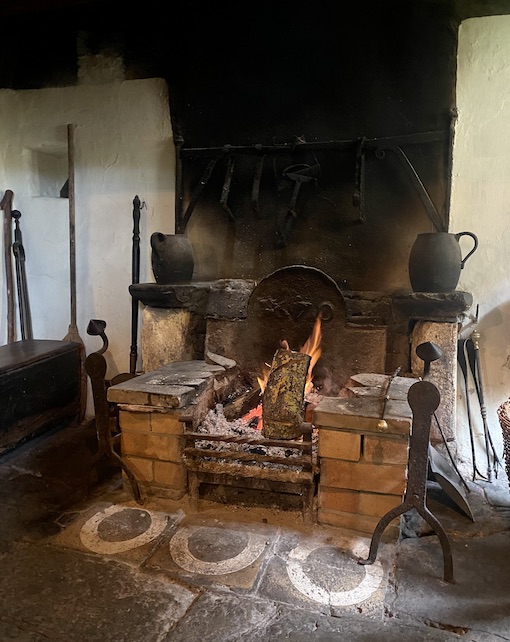
One extraordinary tradition that I’ve seen in no other pub has been kept up at The Fleece: that of chalking or painting white circles in front of the hearths, to protect the building from witches, who were said to enter down chimneys.* If this seems even more unlikely than the story about Cromwell, I can tell you that such beliefs were prevalent in earlier centuries and in rural areas old traditions died hard. I have a book from the 1940s showing a photograph of a woman adding more whitening to the circles in The Fleece – perhaps it’s Lola Taplin herself. As another drinker observed to me, with a humorous grin, ‘I’ve been coming to this pub for years and I’ve never seen a witch in here, so they must work!’
All in all, The Fleece is a lovely pub, a fine and unique place to while away a little spare time over a pint or I’m told, to come for an evening meal. I have a feeling I’ll be back soon.
- - - - -
* This kind of belief is, of course, a historical can of worms. Prejudice against women who were accused of being witches, often with no grounds at all, sometimes simply because they professed knowledge of traditional healing practices in times before modern, scientific medicine, was rife in earlier centuries.
Finding myself in the Worcestershire village of Bretforton at a few minutes past 12 noon, I decided to take a quick look in the local pub, The Fleece. It’s a pub I knew about already, because it is owned by the National Trust and very old. The timber-framed building was originally constructed in the 15th century as a farmhouse – online accounts call it a longhouse, that’s to say a traditional type of small farm house with accommodation for humans at one end and for animals at the other, although it could just as likely have been fully occupied by the farmer and his family. It’s not clear to me exactly when it became a pub, but it was enlarged in the 17th century and much of what remains dates to that time. The building was still in the same family, the Byrds, and their descendants remained there until the last of the family, Lola Taplin, left the inn to the National Trust in 1977. It was, I believe, the first working pub in the Trust’s care.
The building was nearly destroyed in 2004, when a spark set alight the thatch that then covered the roof. Such a fire can take hold very quickly and destroy a building with a wooden structure. However, no one was hurt in the blaze and a rapid response from six fire brigade crews, from the landlord, from locals who rallied quickly to remove most of the building’s precious contents, and from the staff of the National Trust, saved much of the building’s structure and many of the contents. It was restored, but with a tiled rather than a thatched roof, and hospitality, which had continued meanwhile in the adjacent barn, was restored too.
The building’s exterior still looks striking, with its simple old sign and ancient woodwork, but the interior is even more special. In many ways it doesn’t look as if it has changed much for a hundred years. There are open fires, old furniture including a marvellous curved settle, and a remarkable collection of old objects – copper jugs, pots, andirons, even a set of handbells. There’s also a fine array of 17th century pewter that reputedly belonged to Oliver Cromwell – he is said to have exchanged it on the way to the Battle of Worcester, but I’m inclined to treat such stories with a pinch of salt.
One extraordinary tradition that I’ve seen in no other pub has been kept up at The Fleece: that of chalking or painting white circles in front of the hearths, to protect the building from witches, who were said to enter down chimneys.* If this seems even more unlikely than the story about Cromwell, I can tell you that such beliefs were prevalent in earlier centuries and in rural areas old traditions died hard. I have a book from the 1940s showing a photograph of a woman adding more whitening to the circles in The Fleece – perhaps it’s Lola Taplin herself. As another drinker observed to me, with a humorous grin, ‘I’ve been coming to this pub for years and I’ve never seen a witch in here, so they must work!’
All in all, The Fleece is a lovely pub, a fine and unique place to while away a little spare time over a pint or I’m told, to come for an evening meal. I have a feeling I’ll be back soon.
- - - - -
* This kind of belief is, of course, a historical can of worms. Prejudice against women who were accused of being witches, often with no grounds at all, sometimes simply because they professed knowledge of traditional healing practices in times before modern, scientific medicine, was rife in earlier centuries.
Wednesday, September 6, 2017
Ironbridge and Coalbrookdale, Shropshire
A view of the bridge
The Darby family of Coalbrookdale were among the greatest industrialists of their time, the people who revolutionized the production of iron. Abraham Darby I pioneered ironmaking in blast furnaces fuelled by coke, enabling the metal to be produced in the quantities needed for industry to expand rapidly. He also developed a way of casting pots using sand moulds that proved very lucrative. Later generations carried on in the business and Abraham Darby III, grandson of the first Abraham, working with the architect Thomas Pritchard, gave us the area’s most famous structure, the world’s first iron bridge.
The Darbys lived in a pair of houses a couple of hundred yards up the hill from their furnace and works. These houses are substantial Georgian middle-class homes, but not at all flashy. The Darbys were Quakers and did not go in for lavish living – the rooms are quite small and rather plain. But look closely, and one sees evidence of their achievements. This fireplace must be one of thousands produced at Coalbrookdale. But they don’t all have an image of the celebrated iron bridge cast into them. Examine the lower arch of this fireplace and that’s just what you see – an outline that’s world famous now and must have been one of the things of which the Darbys were most proud. How like them to mark this achievement so discreetly.
The iron bridge itself has survived over 230 years, a marvel of graceful design. It manages to span the Severn almost transparently, but its outline is instantly recognisable. It’s in need of repair now – ground movement over the years, an earthquake in the 19th century, and stresses that have always existed have caused cracking. A major project is beginning to repair the bridge, so that it can last far into the future as a monument to the skill and ingenuity of the Darbys and their architect.
The Darby family of Coalbrookdale were among the greatest industrialists of their time, the people who revolutionized the production of iron. Abraham Darby I pioneered ironmaking in blast furnaces fuelled by coke, enabling the metal to be produced in the quantities needed for industry to expand rapidly. He also developed a way of casting pots using sand moulds that proved very lucrative. Later generations carried on in the business and Abraham Darby III, grandson of the first Abraham, working with the architect Thomas Pritchard, gave us the area’s most famous structure, the world’s first iron bridge.
The Darbys lived in a pair of houses a couple of hundred yards up the hill from their furnace and works. These houses are substantial Georgian middle-class homes, but not at all flashy. The Darbys were Quakers and did not go in for lavish living – the rooms are quite small and rather plain. But look closely, and one sees evidence of their achievements. This fireplace must be one of thousands produced at Coalbrookdale. But they don’t all have an image of the celebrated iron bridge cast into them. Examine the lower arch of this fireplace and that’s just what you see – an outline that’s world famous now and must have been one of the things of which the Darbys were most proud. How like them to mark this achievement so discreetly.
The iron bridge itself has survived over 230 years, a marvel of graceful design. It manages to span the Severn almost transparently, but its outline is instantly recognisable. It’s in need of repair now – ground movement over the years, an earthquake in the 19th century, and stresses that have always existed have caused cracking. A major project is beginning to repair the bridge, so that it can last far into the future as a monument to the skill and ingenuity of the Darbys and their architect.
Subscribe to:
Posts (Atom)