Showing posts with label fire station. Show all posts

Sunday, March 15, 2026

Manchester, London Road


When size matters

I have marked my recent visit to Manchester with a series of posts on three of the city’s small architectural gems – a cinema, a chop house and a library – structures that many people might miss in a city full of buildings that are on such a large scale that they command the view. For my next couple of posts, then, I turn to some seriously big Mancunian buildings.

Hardly has the visitor emerged from Manchester Piccadilly station than the parade of architectural juggernauts begins. In London Road, straight opposite the railway hub, is this Edwardian baroque monster, which housed police, ambulance, and fire stations, together with a coroner’s court, for much of the 20th century. It’s an enormous structure, and the part visible in my first photograph is just one facade of a building with four unequal sides surrounding a large courtyard. In 1906, when it was completed, Manchester was a prosperous city that wanted to give the emergency services a home that was architecturally magnificent and the design, by Woodhouse, Willoughby and Langham,* fits the bill. There’s the full Edwardian panoply of towers, turrets, domes, classical columns and grand entrances, all in a combination of red brick and glazed terracotta. Rows of windows are testimony not only to the various offices occupied by the emergency services and the coroner’s staff, but also to the many apartments provided. Workers such as firemen, on call night and day, often lived on site, in this case in homes that were better than most of those in the surrounding, rather poor, area. Whatever one feels about the design as a whole, the architects made a noble effort to compose the diverse elements – the large entrance arch, the rows of windows, the recessed section with its pairs of columns, the various towers – to create a convincing composition.

The decorative details, for those with the time to give them the attention they deserve, are likewise impressive. Among the best are above the largest entrance on London Road. Above the great central arch are two groups of allegorical figures. On the left are three figures representing fire: they bear torches and thunderbolts, and their hair is aflame. Opposite are three water-carriers, who offer the solution: at their feet are fishes and foliage grows prolifically above their heads, representing the life that can thrive when the danger of fire has been averted. Figures with similar iconography are set above the central window and within the arch, near the ‘FIRE STATION’ plaque.

This extraordinary building served the emergency services through much of the 20th century, most of it closing when the fire-fighters moved out in 1986. With the closure of the coroner’s court in 1998, the place was finally empty. In spite of a plan to convert it to a hotel, it was left abandoned and deteriorating until recent years and now a new scheme is underway for a mixed-use conversion. I believe work on this is still ongoing.

- - - - -

* A short-lived local partnership of three architects who practised with various partners and in different groupings. Manchester, a large and growing metropolis, was able to sustain numerous architects – most of the Manchester buildings that I’m posting were designed by firms based in the city.

Tuesday, November 23, 2021

Market Harborough, Leicestershire


Feel free to admire

Sometimes the purpose of this blog is just to point out things that I like – and I don’t necessarily have much more to say about them than that. This is an example, a former fire station that I passed one morning when walking through the centre of Market Harborough. It was built in 1903 (and then extended, hence the asymmetry of the sign’s position) by Johnson and Coales for Market Harborough District Council and they did a pleasing job on the street frontage. The segmental arches to admit the fire engines have a satisfying curve that’s mirrored in the form of the four upper windows, which must front some beautifully light rooms. The combination of good looks and practicality – the green tiles above a granite base combining toughness with a wipe-down surface, the mix of green and red colouring – is also admirable.

The structure has been converted to a café, and it’s good to see that the building has a useful future now no longer needed by the fire service. And that, from shiny red doors to gleaming green tiles, it’s still looking good after almost 120 years of use. And there’s a bonus across the road: an ambulance station by the same firm of architects with black tiles, white lettering, and a Diocletian window of enormous proportions. The emergency services of early-20th century Market Harborough seems to have been very well provided for.

Tuesday, October 13, 2020

Euston Road, London


A fire station – with knobs on

I’ve always admired the Fire Station in London’s Euston Road. It’s something to do with the restrained irregularity of it – all those canted bays sticking out at different heights, and the irregular roofline, and the variety of window sizes and shapes, the whole ensemble held together by the unifying and very Londonish palette of red brick and white Portland stone. Two openings below the delightful lettering (classic stuff, down to the substitution of V for U in ‘EVSTON’) originally marked the entrances to a pair of bays where the fire engines were housed. Later the building was given a single-storey extension to the right containing more such garages, and the two visible in the photograph were turned into offices.

There is more of the same winning mix of brick and stone round the corner on the left – it’s an L-shaped building, but I don’t have a photograph that shows this front. That’s because this is not an easy building to photograph. It’s tall, and demands that you stand back a long way to get it all in the frame. It’s also bounded by major roads – there’s nearly always a big red bus going slowly along Euston Road and blocking the view. And if you step back any further, the fire station starts to disappear behind the buildings on either side of Upper Woburn Place to the south (one such late-20th century block is just visible on the right of the frame).

So to take a photograph that does some justice to the architecture one has to step back – but not too far back – and wait for the buses to pass. I also found it helps to ‘lose’ the rest of the traffic in shadows as much as possible, when the red brick glows against a border of blackness. Who was responsible for this bit of architectural wizardry? The fire station was the work of the London Country Council Architects’ Department at the very beginning of the 20th century. Around this time there was a whole sub-department dealing with fire stations, which were being built in many parts of London. The man on this job is said to have been either H. F. T. Cooper or Percy Erskine Nobbs, who the year after this fire station opened moved to Montreal, where he taught in the university and worked on some major Canadian buildings. If Nobbs was involved, this was Canada’s gain and London’s loss.


Sunday, July 24, 2011

Greycoat Place, London


Architectural pyrotechnics

Nowadays, fire stations are often seen as utilitarian buildings and most of us don’t give them a second glance. But in the Edwardian era, when the idea of purpose-built fire stations across the capital was still quite new, they could be built to stand out. A number were built in the early years of the 20th century when the architect to the London Country Council was William Edward Riley, son of a fireworks manufacturer. Riley got the LCC job in 1899 and stayed until his retirement 20 years later. He had a busy time, building slum-clearance housing schemes, continuing a programme of school building, and providing the capital with utility buildings such as fire stations.

The most famous of these is the fine Arts and Crafts inspired one at Euston, but here’s another good one, the Westminster Fire Brigade Station in Greycoat Place. The brickwork of the upper floors with its stripy stone dressings, sash windows, pilasters, and tall chimneys, is typical of the revivalist style called “Queen Anne”, a kind of loose imitation of a way of building popular in around 1700. But Riley placed this above a lower storey of granite, treated with banded rustication and big key stones above the openings. Details like the semicircular window to the side elevation and smaller round window on the front façade add to the interest.

This is a mix of styles and features that, although we could call it “Queen Anne”, defies classification. Architectural historians often resort to the term “Free Style” for this and other Edwardian mélanges. There’s certainly a freedom about the mix of styles and materials, and the various sizes and shapes of windows and doorways, all of which belie the stolidity of the classical granite and the sober but elegant lettering of the fire station’s name. But what we call it hardly matters. It’s a monumental building with some telling touches – a cracking display from the fireworks-maker’s son.

Tuesday, April 13, 2010

Leighton Buzzard, Bedfordshire


Times of change

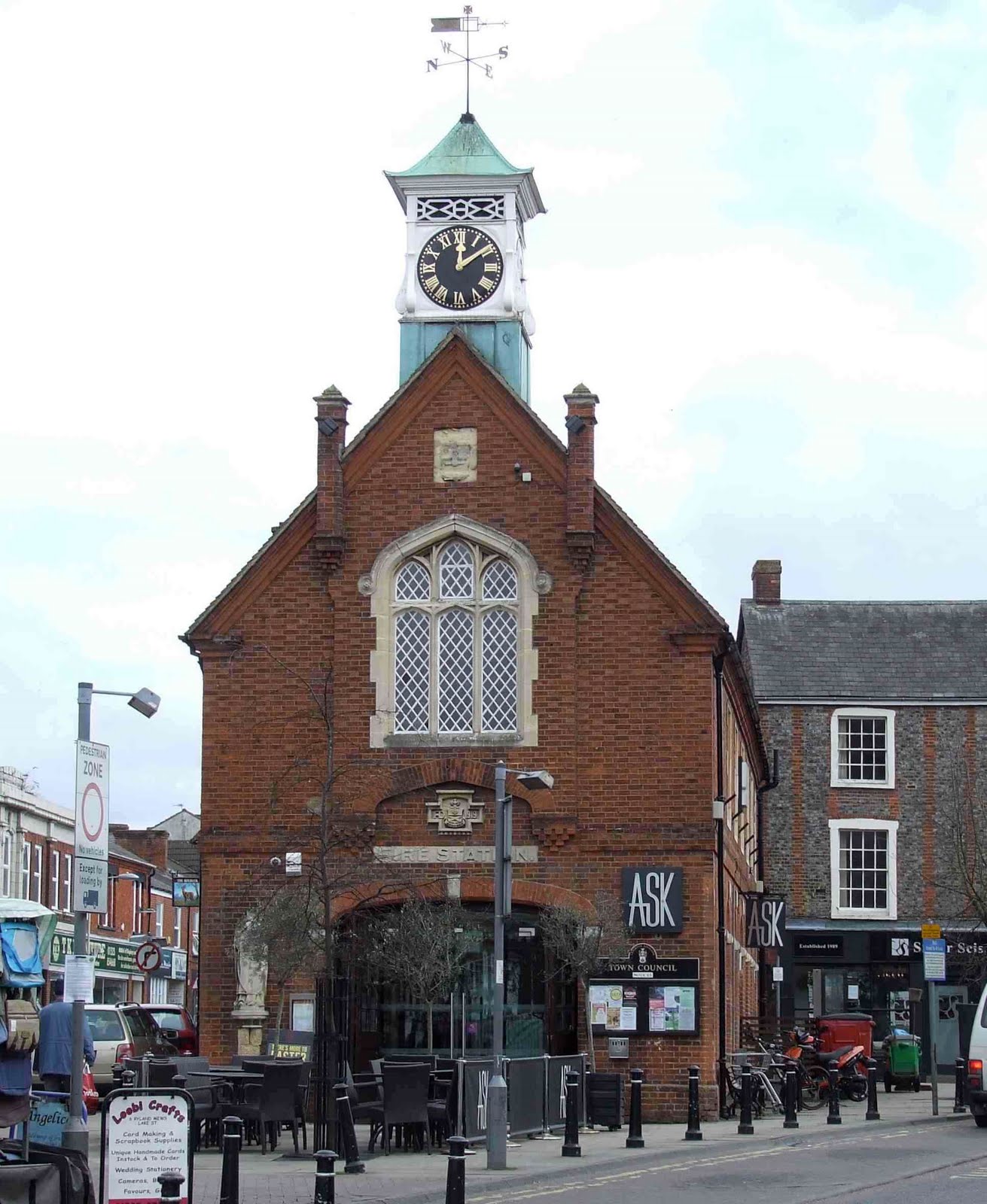
Another white van goes past, and then a car, and as the traffic clears and I raise the camera to my eye a steady procession of pedestrians crosses between me and the building. I lower the camera again and wait. It’s not that I necessarily object to including people in my pictures – there are always people in a busy market place on a Saturday, after all. But not everyone wants to be photographed, and not everyone wants to appear on the web, so I lower the camera.

Perhaps I should just take a photograph of the clock turret and leave it at that. I’m an admirer of the wooden clock towers that often appear on traditional market halls and town halls. Architecture books seem to say little about them – they’re seen, I think, as minor carpentry-stuff, rarely attributable to a specific craftsman or designer, and fit more for the fancier of clocks than for the serious business of architectural history. However, I like their variety and their usefulness and I’m pleased to spot this one. I’ve already assumed, without looking very hard, that the red-brick building that it’s topping is the town’s market hall. Another gap in the traffic, and I look more closely. The building bears a sign saying ‘Fire Station’. ‘Wrong again!’ I think.

But not entirely. This was indeed the site of Leighton’s market hall, and for centuries there was a market building here with an arched lower section for stalls and an upper room used for courts and meetings. The structure was rebuilt in 1851 in brick along similar lines and that, substantially, is the building that still exists. Except that in the early-20th century it was converted for use as a fire station, with a big arched opening for whatever appliances there were to come and go.

The upper part of the building – the big window, the pinnacles, the decent brickwork in a sort of honest simplified Gothic, the clock turret that caught my eye – is very much as it was in the Victorian period. The lower part was remodelled for the fire service with the addition of the big arch and the neat stone plaque. It continued as a fire station until 1963 and has since had other uses. It’s a restaurant now, and is not the first garage-style building with generous floor space to make this transition.

Buildings (like pop stars, political parties, magazines, and the rest) seem to need to reinvent themselves from time to time in order to survive. Buildings are often made redundant because their original user needs more modern premises, or goes bust, or relocates. At this point, many buildings remain empty and decaying until the land they stand on is worth more than the bricks and mortar, and they get pulled down. Unless, that is, someone comes along with some lateral thoughts about how the structure can be used. That’s where the reinvention comes in, and here in Leighton Buzzard instead of firemen sliding down slippery poles there is pasta sliding off forks. And we can all enjoy this Leighton landmark standing proud among the clutter and the crowds. Tortellini, anyone?