Times of change
Another white van goes past, and then a car, and as the traffic clears and I raise the camera to my eye a steady procession of pedestrians crosses between me and the building. I lower the camera again and wait. It’s not that I necessarily object to including people in my pictures – there are always people in a busy market place on a Saturday, after all. But not everyone wants to be photographed, and not everyone wants to appear on the web, so I lower the camera.
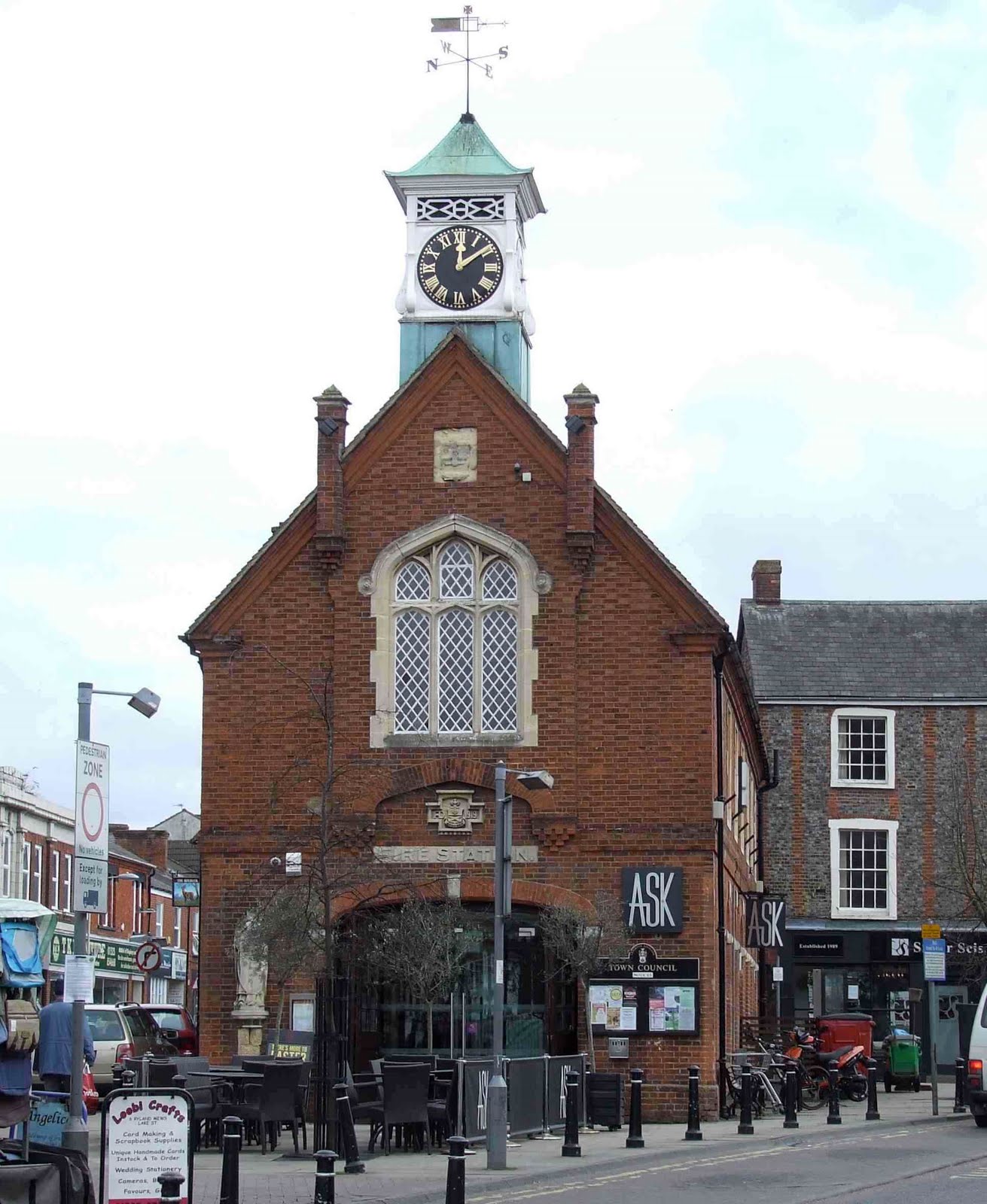
Perhaps I should just take a photograph of the clock turret and leave it at that. I’m an admirer of the wooden clock towers that often appear on traditional market halls and town halls. Architecture books seem to say little about them – they’re seen, I think, as minor carpentry-stuff, rarely attributable to a specific craftsman or designer, and fit more for the fancier of clocks than for the serious business of architectural history. However, I like their variety and their usefulness and I’m pleased to spot this one. I’ve already assumed, without looking very hard, that the red-brick building that it’s topping is the town’s market hall. Another gap in the traffic, and I look more closely. The building bears a sign saying ‘Fire Station’. ‘Wrong again!’ I think.
But not entirely. This was indeed the site of Leighton’s market hall, and for centuries there was a market building here with an arched lower section for stalls and an upper room used for courts and meetings. The structure was rebuilt in 1851 in brick along similar lines and that, substantially, is the building that still exists. Except that in the early-20th century it was converted for use as a fire station, with a big arched opening for whatever appliances there were to come and go.
The upper part of the building – the big window, the pinnacles, the decent brickwork in a sort of honest simplified Gothic, the clock turret that caught my eye – is very much as it was in the Victorian period. The lower part was remodelled for the fire service with the addition of the big arch and the neat stone plaque. It continued as a fire station until 1963 and has since had other uses. It’s a restaurant now, and is not the first garage-style building with generous floor space to make this transition.
Buildings (like pop stars, political parties, magazines, and the rest) seem to need to reinvent themselves from time to time in order to survive. Buildings are often made redundant because their original user needs more modern premises, or goes bust, or relocates. At this point, many buildings remain empty and decaying until the land they stand on is worth more than the bricks and mortar, and they get pulled down. Unless, that is, someone comes along with some lateral thoughts about how the structure can be used. That’s where the reinvention comes in, and here in Leighton Buzzard instead of firemen sliding down slippery poles there is pasta sliding off forks. And we can all enjoy this Leighton landmark standing proud among the clutter and the crowds. Tortellini, anyone?