Showing posts with label coffee tavern. Show all posts

Saturday, January 13, 2024

Hadleigh, Suffolk


Anyone for coffee?

One last post from the fascinating Suffolk town of Hadleigh, before I move on…

Having enjoyed seeing Hadleigh’s church, Deanery Tower, and Market Hall complex, we moved on to the High Street in search of a coffee, and found…the coffee tavern. This is a building of the 1670s and, when one pauses to look at it, it’s a stunner. It’s actually timber-framed, but plastered over so that the framework is not immediately obvious. The upper floor, with its magnificent row of original 17th-century windows, together with the dormered and overhanging roof, are typical of the period. The windows especially are outstanding, featuring arched central lights with elaborate leadwork and a carved head in the middle – high-class woodwork and design reminiscent of the more famous Sparrowe’s House in Ipswich. The cornice and series of dentil-like brackets helping to support the roof are impressive too.

The upper floor overhangs the ground floor slightly, and would originally have overhung more. However, in the 19th century a series of new ground-floor frontages were built under the overhang to create the shop fronts we see today. Did the building originally house shops? It may well have done, given its setting on the Hight Street, but today the structure is usually referred to as the Coffee Tavern. ‘Coffee tavern’ is a term usually used for places of refreshment set up in the late-19th century as part of the temperance movement. In an attempt to reduce the amount of alcohol consumed (drunkenness was said to lead to crime and violence), some groups set up temperance cafés, hotels, and billiard halls. Non-alcoholic drinks were served. All or part of the building was used for this purpose in the late-19th and early-20th centuries. One record from around 1900 describes both a coffee tavern and a printing office on the site. At some point the coffee tavern closed, but among the current occupiers are a printer and a coffee shop. The tradition goes on. We enjoyed both our coffee and the architecture.

Sunday, August 22, 2021

Sherborne, Dorset


Surprised in Sherborne, 1

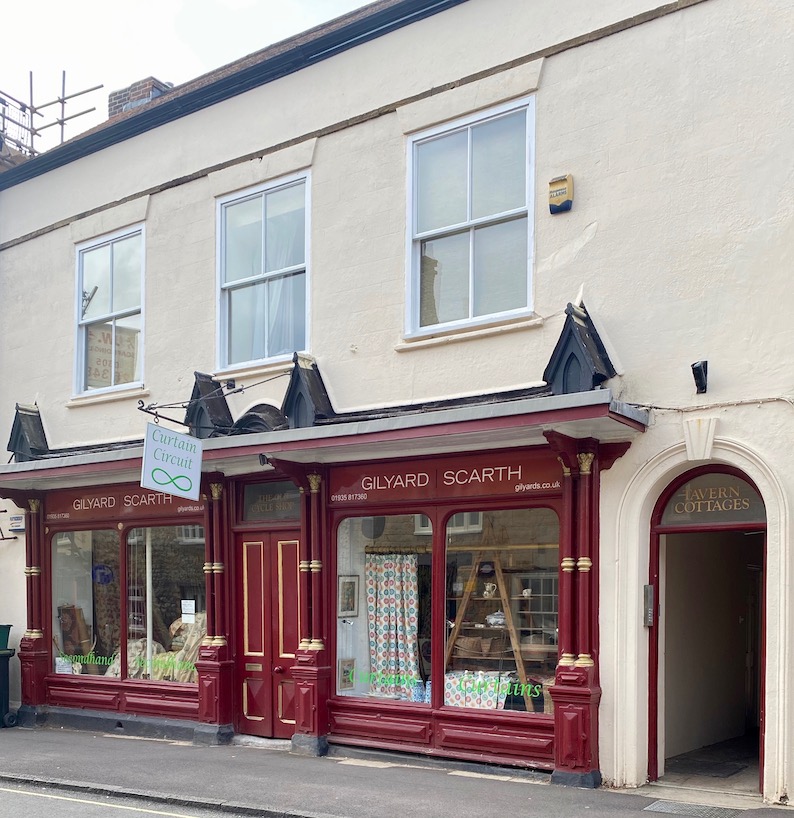
Ever since I wrote a book linked to a television series about the history of Britain’s high streets, I’ve been interested in the architecture of shops, and when I visit a town I’m often agreeably surprised to find old shopfronts still intact and fronting valued local businesses. This frontage in Sherborne was one that caught my eye. It looked to me late Victorian and the array of paired columns, wooden panelling, generous overhang, and slightly Gothic gablets poking out on top seemed to be from the more showy end of the retail spectrum. What could it have been, I wondered to myself: a high-class grocer’s, or maybe something more outré such as an oil and colour merchant or a specialist in well made leather goods? A sign painted on to the glass above the door gave a clue to a business that had been here once: ‘The Old Cycle Shop’. Could that have been the original business?

Not at all, it turns out. The other clue is above the doorway to the right, with its sign saying ‘Tavern Cottages’. A place of refreshment, then? Yes, but not the alcohol-selling place one would expect. This building began life in 1881 as the Sherborne Coffee Tavern. The late-19th and early-20th centuries saw a vigorous anti-alcohol movement. In churches and chapels there were sermons warning against the effects of the ‘demon drink’, campaigners and some nonconformist preachers persuaded people to ‘sign the pledge’ not to touch the stuff, and both campaigners and canny business people founded places where pub-goers could find alternative entertainment – from temperance billiards rooms to coffee taverns.

Coffee had been widely drunk since the 16th century and had gradually evolved from the costly luxury chosen by a few to an inexpensive drink enjoyed by many. Back in the 18th century, coffee houses had been popular among the professional classes in Britain’s large cities. Lawyers, medics, and even writers had their coffee house of choice, where they’d go to drink coffee, read the newspapers, meet friends, and discuss the day’s news. But coffee taverns were never as popular as their ancestors of the Georgian period, perhaps because they were mostly started by middle-class reformers who wanted to encourage the working class to stop drinking and give up the unruly habits of the drunk. The intended customers weren’t keen, and many coffee taverns closed after a few years.

Sherborne’s coffee tavern was bought in the 1890s by a local man, Edwin Childs, who moved his bicycle sales and repair business there. Childs prospered – this was, after all, the heyday of the bicycle – and by the early-20th century was also repairing cars. As the car business expanded, he first converted the shop, removing the big windows, and eventually put up a purpose-built garage elsewhere in the same street. Subsequently the attractive 1880s shop front was restored, and it still looks well in its dark red paint with details picked out in gold, an asset to Sherborne’s rich and varied streetscape and a survivor in an age when a liking for both wine and coffee no longer seems some kind of contradiction.