Showing posts with label temperance. Show all posts

Wednesday, September 18, 2024

Newark, Nottinghamshire

Temple to temperance

The temperance movement of the 19th and 20th centuries found many followers who were so convinced of the evils of alcohol that they gave it up completely, often swearing an oath or ‘signing the pledge’ to steer clear of the demon drink. It was a movement not without controversy (both pub landlords and barmaids protested loudly), but it produced many buildings, such as billiards rooms, cafés, and hotels, designed to provide entertainment or hospitality without alcohol. Few of these could have been be as grand as the Ossington Coffee Tavern in Newark. Its name comes from its founder, Lady Charlotte Ossington, who gave around £16,500 of her money to buy the site and erect the building, employing the architects Ernest George and Harold Peto to design it. Much more than a restaurant, this building of 1882 contained, in addition to the ‘general coffee room’ and kitchen, assembly rooms, a reading room and library, a club room, a billiard room, accommodation for travellers, and stabling for horses. There was also a garden where, in summer, customers could listen to music – a facility that was compared to a German beer garden, but without so much as a sniff of beer or any other alcoholic drink.

George and Peto were a fashionable firm of London architects. The mix of materials they employed, and the assortment of dormer gables, oriel windows, tall brick chimneys and elliptical arches suggest an eclectic range of styles – parts of it evokes Tudor revival, other details, such as the glazing pattern in the windows, brings to mind the early Stuart period. The official listing description calls it ‘Vernacular Revival’, others call its style ‘free old English’. The building certainly has some of the asymmetry of the vernacular, garnished with the timber-framing that is associated with ‘old English’. The mixture of sources, forms and materials is handled with flair.

There’s also quite elaborate plasterwork decoration outside, although much of the original interior decoration, which featured carved wood, panelled dados, and fine plasterwork, does not survive. Both the high level of decoration and the grand architecture suggest that both Lady Charlotte and her architects wanted to emulate the flashy exuberance of contemporary pubs, with their tiled walls and bar fronts, etched and mirror glass, rich woodwork, and so on. In one nickname of the building, the Ossington Coffee Palace, we can perhaps hear echoes of the phrase ‘gin palace’.

The Coffee Tavern was aimed particularly at farmers and traders who came to Newark on market days, as well as other customers who were visiting the town or who lived nearby. However, this potentially large customer base did not fulfil its potential. It seems that the temperance hostelries that were most successful were those that did not try to imitate pubs but presented themselves as cafés pure and simple. A ‘dry pub’, on the other hand, reminded many customers that what they wanted was a real pub, complete with beer pumps or gin bottles. In any case, the temperance movement slowly declined in the early-20th century and the temperance venues that did not vanish completely became more conventional hotels, cafés or restaurants. After a few years serving the temperance cause, the Ossington Coffee Tavern became a regular hotel and is now a café and bistro.
Decoration, Ossington Coffee Tavern, exterior


Friday, June 28, 2024

Reading, Berkshire


Tea and biscuits

Walking around the centre of Reading, I was struck by the occasional architectural gem that survives among a crowd of tawdry modern shop fronts. One particular pleasure was this glorious facade of brick and terracotta, the W. I. Palmer Memorial Building in West Street. It is named for William Isaac Palmer, who became one of the partners in the firm of Huntley and Palmer in 1857, a company that was soon to be the world’s largest manufacturer of biscuits. Biscuits (along with the town’s two other principal industries, beer and bulbs*) brought many jobs and much wealth to Reading. W. I. Palmer became personally very rich, and spent some of his money on civic and philanthropic projects, from helping to fund the new Town Hall and library to his enthusiastic support of the temperance movement.

The Palmers were Quakers and although Quaker beliefs do not forbid alcohol, its followers in general either do not drink or do so very moderately. William Isaac Palmer was a leader of the Reading Temperance Society for much of the second half of the 19th century (he died in 1893) and this meeting place for the movement was rebuilt in 1880s and 1890s and dedicated to his memory. The architect of these improvements and embellishments was F. W. Albury, a local man who was elected Fellow of the RIBA in 1875, when one of his proposers was Alfred Waterhouse, himself a great exponent of this kind of terracotta decoration. Much of the terracotta on this building – moulded into the forms of leaves, classical columns, and inscriptions – was made to Albury’s specifications by Royal Doulton in London.

The temperance movement was successful in steering many away from ‘strong drink’ in the Victorian period and later, but by the 1950s was much more concerned with educating people about the dangers of alcohol. In Reading, the society also sold non-alcoholic drinks and started the Temperance Building Society to provide home loans. Eventually the society moved to different premises and the upper floors of the W. I. Palmer hall were converted to apartments. From the outside at least, it must make a splendid building to come home to.

- - - - -

* The horticultural kind, cultivated by Sutton’s Seeds.
Terracotta name plaque, W. I. Palmer Memorial Hall, Reading

Wednesday, January 17, 2024

Fulham High Street, London

Still going on

Writing about Hadleigh’s Coffee Tavern in my previous post brought to mind the host of buildings that owe their existence to the temperance movement of the late-19th and early-20th centuries. Coffee Taverns, ‘pubs’ selling Bovril, temperance billiards rooms. And I was reminded that more than a decade ago I’d done a post on this blog about such a building in West London. I re-read my post and thought it was interesting enough for a repost. It’s about the former temperance billiards rooms in Fulham High Street, London, and here’s what I wrote about it in 2012:

It must have been in the 1970s, when Philip Larkin’s Oxford Book of Twentieth Century English Verse came out, that I first read and was moved by a poem by P J Kavanagh called ‘The Temperance Billiards Rooms’. In it, the poet remembers how he used to walk past the Temperance Billiards Rooms with his wife, who died tragically young. Aged just 33, the poet salutes the Billiards Rooms alone. He makes the building stand for continuity, in this moving poem about carrying on after a disaster: ‘it just goes on, as I do too I notice’. But it’s also fragile (‘something so uneconomical’s sure to come down’) and so is the grieving poet. It’s a touching poem, and Kavanagh’s description of the place, ‘in red and green and brown, with porridge-coloured stucco in between and half a child’s top for a dome…it’s like a Protestant mosque!’ has a melancholy humour.

I wonder if this is Kavanagh’s building. It’s now a pub (The Temperance), is repainted a rather sorry dark grey and is offering special deals on cocktails. There’s still a dome, still bits of stucco decoration, still stained glass in red and green, still the hall to the right which must have contained the billiard tables. If it’s not the building in the poem, it’s one very like it. Designed in 1910 by Norman Evans, it was one of several such buildings, built for Temperance Billiard Halls Ltd in northern England and the suburbs of London. Their art nouveau glass and decoration, and the chance of a game of billiards, were meant to attract punters away from the temptations of the demon drink, part of a movement that began in the middle decades of the 19th century and saw a late resurgence in 1900–1910. As late as 1908 there was a bill in Parliament to reduce the number of licenses to sell alcohol and ban the employment of women in pubs, a bill that was vigorously supported by temperance campaigners, and equally loudly decried by others, especially those, such as the Barmaids’ Political Defence League, who stood up for the barmaids who were to lose their jobs. The bill was defeated in the end, and the temperance movement declined.

This billiards hall, at any rate, is still there, although the dark paint spoils what looks it had. It’s also fiendishly difficult to photograph, hemmed in by road signs, wires, aerials, railings, and continuous traffic along the Fulham High Street. The best I could do was to include one of the most interesting vehicles that went past as I stood outside, a Mercedes Benz 280SL that takes us just about back to the 1960s, when Kavanagh wrote his poem. Like him, I’m glad the building is still there, although I cannot, like the poet, say that there are, ‘for all I know men playing billiards temperately in there’.


To which I’d add that a quick look at Google Earth shows that the building still has its dark grey exterior paintwork. Although the colour is far from ideal as a replacement for the ‘porridge’ of Kavanagh’s poem, at least the new use (yes, still a pub called the Temperance, how absurdly wonderful is that?) means the building is still there. To use Kavanagh’s language, I salute the Temperance Billiards Rooms. I salute those who restore and maintain beautiful bits of machinery like the Mercedes 280SL in my photograph. And I salute those who, like the poet, have suffered a bereavement, find themselves going on, and manage to make art in the face of their loss. I’ll drink to that.

* * *

For more about architecture and temperance, see Andrew Davison’s essay ‘”Worthy of the Cause”: The Buildings of the Temperance Movement’ in Geoff Brandwood (ed), Living, Leisure and Law (Spire Books, 2010).

For P J Kavanagh’s account of his loss, see P J Kavanagh, The Perfect Stranger (1966)

The picture at the top of this post may be a little clearer if you click on it to enlarge it.

Saturday, January 13, 2024

Hadleigh, Suffolk


Anyone for coffee?

One last post from the fascinating Suffolk town of Hadleigh, before I move on…

Having enjoyed seeing Hadleigh’s church, Deanery Tower, and Market Hall complex, we moved on to the High Street in search of a coffee, and found…the coffee tavern. This is a building of the 1670s and, when one pauses to look at it, it’s a stunner. It’s actually timber-framed, but plastered over so that the framework is not immediately obvious. The upper floor, with its magnificent row of original 17th-century windows, together with the dormered and overhanging roof, are typical of the period. The windows especially are outstanding, featuring arched central lights with elaborate leadwork and a carved head in the middle – high-class woodwork and design reminiscent of the more famous Sparrowe’s House in Ipswich. The cornice and series of dentil-like brackets helping to support the roof are impressive too.

The upper floor overhangs the ground floor slightly, and would originally have overhung more. However, in the 19th century a series of new ground-floor frontages were built under the overhang to create the shop fronts we see today. Did the building originally house shops? It may well have done, given its setting on the Hight Street, but today the structure is usually referred to as the Coffee Tavern. ‘Coffee tavern’ is a term usually used for places of refreshment set up in the late-19th century as part of the temperance movement. In an attempt to reduce the amount of alcohol consumed (drunkenness was said to lead to crime and violence), some groups set up temperance cafés, hotels, and billiard halls. Non-alcoholic drinks were served. All or part of the building was used for this purpose in the late-19th and early-20th centuries. One record from around 1900 describes both a coffee tavern and a printing office on the site. At some point the coffee tavern closed, but among the current occupiers are a printer and a coffee shop. The tradition goes on. We enjoyed both our coffee and the architecture.

Sunday, August 22, 2021

Sherborne, Dorset


Surprised in Sherborne, 1

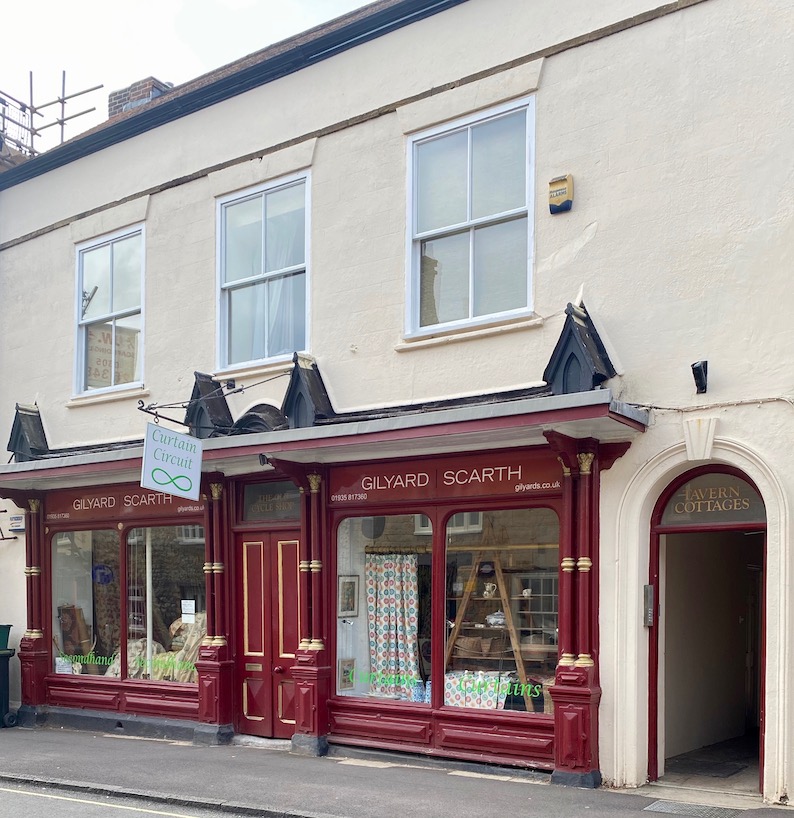
Ever since I wrote a book linked to a television series about the history of Britain’s high streets, I’ve been interested in the architecture of shops, and when I visit a town I’m often agreeably surprised to find old shopfronts still intact and fronting valued local businesses. This frontage in Sherborne was one that caught my eye. It looked to me late Victorian and the array of paired columns, wooden panelling, generous overhang, and slightly Gothic gablets poking out on top seemed to be from the more showy end of the retail spectrum. What could it have been, I wondered to myself: a high-class grocer’s, or maybe something more outré such as an oil and colour merchant or a specialist in well made leather goods? A sign painted on to the glass above the door gave a clue to a business that had been here once: ‘The Old Cycle Shop’. Could that have been the original business?

Not at all, it turns out. The other clue is above the doorway to the right, with its sign saying ‘Tavern Cottages’. A place of refreshment, then? Yes, but not the alcohol-selling place one would expect. This building began life in 1881 as the Sherborne Coffee Tavern. The late-19th and early-20th centuries saw a vigorous anti-alcohol movement. In churches and chapels there were sermons warning against the effects of the ‘demon drink’, campaigners and some nonconformist preachers persuaded people to ‘sign the pledge’ not to touch the stuff, and both campaigners and canny business people founded places where pub-goers could find alternative entertainment – from temperance billiards rooms to coffee taverns.

Coffee had been widely drunk since the 16th century and had gradually evolved from the costly luxury chosen by a few to an inexpensive drink enjoyed by many. Back in the 18th century, coffee houses had been popular among the professional classes in Britain’s large cities. Lawyers, medics, and even writers had their coffee house of choice, where they’d go to drink coffee, read the newspapers, meet friends, and discuss the day’s news. But coffee taverns were never as popular as their ancestors of the Georgian period, perhaps because they were mostly started by middle-class reformers who wanted to encourage the working class to stop drinking and give up the unruly habits of the drunk. The intended customers weren’t keen, and many coffee taverns closed after a few years.

Sherborne’s coffee tavern was bought in the 1890s by a local man, Edwin Childs, who moved his bicycle sales and repair business there. Childs prospered – this was, after all, the heyday of the bicycle – and by the early-20th century was also repairing cars. As the car business expanded, he first converted the shop, removing the big windows, and eventually put up a purpose-built garage elsewhere in the same street. Subsequently the attractive 1880s shop front was restored, and it still looks well in its dark red paint with details picked out in gold, an asset to Sherborne’s rich and varied streetscape and a survivor in an age when a liking for both wine and coffee no longer seems some kind of contradiction.

Sunday, March 11, 2012

Fulham High Street, London


Still there – just

It must have been in the 1970s, when Philip Larkin’s Oxford Book of Twentieth Century English Verse came out, that I first read and was moved by a poem by P J Kavanagh called ‘The Temperance Billiards Rooms’. In it, the poet remembers how he used to walk past the Temperance Billiards Rooms with his wife, who died tragically young. Aged just 33, the poet salutes the Billiards Rooms alone. He makes the building stand for continuity, in this moving poem about carrying on after a disaster: ‘it just goes on, as I do too I notice’. But it’s also fragile (‘something so uneconomical’s sure to come down’) and so is the grieving poet. It’s a touching poem, and Kavanagh’s description of the place, ‘in red and green and brown, with porridge-coloured stucco in between and half a child’s top for a dome…it’s like a Protestant mosque!’ has a melancholy humour.

I wonder if this is Kavanagh’s building. It’s now a pub (The Temperance), is repainted a rather sorry dark grey and is offering special deals on cocktails. There’s still a dome, still bits of stucco decoration, still stained glass in red and green, still the hall to the right which must have contained the billiard tables. If it’s not the building in the poem, it’s one very like it. Designed in 1910 by Norman Evans, it was one of several such buildings, built for Temperance Billiard Halls Ltd in northern England and the suburbs of London. Their art nouveau glass and decoration, and the chance of a game of billiards, were meant to attract punters away from the temptations of the demon drink, part of a movement that began in the middle decades of the 19th century and saw a late resurgence in 1900–1910. As late as 1908 there was a bill in Parliament to reduce the number of licenses to sell alcohol and ban the employment of women in pubs, a bill that was vigorously supported by temperance campaigners, and equally loudly decried by others, especially those, such as the Barmaids’ Political Defence League, who stood up for the barmaids who were to lose their jobs. The bill was defeated in the end, and the temperance movement declined.

This billiards hall, at any rate, is still there, although the dark paint spoils what looks it had. It’s also fiendishly difficult to photograph, hemmed in by road signs, wires, aerials, railings, and continuous traffic along the Fulham High Street. The best I could do was to include one of the most interesting vehicles that went past as I stood outside, a Mercedes Benz 280SL that takes us just about back to the 1960s, when Kavanagh wrote his poem. Like him, I’m glad the building is still there, although I cannot, like the poet, say that there are, ‘for all I know men playing billiards temperately in there’.

* * *

For more about architecture and temperance, see Andrew Davison’s essay ‘”Worthy of the Cause”: The Buildings of the Temperance Movement’ in Geoff Brandwood (ed), Living, Leisure and Law (Spire Books, 2010).

For P J Kavanagh’s account of his loss, see P J Kavanagh, The Perfect Stranger (1966)