Showing posts with label Norfolk. Show all posts

Thursday, July 1, 2021

King’s Lynn, Norfolk


Maritime Lynn, 2

As well as the Pilot Office for people managing the shipping in the harbour and its approaches, the other prominent architectural feature of King’s Lynn’s maritime life was the Customs House. This stately classical building is one of the most famous coastal structures in East Anglia. It is well sited right on the northern bank of the inlet called Purfleet Quay. It’s a tall building and its neat wooden turret with cupola attracts attention to it.

Anyone who knows the town centres of England will recognise this building’s architectural ancestry. Its form, with arched lower story, upper floor with large windows, and roof turret, is similar to that of many of the structures that combine the functions of town hall and market that make the centrepiece of many English towns. Its style is proudly Wren-like, like a smaller version of the magnificent town hall at Abingdon. The semi-circular arches, pilasters, hipped roof with dormers, and roof turret are just the kind of thing one sees on late-17th century buildings – both town halls and country houses like Ashdown. This one is not by Wren, but was designed by a local man called Henry Bell, who had clearly absorbed the essence of this style and brought it to his home town when Lynn was still a prominent port. Anyone inclined to think of Lynn as a backwater should think again: the port was a very busy one at this time. Indeed Bell himself was a merchant whose goods went in and out of Lynn harbour; like many architects in the Stuart period, he was an amateur, and picked his commissions carefully. He’d been to Cambridge, and had gone on a grand tour that included time in Holland, where the buildings clearly made an impression on him.

This building was commissioned by Sir John Turner, a local MP, who also served as the town’s mayor and made his money from his business as a wine merchant. This trade was one of the mainstays of Lynn’s harbour, and Turner would have been as aware as anyone of the usefulness of a building in which the local merchants could do business. Hence the structure’s resemblance to a market house. When opened in 1685, the lower floor of the structure (then with open arches) was used as the merchants’ exchange; the upper floor was let to the Collector of Customs; in 1717 the whole building was sold to the Crown and was already known as the Customs House. It remained in the care of HM Customs and Excise until 1989 and when I lasted visited it was used by the local council and housed the Tourist Information Centre. And maybe that’s not totally inappropriate. King’s Lynn no longer gets its main income form its port; tourism is more important to the town today and the Customs House is a perfect architectural signpost and information point for visitors.

Monday, June 28, 2021

King’s Lynn, Norfolk


Maritime Lynn, 1

This brick octagonal tower poking up near the bank of the Great Ouse in King’s Lynn was built in 1864 as part of the Pilot Office of the town’s port. It’s essentially an observation tower, allowing officials to keep an eye on shipping. Adjoining are workshops and a store for explosives,* as well as the remaining part of the town’s first public baths, which had been put up during the previous decade (and was partly converted to the offices of the King’s Lynn Conservancy Board in the 1980s). This is an important structure historically because it represents the prominence of the town as a port, which was the busiest in East Anglia for much of the Middle Ages, when it was a centre for the export of wool and cloth and the import of wine, timber, and other goods. The port remained a major one for several centuries afterwards, with corn from eastern England becoming the main export commodity as the wool trade declined. In the mid-19th century it was still busy but had begun a slow decline.

As well as ample windows, another requirement of the people keeping watch was a good idea of the wind direction. This is provided by the weather vane on top of the tower’s roof. The shaft of the vane is connected to a compass inside the building, so those working there can read the wind direction without going outside. This ingenious arrangement looks like a typical bit of Victorian wizardry, but the idea goes back further – for example, Thomas Jefferson’s classical country house, Monticello, has a similar arrangement. I don’t know if Jefferson invented it – he was highly inventive and the house has several other ingenious bits of 18th-century technology – but in King’s Lynn it was more than a rich man’s clever toy. No doubt it was well used.

- - - - -

* For signalling flares, apparently.


Monday, September 11, 2017

Walpole St Peter, Norfolk


It does something to me

A regular reader of the English Buildings blog, or someone glancing at the tag cloud in the right-hand column, would realise quickly that churches are a major interest of mine. I visit churches a lot, and I seem to blog about a church at least once a month. Many things draw me to churches – sometimes it’s their long history, sometimes their architecture, sometimes specific objects or works of art they contain, sometimes what I can only call their atmosphere.

The atmosphere I most eagerly savour is the kind that is summoned up by centuries of accumulated history. It’s what I find, typically, in small isolated country churches that have not been over-restored – churches like Inglesham in Wiltshire, to give just one favourite example. There’s something else I get from churches like that, and it’s signalled perhaps by the world ‘isolated’. In a world that contains, in my opinion, far too much noise, a church can be an almost silent place. I find quietude helpful, even restorative, and value the combination of quiet and atmosphere* found in some old churches enough make a special journey to find it.

But there’s another thing that sometimes happens in churches that is the opposite of silence, and can be equally nourishing: the sudden unexpected performance of music. I have been surprised by music in churches quite a few times, and it has always made my visit memorable. This is not, or not usually, run of the mill organ practice – though I have been captivated by that too (one organ piece I heard, in Gloucester cathedral, stayed in my head for years before I discovered what it was). What I mean is rehearsals for special musical events. From time to time I have come across a trio playing Mendelssohn, a choir singing Handel, a bizarre duet for organ and violin, a Schubert impromptu on the piano, and an unidentified baroque cantata – all of these in old churches. All have given me pleasure, in part because these ad hoc performances have been a total surprise.

It’s not just about church acoustics, which can vary quite a bit. In one of our more beautiful cathedrals I can remember a choral rehearsal in which it took me a few minutes to grasp the fact that the words the choir were singing were English ones – the reverberation was playing havoc with the singers’ diction. After a while the conductor dropped her arms in despair, bringing everyone to a halt, and wailed desperately,’I need to hear the altos!’ Often, though, church acoustics are crystal clear. The setting, conducive to worship, is also likely to be apt for the kind of attention that good, unamplified music demands. And in a small church one can get very close to the performers, lending great immediacy to the proceedings.

At Walpole St Peter in Norfolk, the church offers many of the things I most enjoy – airy, late-medieval architecture with repeating patterns of window tracery, impressive woodwork including screens and pews with carved poppyheads and other details, clear glass that lets the sun bathe the interior with light and warmth. But it was music that was in my mind even before I walked past the notice reminding me to remove the pattens from my feet¶ and pushed open the door. I have a recording of a fine Bach concert by the English Baroque Soloists and Monteverdi Choir under John Eliot Gardiner that was made in this glorious 15th-century church. How wonderful it would be, I thought, if someone’s playing Bach in here. Imagine my surprise as I opened the door to hear not ‘Wachet auf’ or ‘Jesu, meine Freude’ but a woman singing Cole Porter. There followed a long selection from the American songbook, most of it beautifully sung, a rehearsal for a concert later the same day. The person minding the singers was quite happy for me to wander around, so I tiptoed quietly, admiring the window tracery and the woodwork, and savouring the way the sunlight coming through the clear glass windows illuminated pews and carvings, to the accompaniment of ‘Night and Day’, ‘You’re the Top’, and ‘You Do Something to Me’.

And the whole experience did do something to me, and I was very grateful. I did not resent losing a few minutes’ silence for some good music-making. Music and silence, apparent opposites, are not so far apart after all. There have been whole books written about silence, but perhaps the best thing I’ve read about the subject is the shortest and most laconic, the exhortation of Alfred Brendel, master interpreter of the Viennese piano classics† and revelatory writer about music. He told us simply to remember the anagram: LISTEN = SILENT.§

- - - - -

* Compare Philip Larkin, ‘Church Going’: ‘It pleases me to stand in silence here’.

¶ A notice left over from the 19th century, at least: ‘It is requested that all persons will take off their Pattens at the Church Door’.

† Now retired from the concert platform, but his recordings remain.

§ Alfred Brendel, A Pianist’s A – Z (Faber & Faber, 2013)

Tuesday, August 8, 2017

Big house, small details


Holkham: The social, architectural and landscape history of a great English country house by Christine Hiskey
Published by Unicorn Press


At the end of Holkham by Christine Hiskey are two photographs that for me sum up the turns and turns-about in the history of a great house. The pictures show the same room, the Statue Gallery, in the 1960s-70s and the 1980s. In the first picture, the room is dominated by a rather fussily patterned (but very beautiful) carpet and some chairs upholstered in bright red. In the second, the room has been restored to create the effect it originally made in the 18th century, with bare, polished floor boards and chairs covered in blue leather. The evidence for the blue leather on the chairs comes from the earliest inventories of the house and a fragment of leather caught under later upholstery.

This coming together of documentary and physical evidence, this fine detail, characterises Hiskey’s fascinating account of one of our greatest houses, Holkham Hall in Norfolk, from the time it was built in the 18th century under Thomas Coke, 1st Earl of Leicester, to today, with the 8th Earl (another Thomas Coke) in residence. Holkham is vast, one of the biggest English houses, and very, very grand. It deserves a weighty history and this is what it has got – it’s impossible to do justice in a short review to the 500-odd pages of dense social, architectural, and landscape history in this book. There is so much here and all of it backed up with evidence from the estate’s extensive archives (the author is Holkham’s archivist) and with scores of fascinating illustrations. 

Holkham tells the long story of the construction of the vast house, a task that took the 1st Earl 25 years and was still not finished when he died (his widow saw the building to completion) and involved several different architects, whose contributions are difficult to disentangle. The building of the hall (including the sourcing of materials, the work of the small army of craftsmen, the changes in design) is given a substantial portion of the book. It describes how the family lived in the house, and how the various bits of this vast pile were used – not least in the early years when the Cokes were living in the completed portion of what was otherwise a half-finished building site. It explains the estate, and how the village, farms, and park related to the house. And it chronicles the changes made to the house over the years, often in detail as fine and evocative as that scrap of leather under the chair upholstery.

It covers of course, the Coke who’s best known to anyone with a smattering of English social history – Thomas William Coke or ‘Coke of Norfolk’, who is most famous as an agriculturalist, as well as being a prominent Whig Member of Parliament, staying in office until the 1832 Reform Act was passed. As well as all this he was well liked as a host, and the book quotes several accounts by his guests, who praise his generosity (he seems to have been one of those people who made everyone feel that they were the favourite guest); they also loved his library.

And so it goes on, through the Victorian period and 20th century, to our own. We learn a lot about the vast corps of servants, about relations with tenant farmers and villagers (mostly good – the Cokes were not ones for shifting people willy-nilly or knocking down cottages to create lakes). Then there are the dealings with local tradesmen. The Cokes bought a lot of their supplies locally, and Hiskey has lists of local businesses (apothecary, brush maker, saddler, basket maker, cooper, cabinet maker, druggist, draper, glover…) who sold goods to the house. Even that most important of symbols of country-house grandeur, the servants’ liveries, came not from London but from nearby Holt.

One could go on citing fascinating and animating details – from primitive electricity generators to provision for fire-fighting: before the house was finished, men had to put out a fire in the room of Matthew Brettingham, resident architect, and by 1750 the house had its own fire engine, with leather hoses. Hundreds of such details make up this absorbing account, a fitting tribute to one of the greatest English houses, its builders, households, and owners.

Friday, November 20, 2015

King's Lynn, Norfolk


 The English pig again

I’ve noticed recently the creative use of decorative tiles in shops and on shopfronts in the Victorian and Edwardian eras, butchers being particularly drawn to tiles for their decorative and hygienic qualities. It’s a large field, which I need to look into in more depth, but meanwhile I can’t resist sharing one more example that I found recently, even though I know little about it. This is a shop front in King’s Lynn, which has a number of beautiful pictorial tiles, each featuring an animal or farming scene delineated in fine detail.

I do not know who made these tiles. I know Minton used this sepia palette (I once owned a house that had a fireplace adorned with lovely Minton sepia tiles), and they produced farm scenes with drawings by William Wise, although these in Lynn do not match the examples I’ve seen. Minton as well as other companies must have had various ranges to fulfil the no doubt heavy demand. These are particularly characterful, a strong pig’s head, confronting us full on with steady gaze and creased flesh; a well drawn cow or bull’s head with a lot of fine detail; and a group of sheep huddled together in a setting of grass, twigs, and picturesquely tumbledown fencing. The sheep, I think, are conventionally charming, but to my eyes the drawing of the two animal heads is particularly strong and effective.

That all this can appear on a mass produced tile a few inches square, set off with a band of bright geometrical tiles that are also very attractive, is a tribute to the Victorian marriage of art and industry, which at its best could be harmonious and more than just eye-catching. Advertising of a kind, it’s true. But the sort of advertising that stands the test of time.


Saturday, February 21, 2015

West Runton, Norfolk


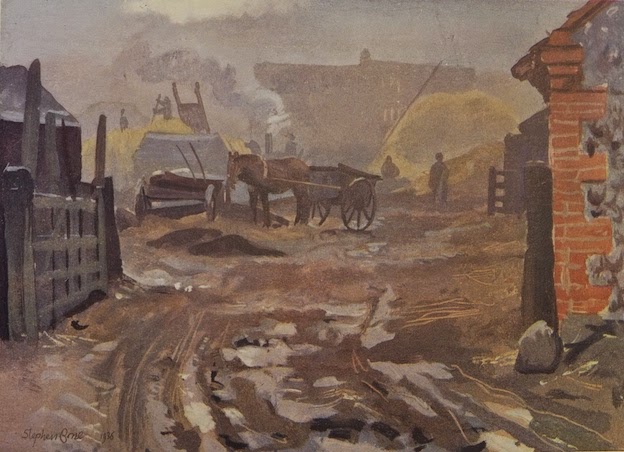
Winter Morning in the Farmyard…Illustration of the month

This month’s illustration is a farmyard scene by Stephen Bone, painted in 1936. Although it doesn’t have much architectural content (apart from the corner of a building on the right, which looks as if it’s built of flint with brick quoins) I greatly admire the way it conjures up a place and a time.

Stephen Bone (1904–58) was the son of the Scottish artist Muirhead Bone and his wife Gertrude Helena Dodd. He was encouraged to draw by his father and taught as a boy by Stanley Spencer, who lodged for a while at the Bone family house near Petersfield. Bone went to the Slade, but left early, not liking the school’s academic approach to draftsmanship, and embarked on a career as a book illustrator, excelling as a wood engraver. He also travelled widely, notably with his wife and fellow artist Mary Adshead (they met at the Slade), and when he travelled, he painted, producing colourful landscapes on board. Some of these travels led to a book, Albion: An Artist’s Britain, from which my illustration is taken.

What a lot of atmosphere Bone conveys with his limited and rather muddy palette. It’s winter, and quite early in the morning. The farm is already hard at work – the threshing machine is steaming away, someone is on top of a stack, a horse waits patiently between the shafts. We observe all this through the gate, at one remove, as it were – and through the mist, which makes the scene less distinct but also encourages us to look into the picture and puzzle at what’s going on. Bone reported: ‘Dimly through the mist one sees threshing in progress. The January frost was thawing into mud and my feet were cold and wet.’

From Bone’s thick, painterly way with the mud and frost in the foreground to the looming shapes of stacks and buildings in the distance, from the vague figures to the precise lines with which objects such as ladders and cartwheels are delineated, it’s clearly a composition that has been put together with great care. At first glance it all seems to so casual – those thick foreground daubs of paint. But look for a minute or two. Look at the gate, for example, and the artful way a few strokes of the brush summon up the shadows on the uprights, the frost on the top rail. Look too at the combination of diagonals (ladders, cart shafts, the stack-man’s fork handle), again portrayed with a few slender lines. Marvellous.

Bone’s Albion was published in 1939, the year war came. Its author-illustrator joined up, serving in the camouflage unit before becoming an official war artist (his father had been the very first official war artist in World War I). After the war he continued painting his landscapes, but dealers found them uncommercial. Bone carried on painting the way he wanted to anyway – but forged for himself additional careers in illustrated books (working with Mary Adshead), as a broadcaster (on popular British radios shows such as The Brains Trust), and as an art critic. I think he’s probably still rather under-appreciated: my copy of Albion cost just £5.

Wednesday, July 20, 2011

Hingham, Norfolk


Hunting the hart

Spotting my recent posts on unusual inn signs, and anticipating that I’d soon be moving on to post a three-dimensional sign, Peter Ashley of Unmitigated England sent me this picture of the White Hart at Hingham. Hingham is known for its fine collection of Georgian houses, built apparently when local gentry moved in to reduce their reliance on the area’s inadequate roads during the winter, giving them elegant town houses and Hingham itself the nickname ‘Little London’. The White Hart sign is a real winner, a visual asset where a conventional hanging sign, or maybe a row of wooden letters attached to the wall, would have been expected. I like the way that Peter’s photograph catches the beast as if it is just becoming aware of the pursuing hunter – a hunter equipped of course with a weapon no more deadly than a Leica.

When not wielding his Leica, incidentally, Peter Ashley has had his paintbrushes out. The result is a rather lovely capriccio depicting a selection of the most notable buildings in the town of Stamford in Lincolnshire. It’s an artful image, containing lovely examples of architecture from the Middle Ages to the 20th century, plus a number of picturesque inclusions, from a railway train (steam-hauled, naturally) to street furniture. Prints of the image have been made and some of the proceeds from their sale will go to the Stamford Civic Society. You can find out more about the prints here and there’s a short film about them here.

Peter Ashley, Unmitigated Stamford

Wednesday, February 10, 2010

Norwich


Strongfellows

As a regular visitor to the Czech Republic, I’ve often been impressed by the giant carvings of Atlas-like figures who hold up doorways, porches, and similar features on some of the most imposing Baroque and Neoclassical houses in Prague. On buildings like Prague’s great Clam-Gallas Palace, giants, all bulging thews and flowing hair, strain their muscles in an eternal struggle to stop the structure falling down.

English buildings occasionally have supporting figures, but these supporters, chunky male descendants of the caryatids of ancient Greece, are apt to be more phlegmatic. The rather homely statues in the photograph support the entrance porch of a house near the cathedral in Norwich. They depict a pair of heroes – Samson (is he carrying the jawbone of an ass?) on the left and Hercules (with his lion-pelt cloak) on the right. They seem to have walked straight out of a 17th-century woodcut or emblem book, and wonderfully combine folk art with knowing allusion to the Biblical and Classical worlds. They are the kind of figures around which legends are apt to cluster, and one story maintains that when the cathedral clock strikes midnight, the pair leave their posts and wallop one another with their clubs.

Samson and Hercules form a memorable entrance for a house built by a mayor of Norwich, Christopher Jay, in 1657. They’re apparently replacements of the original 17th-century figures, but retain the vigour of their predecessors, even if their crispness of line and form has been smoothed over somewhat by various repaintings. Sadly, the wrong kind of painting has begun to appear – the kind of graffiti that represents the human equivalent of canine leg-cocking. The building, which was once a nightclub, now seems to be vacant. One hopes that it will attract a caring owner or tenant. And soon.

Many thanks to Zoë for the photograph.