Showing posts with label Altarnun. Show all posts

Friday, May 28, 2021

Altarnun, Cornwall


The hard stuff


In the list of English building stones most familiar are the sedimentary rocks, such as limestones and sandstones, that are so widely found and widely used for building. In the Middle Ages, when so many of the country’s churches, castles, and other notable buildings were constructed, these stones were widespread, plentiful, and widely used. Many of them were also sympathetically yielding to the carver’s chisel, and whether for the hunky punks of Somerset or the glorious Romanesque carvings of Herefordshire or their contemporaries in many other places, often just as stunning, masons and carvers used these materials enthusiastically. But there are other stones with very different qualities. One such group are the granites of parts of Cornwall, Devon, and Lancashire, igneous rocks that are so hard they rapidly blunt any tool that one is rash enough to use on them.* Early builders were sometimes thankful to find ‘field stones’, chunks of granite that they could pick up and use with little or no chiselling. An entire church built of granite is a testimony to a lot of very hard work.

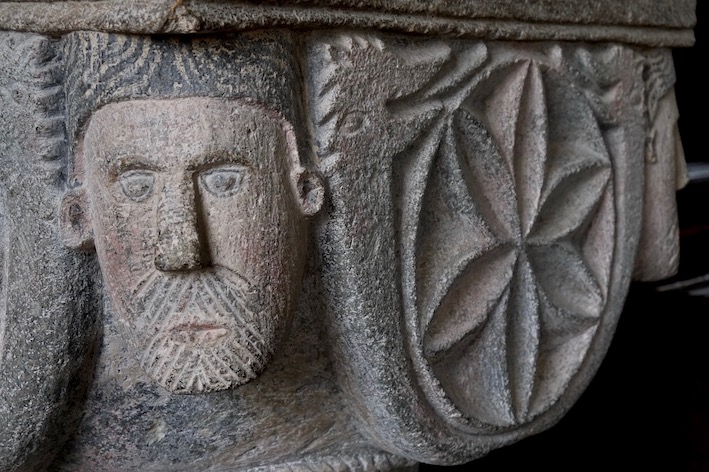
Such a church is St Nonna’s, Altarnun, in Cornwall. Not for this building are the glass-flat blocks of ashlar stone that we see so often on the limestone belt or in the sandstone country. The surfaces, though well worked, have a roughness that gives them a character of their own. My photograph shows a detail of the superb Norman font. There’s a carved head at each corner and in the middle of each side, a roundel with a six-petalled ‘flower’ motif, embraced by a some kind of two-headed serpent. It’s simply detailed – getting fine detail into this stone is a real challenge – but wonderfully strong. It would have been further enhanced with coloured paint, of which traces remain – a hint of red on the cheeks of the face and a little grey to suggest hair. Whoever carved this has not been cowed by the hard rock, but has gone with an approach that suits the quality of the stone. A lesson in making the best of a material, something that ancient craftsmen did magnificently.

- - - - -

* I once tried to drill a hole the granite wall of a house, to fit a curtain rail. My good quality hammer drill was defeated: once through the plaster surface, the tip of the bit just danced about on the surface of the rock, knocking away more and m ore surrounding plaster as it did so. We called in the professionals, who had a machine the size of my arm that did the job.

Wednesday, June 17, 2015

Altarnun, Cornwall


Doodle-sack*

I’ve been looking at a lot of church woodwork recently, cricking my neck to examine carved angels in roofs, and clicking my knees to get down and peer at the images on bench ends. I’ve been struck, as I’ve done this, by the variety of musical instruments being played, especially by carved angels (there were far more than harps in medieval heaven, clearly), and down on ground level too. Altarnun’s superb set of bench ends features a couple of musicians, one playing some kind of fiddle, and this bagpiper, who gives a fair indication of the folkish nature of the art, and also, presumably, of the music to be heard hereabouts in the late Middle Ages, when these bench ends were carved.

In the United Kingdom we tend to think of bagpipes as Scottish. The Scottish pipes skirl in military parades, at royal occasions, and I’ve even seen buskers, wearing the kilt and taking the chance with their pipes on the streets of London. We should know better, of course, than to think the Scots have the monopoly. There are Irish pipes, Northumbrian small pipes, all kinds of bagpipes. They’re all over Europe too. I was thrilled during my travels in Central Europe to find the bagpiping centre of Strakonice in the Czech Republic. And there is the opera Schwanda the Bagpiper,† and so on and on.

There are plenty of references to early pipes and bagpipes in Cornwall, including a number of carvings in churches. These instruments are interesting in that, unlike many bagpipes, they have two chanters – the pipes with holes on which one plays the melody – which must open up harmonic possibilities denied to players of bagpipes with a single chanter.

The carving of the figure is simple but bold, and it is badly worn. But one still gets an impression of the vigorous style – in the folds of the costume, the modelling of the bag, the extraordinary hat, even the little dog. John Betjeman said that a church should bring one to one’s knees. Peering at this bagpiper got me kneeling to look closely – not quite the kind of prayerful kneeling that Betjeman had in mind. But Betjeman also encouraged us all to use our eyes. And I’m glad I got down, and peered.

- - -

* I am playing here on Dudelsack (the sack on which one tootles), the wonderful German word for bagpipes.
† Švanda dudák in Czech, Schwanda der Dudelsackpfeiffer in German, by the composer Jaromir Weinberger and based on a play by the Czech writer Josef Kajetán Tyl.

Saturday, June 13, 2015

Altarnun, Cornwall


Local hero

I visited Altarnun primarily to see the parish church (which is late-medieval, beautiful, and packed with interest, including an outstanding set of 16th-century bench ends that I'll post about soon), but also found this simple but interesting building. It’s a former chapel, and is small, with just two sash windows (6 x 6 panes) lighting the front wall of what was the main chapel and a low bottom storey that was originally given over to storage and stables. The most striking feature is a bust of John Wesley above the door.


This bust is interesting for several reasons. It gives us a date, 1836, which is apparently the date of an extension to the building, not the year of its original construction: one should always beware of datestones. That date also caught my eye because of the lettering. The 3 and 6 take a rather odd form but the overall impression is emphatic and impactful.

More memorable is the carving of the founder of Methodism, shown in profile and sticking well out, so that it’s not so much a relief as three-quarters of a bust. The sculptor was Neville Northey Burnard, who was born in one of the adjoining houses, carved the bust when he was 16, and went on to work widely in London as well as in his home county. The carving has a vigour that helps to explain how Burnard became a successful portrait sculptor – although the success didn’t last because he turned to drink after the death of his daughter, and went into a decline, living for years as a tramp. It’s good so see his early portrait of Wesley, remaining in place even after the chapel it adorns has been converted for residential use.