Showing posts with label Capability Brown. Show all posts

Wednesday, October 11, 2023

Croome, Worcestershire

A glance into the past

Early on in the history of this blog, I did a couple of posts about Croome Court, the 18th-century house of the earls of Coventry. What especially interested me was the number and variety of buildings in Croome’s landscape garden and the surrounding countryside, from the classical ‘Temple Greenhouse’ by Robert Adam to a circular panorama tower. Croome is a place I’ve been meaning to revisit for a while now, and I planned to do a post about the house and its 18th-century architecture but, as usual, something unexpected caught my eye. So, much as I enjoyed looking at the Georgian architecture of the great house, designed by Capability Brown and with interiors partly by Robert Adam, here at the heart of this 18th-century building is, of all things, a bit of timber-framed wall.

The 6th Earl built Croome Court as we know it, an elegant Palladian house with corner towers and a central classical portico, in the 1750s. But the central part was actually a rebuilding of the family’s earlier 17th-century brick-built house – the architect, Brown, rebuilt it using the old foundations, facing it in stone, laying out new rooms inside, and adding the corner towers and portico. The 17th-century house, however, had an even earlier, timber-framed house at its core, and it’s a fragment of this that I noticed as I walked around the building’s basement. One of the National Trust’s helpful guides, seeing me looking at this, pointed out details on the floor that showed the lines of early, long-demolished walls among the floor tiles.

And so Croome Court, so classically perfect, turned out to be a bit of an architectural jigsaw, as so many buildings do when you look carefully. I don’t know if it was a member of the Coventry family or one of the house’s later owners* or the National Trust who now run and maintain the building who left this small section of timber-framing exposed. But I was pleased that they’d done so, because it made me think of the house in a different way, one more true to its complex history.

- - - - -

* The ownership history of the house has been varied since the 1940s. Sold off by the family after World War II, it became successively home to a school, to the UK headquarters of the International Society for Krishna Consciousness, to a property developer who planned to turn it into a hotel, and to another developer who lived in it for a while. The Croome Heritage Trust then took over the house in tandem with the National Trust, ensuring its survival.

Wednesday, December 29, 2021

Stowe, Buckinghamshire


Buildings in a landscape, 1

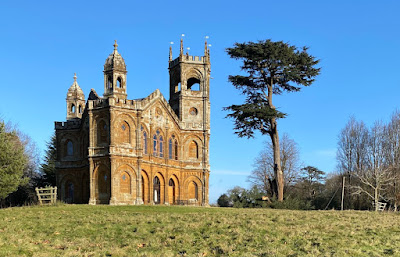
Stowe is one of the biggest and most magnificent of English landscape gardens. It’s a 400-acre masterpiece that bears the stamp of great 18th-century gardeners such as Lancelot ‘Capability’ Brown, who sculpted terrain using earth and water and trees to create scenery that was deemed to be more ‘natural-looking’ than the formal gardens that were fashionable in earlier ages. These landscapes were punctuated by dozens of buildings, statues and other monuments that formed focal points for vistas. And at Stowe, men of the calibre of William Kent, James Gibbs and Sir John Vanbrugh all contributed to the architecture.

This array of talent was at the service of the estate’s owners, the Temple family, and of these, Sir Richard Temple (1675–1749), who inherited Stowe in 1697 and was made 1st Viscount Cobham in 1718, was probably the most important. It was he, building on work done by his predecessors, marshalled the talent and provide the funds to create the gardens largely as we know them and to commission the buildings that are one of its major glories still. As is well known, Cobham chose and influenced the architecture to reflect his philosophical and political views, and these views were determinedly Whig, and drew on the ideas of the Enlightenment and of authors from Francis Bacon to Alexander Pope.

To be a Whig in the 18th century meant, so Cobham argued, supporting the British constitutional monarchy, opposing notions of absolute monarchy propounded by the Stuarts and their supporters, and standing up for political freedom and liberty. Cobham saw Whig virtues embodied in certain British heroes, some historical, some contemporary, some people of action, some contemplatives. Many of these qualities were, it was said, embodied in figures such as Elizabeth I, William Shakespeare, John Locke, and John Milton, whose busts are displayed in the Temple of British Worthies, one of the buildings at Stowe.

Another large building in the garden is the Gothic Temple, designed by James Gibbs and part of a campaign of building and gardening that took place at Stowe in 1739–42. Unlike the Temple of British Worthies, the Gothic Temple’s connection to Whig values is less obvious. It’s easy to see it as an exception (most of the architecture in the garden is classical) and interesting as a piece of self-conscious Gothic on a large scale that predates Horace Walpole’s house Strawberry Hill, so often cited as the structure that kick-started Britain’s Gothic revival.

But from Cobham’s point of view, the Gothic Temple could be seen as symbolising virtues that Whigs valued highly. For him, Gothic meant vigour, hardihood, and a love of liberty, and was valuable as a style with north-European roots, standing at a remove from the ‘southern langour’ symbolised (allegedly) by, say, baroque buildings. It is, from this standpoint, thoroughly Whiggish.* And the building is certainly there to stand out, catch the eye, and stimulate thought and conversation. It’s huge, it’s unusually triangular in plan†, it occupies a prominent, elevated site, and is the only one of Stowe’s structures to be built of glowing orange ironstone. One might ask, seeing it for the first time, ‘Whatever is that?’¶ I’ve tried to suggest the sort of answer its creator might have given to this question. 

- - - - -

* Although of course looking at it another way, none of these virtues belong exclusively, or even at all, to Gothic any more than they do to other artistic styles. I am simply trying to describe what Cobham and his Whig friends found in the style.

† Had Cobham or Gibbs got Sir Thomas Tresham’s earlier Triangular Lodge in Northamptonshire in mind?

¶ Nowadays it is also a holiday home, restored and managed by the Landmark Trust.

Thursday, December 16, 2010

Croome, Worcestershire


Winter blooms

Croome is historically important because it is the first major work of the great landscape gardener and architect Lancelot Brown, known as ‘Capability’ Brown because of his habit of assuring prospective clients that their grounds had great ‘capabilities’ for improvement. At Croome, Brown designed both the house and the park, although his work was supplemented in the house by Robert Adam, who worked on the interior, and James Wyatt, who designed some of the ‘eyecatchers’ around the edges of the park.

The park itself, created for the 6th earl of Coventry from 1747, was designed to feature a river, imitating the nearby Severn, and a large curvaceous lake with an island. Stately trees punctuate the views, as do a fascinating selection of garden buildings, including a grotto, guarded by a Coade stone statue of Sabrina, goddess of the Severn. Some of the buildings were designed by Brown, some by Adam, and James Wyatt added several of the more distant eyecatchers, including a ruined ‘castle’ that I included in an earlier post.

I was planning to do a post about Brown’s grotto at Croome, but on the frosty afternoon I walked around the park the other day the statue of Sabrina was swathed in wrapping, put to sleep as it were for the winter under a protective puffy green duvet, as were the other statues and urns dotted about the park. So instead, here’s a building called the Temple Greenhouse, which was designed by Adam.

Today it looks more like a temple than a greenhouse, because the windows that were once fitted between the columns have been removed. So it can no longer contain exotic plants, but still makes a noble feature in Croome’s landscape. Adam included symbolic sculptures to complement the vegetation that once filled the greenhouse: overflowing cornucopias and this brimming basket of flowers. These vigorous reliefs are full of life, with a variety of blooms turned this way and that, and leaves twisting, as it were, in the breeze. They bring a welcome bit of summer to the frosty winter landscape.


* * *

Croome Park is owned by the National Trust, and there are some stunning photographs of it here. The house, Croome Court, is owned by the Croome Heritage Trust, and is leased to the National Trust, which is managing its restoration.