Showing posts with label Crucifixion. Show all posts

Saturday, December 17, 2022

Daglingworth, Gloucestershire

Under snow and in hiding

The heading above could be about me. Gloucestershire has been snowbound for days, the temperatures have dipped to new lows, and I’m hardly venturing out at all, let alone looking at buildings. So I thought I’d find an appropriately chilly photograph: one from some years ago of the church at Daglingworth, near Cirencester, seems to fit the bill.

Looked at in passing, there seems to be nothing unusual about this little building. Apparently it’s a medieval church with a short version of the plain and simple west tower so common in the Cotswolds, and a later chancel, which turns out to be a Victorian rebuild of 1850–51. Look closer, however: long and short quoins and a doorway with a semi-circular arch of great simplicity suggest that the nave is Anglo-Saxon. Inside is a Saxon chancel arch and a group of four carved reliefs – two Crucifixions, a Christ in Majesty, and a St Peter – that also look pre-conquest.

The better preserved of the Crucifixions is the most striking of all. Set in the nave very close to a south-facing window, it’s difficult to photograph at all well, but the image above will give you the general idea. The crucified Christ wears a loincloth and his head is surrounded by a circular nimbus with a cross. On either side stand two Roman soldiers, one with the spear that pierced Jesus’ side, one with the vinegar-soaked sponge. Scholars argue about when and where it was carved – the late-10th or early-11th century seems to be the most likely guess for its date.

What’s certain, however, is that this relief and two of the others spent years hidden from view. They were only discovered when Victorian workers took apart the nave’s east wall during the rebuilding of the chancel. They found the stones reused in the masonry, their carved faces turned inwards so that they could not be seen. Were they hidden during the iconoclastic period of the Reformation, their images concealed by someone who revered them too much to destroy them? The Victorians had other ideas, removed them from their hiding place and displayed them on the walls. Although damaged, the carvings are still strong and moving images and although the church has been empty whenever I’ve visited, I’m sure people come many miles to see them. Historians of early medieval art and church-crawlers certainly know about them. Others should too.

Thursday, April 5, 2012

Fairford, Gloucestershire


Focal point

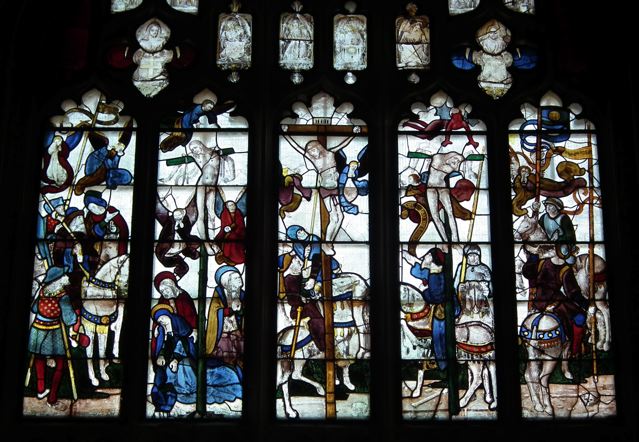
This stained glass window comes from Fairford church in Gloucestershire, a building that was rebuilt between about 1490 and 1510. The set of windows here is the most complete ensemble of late-medieval windows in any English parish church and is probably from the workshop of Barnard Flower, who worked on such high-profile projects as Henry VII’s Chapel in Westminster Abbey and the chapel of King’s College, Cambridge. These windows are among the glories of English art.

Jesus is shown in the central panel. The Roman centurion (called Longinus in some traditions) pierces his side with his spear, an incident described in the Gospel of John, who records that both blood and water flowed from Christ’s side. There is no trace now of blood and water (symbolic among other things of Jesus’ humanity and deity, and of his sacrifice and baptism) in the image in the window – the point of the spear seems to be entering the flesh, though, and perhaps the blood and the water have been lost to time.

In the panel to the left of the centre is the first thief, who is repentant, and on whom an angel looks down. At the base of his cross is the Virgin Mary, supported by Mary the wife of Clopas. Mary Magdalen, with her long hair and pot of ointment, is with them, and gazes at the figure of Jesus. In the panel to the right of the centre is the second, unrepentant, thief, who is accompanied by a devil, a figure with red skin (the devils in the Last Judgement window at Fairford are also red) and grayish, bat-like wings, hovering above the thief’s head. More Roman soldiers occupy the outer panels, and the bearded gesticulating figure on horseback in the left-hand panel is Pontius Pilate (another lower panel, not shown in my photograph, depicts him washing his hands).

There is one other important figure in this window, the foot soldier with the red hose on the bottom left, who is made to stand out with his patterned and brightly coloured clothes. Like many other figures in the window, his gaze is directed straight at Christ. Unlike the others, his collar bears an inscription: ‘IO SAVELE’, which is likely to be a shortened form of Sir John Savile, an associate of King Henry VII. His naming and his position suggest that he was the donor of the windows. His was a noble gift.

This beautiful window is a lovely example of the stained-glass-maker’s art at the point in history where, in England, the Middle Ages are waning and the Renaissance is arriving at last. It combines the traditional rich colours of medieval glass (the blues of Mary’s dress, the deep reds of the some of the solders’ garments, and so on) with sensitive drawing of the faces and lively poses. From the pointing Pilate to the hovering devil, from the observant soldiers to the caring Maries, there is a lot of life in this scene of execution. There is also a careful focus on the main figure, with the pointing hands, the spear, Savile’s gaze, and even the tilt of the flanking crosses, leading our eye towards Jesus. This is also, of course, the church’s east window, in the prime position above the altar, so the architecture and layout of the church draws us to this focal point in the building and the Christian story.

Friday, March 12, 2010

Tudeley, Kent


Through the paths of the seas

I usually blog about buildings I’ve seen or visited recently, but today I’m breaking this rule to turn your attention to a church I visited years ago, but which I’ve been reminded of a couple of times in the last few weeks. It’s the church of All Saints, Tudeley and this unassuming building is remarkable because it contains a complete set of twelve windows designed by Marc Chagall.

In 1963, Sarah, the daughter of Sir Henry and Lady d’Avigdor Goldsmid, was killed in a sailing accident at the age of 21. The family commissioned Chagall to create an east window for the church as a memorial to Sarah, and it was installed in 1967. Subsequent commissions led to all the other windows in the building being reglazed with magnificent Chagall glass.


In the east window, a girl floats among blue waves, almost as if cradled on the water. Mourners are beside her, and there is a vision of the Crucifixion and angels above. To the right, a ladder connects the two parts of the scene, and a figure climbs the ladder towards Christ. There’s a tremendous strength here – the figures don’t flirt with sentimentality as Chagall sometimes seems to me to do – and the way the artist has used the shapes of the individual pieces of glass to suggest the swirling waves works superbly. You’d not think that Chagall turned to glass design towards the end of his life. These windows are the work of a master.

The combination of blues and yellows in the east window sets the tone for the rest of the glass, which is predominantly blue, and, in the nave’s south wall, yellow, to invite and complement the sun’s rays. It’s impossible to describe the effect of the Chagall windows, with their birds, figures, and angels. You have to visit the place yourself and experience the visual immersion in blue, and, if you are fortunate, the warming yellow rays of the sun.

Further illumination and interest can also be had from visiting an exhibition, currently on at Mascalls Galley in Paddock Wood, which includes Chagall’s designs for the Tudeley windows and a number of representations of the Crucifixion by British artists from Eric Gill to Tracey Emin.

There is more information about the exhibition here and about the church here.