In love with building
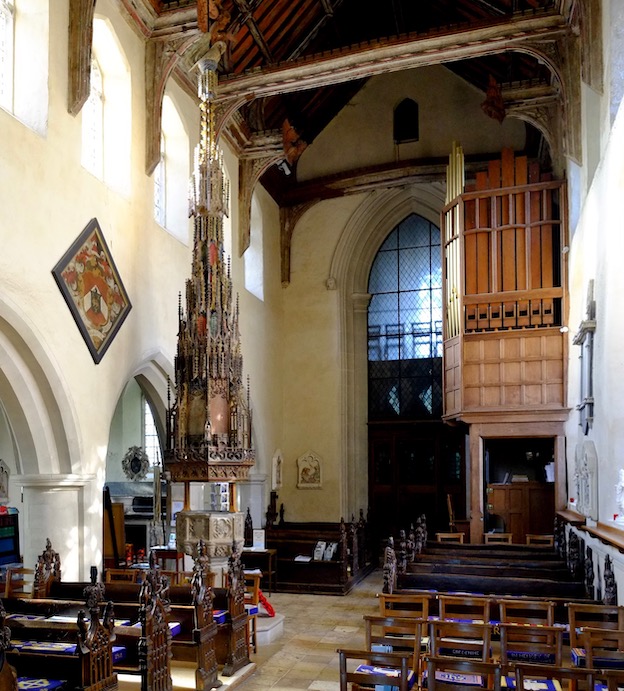
Since the 13th century, when churches were ordered to keep their fonts securely covered to prevent people stealing the consecrated water,* font covers have been the norm. Often, there is a simple, lockable wooden lid; frequently the cover is a little more elaborate, a structure that complements the font on which it sits. In East Anglia, however, the font covers of the 14th and 15th centuries became memorable works of the wood carver’s art.
Rising some six metres towards the roof of the nave, the font cover of the church of the Assumption, Ufford, is one of the most magnificent of all. At about 20 feet tall, the cover is a stunning wooden confection made up of niches, arches, and pinnacles. It tapers to the point where a pelican stands, pecking at her breast to feed her young. The Pelican in her Piety is of course a symbol of the sacrifice of Jesus Christ and its reenactment in the Mass, and this would have been but the climactic symbol on a font cover that was once covered in statues of biblical figures and saints – these were all lost during the iconoclastic purges following the Reformation. Apparently the statues had already been removed when the notorious 17th-century destroyer of images, William Dowsing, visited the church and had oversaw the smashing of stained glass.
What is left is still breathtaking, an essentially architectural object, in which the niches and pinnacles taper towards the top so that the cover takes the shape of a spire. I can’t help being reminded, looking at structures like this, of the words of the Arts and Crafts architect and educator William Richard Lethaby, when he wrote about the architectural form that decoration so often took in the Middle Ages:
The folk had fallen in love with building, and loved that their goldsmiths’ work, and ivories, their seals, and even the pierced patterns of their shoes should be like little buildings, little tabernacles, little ‘Pauls’ windows’ .
Chaucer, too, described someone with the patterns of Paul’s windows on his shoes, by which he meant designs like the tracery of the rose windows in Old St Paul’s cathedral. This use of architectural motifs such as tracery, niches, and pinnacles, is seen throughout medieval art. There’s nothing typical about the sheer richness of grand Suffolk font covers, though.† They are outstanding, and Ufford’s is one of the best of all.
- - - - -
* For use in ‘black magic’ or other non-Christian rites, it was said.
† And occasionally elsewhere. For an Oxfordshire example with a Suffolk link, see my post here.


