Showing posts with label monastery. Show all posts

Wednesday, July 2, 2025

Lindisfarne, Northumberland


Relics and patterns

Lindisfarne Priory is in many ways the archetypal medieval monastery. Its links to the relics of the revered Saint Cuthbert (and therefore with the early history of Christianity in Britain), its isolated position on a near-island that’s cut off from the mainland at high tide, its ruinous state today – all these are the kind of things we think about when we think about early monasticism in England. The original monastery was founded in 635, when Northumbrian king Oswald granted Lindisfarne to Aidan, who made it the centre for converting Northumbrians to Christianity. In the 670s, Cuthbert, then prior of Melrose Abbey, was invited to Lindisfarne and became famous for his saintly way of life, his wisdom and as a healer. When he was canonised, his tomb in the church at Lindisfarne became the centre of a cult. The influence of the Lindisfarne monastery grew, but after a Viking raid in 793, the monks removed his body and other relics to a safer place and the monastery was abandoned – at first Cuthbert’s shrine was at Chester le Street, later at Durham. Here, it’s said, the wheeled cart carrying his body could not be moved any further and those accompanying the coffin interpreted this as the will of the saint expressing itself.* At Durham his relics remain. As a result, Durham prospered, the present cathedral church was begun in 1093, and Cuthbert’s shrine was enhanced by a large collection of other holy relics, including a rib of Edward the Confessor and a tooth of St Cecilia.†

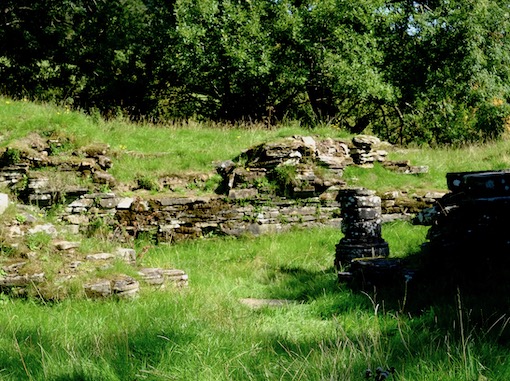
However, eventually monks returned to Lindisfarne and built a new church. When they did so, they designed its architecture to reflect that of Durham. Durham cathedral’s magnificent Norman nave has tall columns with bold geometric designs cut into them – amongst these are chevron patterns and flutes; there are also piers with multiple vertical shafts around them. Although the piers at Lindisfarne are much smaller than those at Durham and are now greatly eroded, you can still see similar designs on them – a pier with chevrons is clearly visible in my photograph, alongside another with multiple shafts. The stump of a further pier with a fluted design exists to the west of these. These architectural flourishes were a way of paying homage to the cathedral at Durham, by then in effect the senior or mother church of Lindisfarne, and of acknowledging the importance of the place that housed the remains of Cuthbert, so deeply revered by the monks of Lindisfarne.

- - - - -

* Apparently, when anyone tried to move the body beyond Northumberland, similar things happed – at one point it was put on a boat bound for Ireland, only for a storm to blow the vessel back.

† There is a good account of the story of St Cuthbert’s remains and of the relics at the shrine at Durham in Charles Freeman, Holy Bones, Holy Dust: How Relics Shaped the History of Modern Europe (Yale University Press, 2011).

Thursday, September 7, 2023

Muchelney, Somerset

Devoted to baser things

Dedicated as they were to higher things – prayer, the celebration of the Office at the canonical hours, the copying of books, especially holy scripture, and so on – monks needed also to cater for the needs of their bodies, from healthcare and food to lavatories and drains. Monastic drains often leave their traces, because they were carefully built and engineered, and set at or below ground level, so drainage channels often survive where standing buildings have disappeared. The lavatories that connect to these drains, by contrast, usually vanish. This makes the medieval lavatory building at Muchelney Abbey, probably built some time after 1268*, a rare survival.

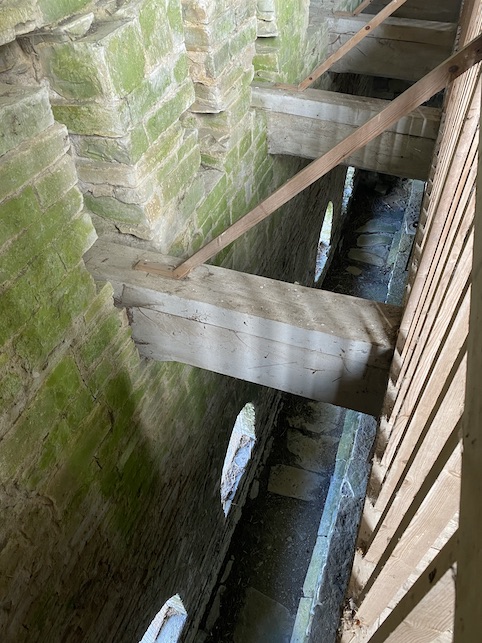
The latrine block stands out because it’s two storeys high and has a striking thatched roof, although it is said that the roof was probably originally covered with slates.† The upper floor has a gap all the way along one side, where the wooden structures of the lavatories, together with partitions between each one, were fixed. This arrangement allowed the waste material to fall to the drain directly below, where it was flushed away using water from the abbey’s conduit. However, the flow from the conduit was probably not very fast, as a look from the upper flor down to the drain (as in my second photograph) shows a row of arches at the bottom, through which the monastic servants, or the monks themselves, could clean the drainage channel.

When it was built, the latrine block formed one end of the eastern range of the cloister. Next to it on the upper floor was the monastic dormitory or dorter – this proximity of lavatory and dormitory was standard, and the lavatory is often known as the reredorter. The abbey’s dissolution in 1538 led to the decay of most of the buildings, but this block was retained and used as a farm building. The change of use ensured its survival, giving us a special insight into one way in which medieval monks catered for the more mundane aspects of their everyday life.

- - - - -

* This date is based on tree-ring analysis of ancient timbers.

† I’m indebted to English Heritage’s guidebook to the monastery for much of my information about the building.

Friday, October 23, 2020

Craswall, Herefordshire


The edge of the world 

On the far western edge of Herefordshire, up in the hills that dominate the border between England and Wales, lie the ruins of Craswall Priory, one of the most remote of English monasteries and the highest above sea level. Not easy to find, the ruins are on private land (which the owners open to the public) and in the Middle of Ages the place would have felt even more remote than it does today. The occupants were members of the Order of Grandmont, also known in France as the Bonshommes. They were highly austere (they were silent, ate very simple food, wore coarse habits, based their rule closely on the Gospels) and described themselves as hermits – not in the sense that they lived alone, but because seclusion from ‘the world’ was very important to them. This lonely place must have suited them.  

The ruins today are fragmentary but fascinating and atmospheric. The rounded walls of the church’s apsidal east end are visible, as are some of the walls of the chapter house and bits of foundation and wall of other monastic buildings. Everything is on a small scale – Grandmontine communities were limited in size. Most of the extant walling looks fragile, with gaps rather than mortar between many of the stones. Grass and other flora is establishing itself in the masonry. Yet there are signs of former splendour. ‘Look! Architecture!’ I cried, as I caught sight of the remains of the chapter house, shown in my photograph. The moulded base of a circular pier (one of two that would have held up a vaulted ceiling) and quite an ornate set of mouldings at the bottom of the chapter house’s doorway were what caught my attention. They look 13th century, which ties in with the priory’s foundation in around 1225. 

As one of only three Grandmontine priories in England, Craswall’s ruling or mother church was in France, where the order was founded. As such it was known as an ‘alien priory’ and English kings, suspicious of the influence of (and even spies from) enemy countries, made several efforts to remove or ‘suppress’ religious houses of this kind. Most alien priories had gone by 1414, but Craswall managed to survive until 1462. The buildings must, then, have been gradually deteriorating for well over 500 years. What is left is fragile indeed, and looks as if it needs some serious conservation work. One hopes that this will be possible – without totally losing the feeling of unkempt remoteness which is one of the things that makes the place so special. 

- - - - - 

There is more on Craswall Priory here.

Long ago I did a post about conservation work at Wigmore Castle, which wonderfully maintains the balance between building and environmental conservation. 

Sunday, March 30, 2014

Boscobel, Shropshire


What we think about when we think about ruins

The other week I found myself not far from the ruins of White Ladies Priory, a medieval house of Augustinian canonesses in quiet, remote country in Shropshire. You walk up a muddy tree-lined track to the ruins and as you reach the site the trees part and the vista opens up so you take in not just the fragmentary walls of the monastery but also swathes of woods, fields, and rolling hills beyond. There’s not a lot here, but the place is so quiet that in the shadow of these few 12th-century walls you can get a sense of the peaceful life that the five canonesses, their prioress, and their few lay servants perhaps lived until Henry VIII closed the monasteries and forced the White Ladies (so called because of their pale linen habits) to leave.

Ruins, I find, encourage such thoughts about the past, and much else. They seem to bring us close to figures of the past – knights, it may be, or nuns, or canonesses, while at the same time, by their very ruination making the past seem remote. They evoke sympathy with their builders and opprobrium for the vandals, enemies, and demolition men who came after them. They warn us of our own mortality, and point to the disappointments with which our endeavours might end, giving us an image of our own melancholy in the process. They embody the confrontation of art and nature, but also remind us of the softening of the edges that time brings to buildings, the softening that Ruskin, for example, preferred to the hard lines of the new. They open up, in short, space for all kinds of Romantic contemplation of the past and present.

Not all of this is pleasurable, but there is a long tradition of the aesthetic and emotional enjoyment of ruins, an attitude that the Germans call Ruinenlust, a term turned into the English Ruin Lust in the title of an exhibition currently showing at Tate Britain in London. The Tate exhibition traces this back to the Romantics with magnificent pictures of Tintern Abbey (by Turner amongst others), and with Constable’s sketch of Hadleigh Castle. Other highlights include works by Piper, Sutherland, and Paul Nash, Jon Savage’s haunting images of Uninhabited London, and Jane and Louise Wilson’s photographs of Nazi fortifications on the Atlantic Wall. From John Martin’s vast canvas of the destruction of Pompeii to Tacita Dean’s Kodak, an elegy for 16 mm film, it’s thought-provoking stuff, of great visual richness.

And yet I longed for more – on the historical background of ruin-watching, for example. This goes back much further than the Romantic period, especially in literature. A scene in John Webster’s play The Duchess of Malfi (c 1614), for example, has Antonio, the husband of the Duchess, meditating on ruins:

I do love these ancient ruins:
We never tread upon them but we set
Our foot upon some reverend history.
And questionless, here in this open court,
Which now lies naked to the injuries
Of stormy weather, some men lied interr’d
Lov’d the church so well, and gave so largely to’t,
They thought it should have canopy’d their bones
Till doomsday; but all things have their end…

In the first three lines of this speech, Antonio is alluding to John Florio’s English translation of Montaigne’s essays, in which Montaigne himself is quoting Cicero, which shows how far back such thoughts can be traced. Countless Renaissance painters, 18th-century poets, and their successors who are chronicled in the Tate exhibition have had similar thoughts and transmuted them into art. At the ruined priory in Shropshire I was not, I thought, too far from them in spirit as I scraped the mud from my shoes and thought of Charles I, who hid here when he escaped after the Battle of Worcester during the English Civil War and, before him, of the White Ladies walking in the lanes around their isolated church and monastery, 500 and more years ago.
Doorway, White Ladies Priory, Shropshire
- - -

Among the books on responses to ruins are: Brian Dillon, Ruin Lust (Tate Publishing, 2014), produced for the exhibition; Christopher Woodward, In Ruins (Chatto & Windus, 2001); and, best of all, Rose Macaulay’s classic, Pleasure of Ruins (Thames and Hudson, 1966).

Tuesday, February 2, 2010

Meare, Somerset


Phone for the fish knives, Dunstan

At Meare, a few miles from Glastonbury, this plain but striking medieval building stands in the middle of a field. It was the fish house of the great abbey at Glastonbury, and, as well as accommodating the abbey’s water bailiff, provided somewhere where the salting and drying of the monastery’s fish could take place. When it was built, in the 14th century, it stood right next to the fish-filled lake that gave Meare its name.

Medieval domestic and industrial buildings are rare enough, but this is the only surviving building relating to the fishery activities of an English monastery. Fishing and monasticism might seem odd bedfellows, but in fact fish formed an important part of the monastic diet, and the earthworks of many former abbey fishponds survive all over the country. A lot of them are marked on Ordnance Survey maps, which are invaluable tools for anyone looking for interesting lumps and bumps in the landscape, and monasteries often had several pons, to help in management of the supply of fish.

Fish were eaten widely in medieval monasteries, but it’s not known for sure how much fish the monks ate or when. Studies of monastic accounts suggest that when monks could get them, sea fish such as cod were eaten on feast days. But because freshwater fish (such as carp, tench, and bream) were farmed by the monks themselves, they don’t necessarily appear in the records which mostly account for foods brought in from outside.

Amounts consumed would also have varied according to the wealth of the monastery. While the inhabitants of smaller, poorer abbeys might have put up with a mainly vegetarian diet, those of larger, richer monastic houses probably ate meat and fish regularly. There's also evidence that, while meat was often looked upon as a luxury food, fit for worldly lay people but not for monks, fish was sometimes seen as lower-status food. So more than one reforming abbot weaned his well fed carnivorous monks off meat by increasing their fish intake.

Another issue was the size of the available ponds. According to one estimate, to produce a regular supply of fish, a monastery needed some 2 acres of pond per monk. So not every monastic house could provide all the necessary fish on site – some had to come in from local rivers, and monasteries guarded their river-fishing rights jealously.

Glastonbury was a large monastery and at Meare they had a huge pond – a mile and half across, apparently. A medieval account says that the Meare pond contained 'an abundance of pike, tench, roach and ells and of divers other kinds of fishes'. It sounds as if the monks of Glastonbury were very well provided with fish for the table.