Here comes the Sun, or, Odd things in churches (14)
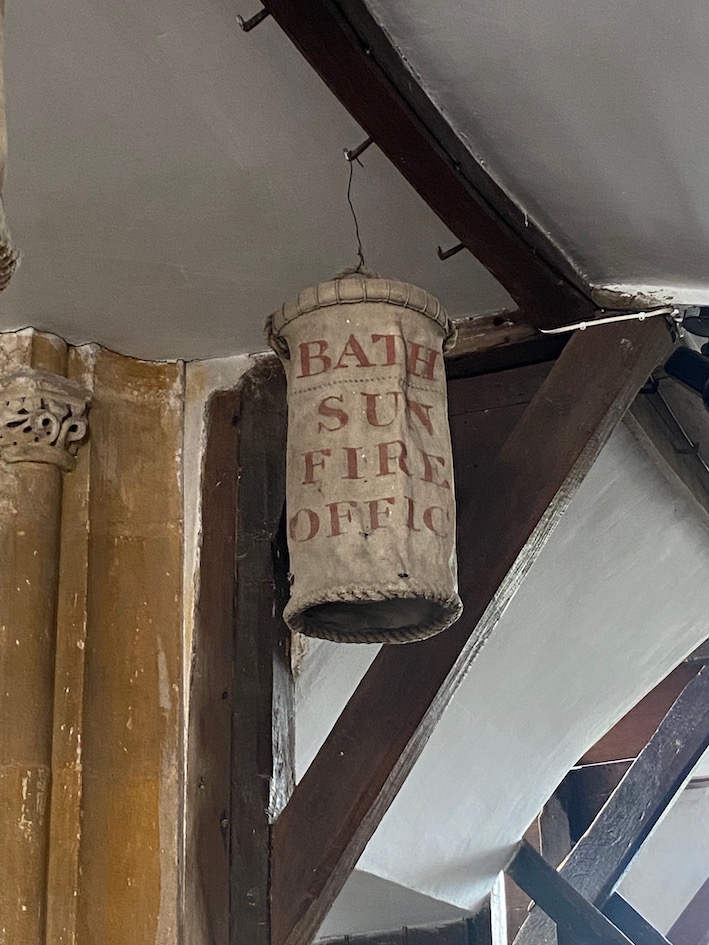
People who look carefully at old buildings will know all about the Sun Fire Office. It was an insurance company, founded in 1710, and it’s still going in a different form. It’s familiar to devotees of old houses because the company’s clients used to fix a metal plaque bearing the company name and symbol (the Sun in splendour, naturally) to the fronts of their houses. Then when the Sun sent out their fire-fighters, they would know you’d paid for the service and would attack the blaze with whatever equipment they had.
One aid to fire-fighting was provided by fire buckets filled with water or sand. One often sees bright red metal ones hanging on the platforms of stations on preserved railway lines. But back in the days when the Sun Fire Office first started, canvas buckets were also in use. I’d never seen these in a church before, but at Puddletown several remain, hanging from hooks under the west gallery. There are many more hooks than buckets, so perhaps originally there were more. More would be a good idea, as they’re not very large and a couple would not go very far when extinguishing a fire of any size larger than a smouldering pipe left in an absent-minded church warden’s pocket. These fire buckets now go on an informal list I keep in my head of fire-fighting equipment I’ve spotted in churches – fire hooks for removing burning thatch and the occasional rare hand-pumped fire engine are also included. All a far cry from today’s enormous fire engines with their turntables and ladders, but as welcome in extremis as their diesel-powered descendants can be today.
Showing posts with label sun. Show all posts
Saturday, September 4, 2021
Monday, July 9, 2018
Ripple, Worcestershire
Fear no more the heat o’ the sun
St Mary’s church, Ripple, has an impressive set of misericords, those medieval fold-up seats that have a ledge that protrudes when in the folded position, enabling tired monks or canons to lean while standing to say, or sing, the office. Twelve of them illustrate the labours of the months, but my photograph above shows one of the others, a rather splendid sun. It’s quite unusual for a parish church in a small village to have carved misericords like these, but Ripple church is quite surprisingly large. No doubt this is because it was in the Middle Ages a possession of the cathedral-priory of Worcester.
The carvings on the seats – vigorous and here quite deeply chiselled – are not the sort of great sculpture that the cathedral authorities would have used to adorn the walls and vaults of their great ‘mother church’ in Worcester. In contrast, they are typical of the vernacular work that one finds on misericords, and more than good enough for a monk to rest his bottom on, and for us to admire when in this summer’s searing heat we take refuge in a shady church, for the peace and the cool.
- - - - -
I have put a couple of other misericords from Ripple on my Instagram page @philipbuildings
Labels:
carving,
church,
Gothic,
misericord,
monks,
Ripple,
sun,
Worcestershire
Saturday, February 28, 2015
Bath, Somerset
In splendour
In England in the dark month of February, we long for the sun and regularly comment on its appearance or non-appearance, and constantly consult the weather forecast to track the possible parting of the clouds. (What did we do before the internet? Consult the weather vane, for one thing.) And when the actual sun is not out, we find images of him everywhere, on buildings especially.
Not all these images are literal. Back in the 1970s, the photographer Tony Evans produced a whole book, The English Sunrise, of stylized sunrise images – the sun’s rays suffusing Art deco stained glass windows, Albion truck badges, Young Farmers’ Club emblems, cinema facades, tins for gramophone needles or tobacco, and suburban garden gates.
Marvellous stuff as this is, one could make another compilation of portrayals of the sun fully risen and radiating heat and light through 360 degrees. The sun in splendour. You see him a lot, once you get your eye in. On pub signs and door knockers, for example. I’ve even seen him peeping from a capital atop a pilaster in Central Europe. But back home in England he’s as likely as not to be found on old fire insurance plaques – the ones people put on their houses to show that they’d paid their premium, without which, in the good old days, the firemen would not call in times of need. Here’s a lovely example from Bath: nicely modelled face; lively, wriggly rays; pleasant lettering. Splendid!
Sunday, July 20, 2014
Winchcombe, Gloucestershire
In the sun
My visit to Hook Norton reminded me that it was almost exactly seven years since I went there to look at the brewery. And, since my post about the brewery was my third-ever blog post, it’s almost exactly the seventh birthday of the English Buildings blog too. It’s hard to believe I’ve been maintaining this blog for so long, and that it has remained constant (though constant in its variety, I hope) through a period that has seen so much change: a global recession, the substantial reconfiguring of the industry (publishing) in which I work, the advance* of social media in such varied directions that mere blogging seems old-fashioned at best.
I’m not one for navel-gazing§ but it does seem to me that blogging still has something to offer me and my readers. Although my posts are rarely long, a blog does give one the space to say more than the usual Flickr caption, more than one expects to read on Facebook, more, of course, than a tweet.† And so for seven years and through nearly 700 posts I’ve set down my thoughts about many an English building, including a large number that have not otherwise been much noticed.
Amongst these unregarded pieces of architecture‡ have been, this year, a number of outstanding public lavatories, a few prefabs, some corrugated iron, a gasworks, and several odd things in churches. Among other things, I’ve weighed up the quality of lettering on buildings, gazed at gazebos, and pondered what we think about when we think about ruins. I’ve tried, then, to concentrate on the architecture that most books (and most people come to that) don’t notice or have time for and to show that even close to home there are things worth looking out for, and looking at.
John Russell,¶ who wrote so much and so well about art, and occasionally about places, in the 20th century, said that in wartime, the short journeys that were permitted by the restrictions of time, movement, and petrol rationing, could, in their way, carry just as much significance as the grander tours that were undertaken in more favourable circumstances. This blog, too, is in its way a testimony to the satisfactions of small journeys, the joys of the passing glance, and the glory of the ordinary. Thanks to those of you who've stayed with me on these wanderings, and also to readers who have joined me occasionally, for the interest of the ride. I've enjoyed, and benefitted from, your comments and nuggets of further information about the places I've visited. In the process, I hope I’ve given a lot of little known buildings some time in the sun.
- - -
Photograph: Door knocker, former Sun Inn, Winchcombe, Gloucestershire
- - -
*If you can call it that
§Not if the navel is my own, anyway
†I have a Twitter account, but cannot bring myself to do anything so avian as to Tweet.
‡ Pieces of architecture: I use this phrase in allusion and tribute to the great Nikolaus Pevsner, cataloguer and analyst of the buildings of England, who said, ‘A bicycle shed is a building, Lincoln Cathedral is a piece of architecture’. It’s because I talk so often about mere buildings that this blog has the title that it does, but readers will know that I often find the quality Pevsner attributed to architecture in ‘low-status’ structures such as public lavatories, sheds, and workshops.
¶ Not the most famous of art critics (too gentle and forgiving for many), but one whose work opened my eyes to the visual arts when I was young; I think his book on Bacon is still well worth reading, his Matisse Father and Son is fascinating, and Reading Russell, a selection of short pieces, gives an idea of how his writing enlivened the (London) Sunday Times and the New York Times for years.
Wednesday, August 21, 2013
Lyme Regis, Dorset
Here comes the sun
While I was at Lyme, most of the buildings that caught my eye were more substantial structures than the beach huts in my previous post. One of my favourites is this house on Marine Parade, facing the sea. It's a lovely building mainly of blue lias masonry and the design, with mullioned windows, decorative leadwork, emphatic bay, and rubble walls with dressed quoins and windows, suggests the hand of an architect who followed the Arts and Crafts movement. And so it proves. This house is the design of the Scottish architect Arnold Mitchell, who worked as a young man in the 1880s for Ernest George and Peto, one of the most successful London practices of the time, where he would have seen some stunning houses on the drawing board and imbibed a range of influences – Queen Anne, Arts and Crafts, Flemish revival, and so on. When Mitchell eventually set up on his own he had, from the evidence of this building, acquired some of George and Peto's assurance.
The house dates from 1903 and stands out from the white- and pink-washed buildings, mostly rather lower, that surround it, on some of which Mitchell also worked. It's a building that wants to insist that it's at home here, though – the wall at the bottom is studded with ammonites, one of the types of fossil that makes this place famous among palaeontologists. The most stunning feature, though, is the sundial. The glorious scrolling foliage and characterful head of Sol himself make this feature, generously large, stand out to the full. The lettering is good too, especially the motto at the bottom, which completes the frame. The whole relief is wonderfully fitting for this coastal setting, on a house looking confidentially out to sea.
Sunday, July 5, 2009
Ruardean, Gloucestershire

The nick of time
Some of the greatest pleasures are the unexpected ones. I went to Ruardean in search of a Norman carving above the church doorway. But before I got near the church itself I was struck by this inscription, which is on the inside of the small lychgate that forms the entrance to the churchyard. The sun lit up the lychgate’s stone wall as I looked at it and, since the resulting photograph is very contrasty, here’s the text for the sake of clarity and ease of reading:
Redeeme thy precious Time which steals So fast away
and in gods Hous forgiveness Ask, and for Salvation Pray.
May ye 10th 1743
James Mutlow & Hendrey Heane, Churchwardens
I don’t know where these words come from, but they are similar to those of Bishop Ken’s morning hymn, which he wrote in the late-17th century but redrafted later, so that there are several different wordings, one of which includes the lines
Thy precious time misspent, redeem,
Each present day thy last esteem.
Ken’s hymn was widely circulated in A Manual of Prayers (1709) and so would no doubt have been a familiar part of the religious landscape when this variation on the theme of redeeming time was carved. The words also look as if they would do for a sundial, and I felt it was appropriate somehow for the setting evening sun to bathe them in warmth in my photograph.
The other thing that caught my eye, of course, is the style in which the letters are cut, with the plain forms now and then garnished with something capricious and different – the capital T of ‘Time’ and P of ‘Pray’. And the final s of ‘churchwardens’ looks like a determined effort not to be broken by the last straw – the word might have been made to fit if the corner had not chipped off the stone. In the nick of time, as it were, the carver decided to stick the ‘s’ on top of the ‘n’. And call it a day.
Wednesday, July 9, 2008
North Cerney, Gloucestershire

The sun is a great visual friend to buildings. Under the warming influence of its rays old red bricks shimmer, windows become a patchwork of glittering reflections, and stone seems to change colour before our eyes. Along the limestone belt that stretches from Dorset to Lincolnshire, for example, stone that looks grey against a cloudy sky can warm up in the sunshine to the ‘honey-coloured’ appearance beloved of the guidebook writers, while the darker lias walls of parts of northern Oxfordshire and southern Northamptonshire turn a rich toffee shade, an architectural feast, indeed.
With the sunlight also come shadows. The crisp shadow lines made in the sun by the protruding bits of a building – stringcourses, pilasters, mouldings – define architectural shapes and rhythms. Shadows also reveal details that are easy to miss on a dull day. Recently I was out with a friend exploring his village church and churchyard. As we came out of the porch and glanced to our left a shaft of light illuminated an 18th-century gravestone. Suddenly its worn inscription, which had been virtually invisible before, was legible again. My friend quickly wrote down its words, capturing the outline of a life before the sun, and the dates, disappeared again.
At least on a gravestone we expect an inscription and know where to look. But the sun can also illuminate the unexpected. This creature is incised with a shallow line on an outside wall of the church at North Cerney, which lies between Cirencester and Cheltenham. It’s a beast called a manticore. Such animals are mentioned in the writings of Classical authors such as the Greek Ctesias and the Roman Pliny, and they are also described in medieval bestiaries. Manticores are meant to have the body of a lion and the head and shoulders of a man – although this example has feet that look like hoofs and a tail that bears a passing resemblance to that of a beaver. There is another at North Cerney, which has a more leopard-like body.
No-one knows why these beasts should be there. Monsters, it is true, are often depicted on the outsides of medieval churches. But they usually appear as small carved corbels not as shallow reliefs taking up more than a linear metre of wall. The best guess is that they are masons’ graffiti carved in the late-16th century, but we can’t know for sure. The sun, which can illuminate hidden lives and reveal fabulous carvings, can also raise unanswerable questions.
Subscribe to:
Posts (Atom)

