Showing posts with label vault. Show all posts
Tuesday, June 14, 2016
Wing, Buckinghamshire
Above and below
When I arrived at All Saints’ church, Wing, last week, a service was just finishing and I stood back while the parishioners chatted by the porch and gradually dispersed and made their way home. There was plenty to hold my attention, especially at the church’s east end, where I admired the architecture of the apse (in the foreground of my picture above) in particular. This unusual, seven-sided structure probably dates to the ninth century, which puts it on a par with the church at Brixworth (slightly earlier) and the tower at Earls Barton (slightly later) as one of the stand-out examples Anglo-Saxon architecture. The walls are decorated with narrow bands of stone (called pilaster strips) and blind arches – typical Saxon motifs – but the two big windows in this part of the church are later insertions. The apse would originally have had very small, single-light windows like the one remaining low down on the left, where the structure of the apse joins the later medieval aisle.
I knew from reading that this apse stands above a small crypt, and as I walked around the walls I could see the entrance to this crypt, protected by some iron railings (again just visible at the base of the apse walls in my photograph). I could see that the entrance was firmly locked. However, when I finally went inside the church I was greeted by the vicar and several parishioners, lingering after the service, and had an enjoyable few minutes’ conversation about the beauties and history of the building. At the end of this I was offered the chance to go down into the crypt, which was generously unlocked for me.
Descending a few stone steps, I found myself in a small space, vaulted and held up by massive stone piers. The rubble masonry and unplastered stonework make the space feel very ancient and primitive to modern eyes, and yet to design and execute the vaulting in this unusual polygonal space required some sophistication. The overall impression nonetheless is of ancient simplicity. It’s very hard for a non-specialist to date a structure like this. Experts think it may even predate the apse above, being part of an earlier church, and being modified when the upper part of the apse was built. Niches in the outer walls may have housed the remains of the church’s founders; the possible partial rebuild may have been to house holy relics (like those in the Saxon crypt at Repton), but it’s impossible to be sure about this.
I am sure, though, that I’m very grateful to those in the church when I happened to arrive the other day, for giving me access to this bit of history. The life of the inveterate church-crawler and building blogger is so often made more rewarding by the kindness of strangers.
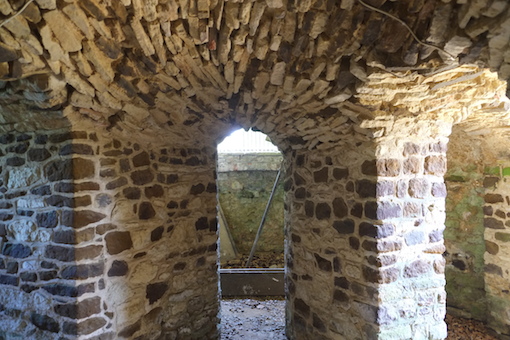
Crypt, All Saints’, Wing, Buckinghamshire
Sunday, June 29, 2014
Deddington, Oxfordshire
Survival and change
The parish church in the middle of Deddington, built of toffee-coloured stone like much of the town, is a mixture of periods, with notable details from the 13th, 14th, 15th, and 17th centuries. The 17th-century parts include the north porch, an example of the survival of a kind of Gothic into the period when much English architecture was turning Classical. The old antiquarians used to call this style ‘debased’, because it was a kind of mongrel mixture of traditional late-medieval Gothic with other elements that owed something to the new classicism – and the Gothic elements weren’t always very orthodox. The more current designation, ‘Gothic survival’, doesn’t do it justice either. Gothic has done more than survived: it has changed, sometimes in very interesting ways.
My photograph, of the roof of the north porch, shows, I think, some of this interest. The basic form is a shallow dome, but if this sounds like a classical kind of roof, there’s nothing classical about the details. The dome is finished with a network of ribs a bit like those in a fan vault – but forming a circle, not a fan. It’s almost like a rose window, with the glazed parts filled in with stone and the central part finished with the ubiquitous quatrefoil. By adding a trefoil at each corner, the circle is squared. The whole design is a telling example of the coming together of tradition and innovation, and the sort of quiet architectural surprise which keeps me visiting parish churches.
Friday, June 6, 2014
Malmesbury, Wiltshire
Now and then
The entrance to Malmesbury Abbey contains some of the most celebrated Romanesque sculpture in England but, in this blog’s spirit of searching out the unregarded, I’m featuring today not the great carvings in the porch, but one of the bosses from the ceiling in the church itself. I’m not claiming greatness for this carving, just suggesting that bosses can give pleasure if we take the time look at them – armed perhaps with what their medieval creators could not have imagined, a pair of binoculars or a camera with a telephoto lens.
This boss, then, is not a great piece of carving, but has some nice touches, such as the swirling hair and flanking leaves, to compensate for the rather small mouth and lack of modelling around the chin. I don’t know who it portrays – some say that it represents Margaret of France, second wife of Edward I. Margaret died in 1307 and the vault is early-14th century, so that’s a possibility. She was not formally crowned, so the carving’s lack of a crown doesn’t mean it cannot portray her.
The other interesting feature of the boss is the colour. I believe this was added during a restoration in the 1920s, but the yellow and terracotta shades and the gilding are probably not too far from the medieval colouring. However the overall effect is more modern somehow. Is it the blushing cheeks? Or the use of flesh tones that make it look as if the subject has naked shoulders? Whatever the case, the carving is now an interesting hybrid, part of the evolving and transforming history of the building that contains it.
Labels:
abbey,
boss,
Gothic,
Malmesbury,
Restoration,
stone,
vault,
Wiltshire
Subscribe to:
Comments (Atom)
