Showing posts with label Droitwich. Show all posts

Thursday, October 13, 2022

Droitwich, Worcestershire


Transformations

The walk around Droitwich that inspired this and the previous post was only my second visit to this town, the previous one being many years ago. As a result, the building above took me completely by surprise: I didn’t remember it at all, yet surely if I’d seen it I would have recognised it. The reason is that until recently its facade was hidden behind a wall of rendered brickwork: there was little hint that there was a timber-framed structure behind. Recently, this timber-framed building, actually the wing of a much larger house, has been conserved, and the later brickwork removed.

What was left behind the brickwork was not much at ground-floor level: three stout timber posts, which supported a largely complete wooden structure above. The restoration involved building new woodwork to go between the posts and repairing the upper storeys. This work is now largely complete, producing an attractive wood-framed frontage, wholly appropriate to the structure of c. 1420 of which it is part. The transformation is remarkable, a tribute both to the original builders and to the 21st-century architects, craftspeople, campaigners, and funders who made it possible: hats off to all.

The building now visible is the solar wing of the house: that’s to say the wing containing the private living apartments of the original owner. Adjacent one would expect to find a more ‘public’ or formal room, a great hall. What is left of the hall is in the building to the right. It is said to be even older that the wing in my photograph, but is disguised by a later facade, just as the now restored wing was until recently. This building would originally have contained a large, full-height hall, with no first floor, although, as is clear from the frontage today, it now has an inserted upper floor. I don’t know whether there’s enough of the ancient structure to warrant a refurbishment like that given to its neighbour. Such an ancient hall would be more remarkable still.

Sunday, October 9, 2022

Droitwich, Worcestershire

Salt and vinegar?

English Buildings: all architectural life is here, from cathedrals to parish churches, even unto the Droitwich Spa Fish & Chip Bar. I took this picture because it seemed to me a very clear illustration of a problem that became pervasive in Droitwich, leading to a major change in the economy in the late-20th century. The problem is obvious enough: subsidence, which occurs when the ground under a building sinks, causing the foundations and also the above-ground structure to move, leading to cracks, sloping floors, wonky walls, all kinds of structural chaos. The cause is less obvious. Subsidence occurred here because of the extraction of brine from the large underground deposits beneath the town.

Beneath Droitwich are large deposits of rock salt. When surface water penetrates the ground it dissolves the salt, producing the liquid called brine. By pumping the brine to the surface and heating it, people produced salt in huge quantities, for Droitwich’s brine contains around ten times as much salt as sea water. So brine extraction became a major industry in Droitwich and nearby Stoke Prior (there are more salt deposits in Staffordshire, Lancashire, and, especially, Cheshire).

Salt-working in Droitwich grew to a large scale in the 17th to 18th centuries, and continued through the 19th. By the 1920s, large-scale working in Cheshire and elsewhere sent the Worcestershire industry in decline, continuing on a small scale. But by this time, the damage to buildings had already begun. The resulting damage was a further nail in the coffin of the salt works, and by the late-20th century, brine extraction in the town had ended. Some buildings still show obvious signs of the damage caused by subsidence but none, I think, quite so clearly and outwardly as this one. It’s drastic, but the building still seems to serve up England’s traditional fast food. Salt and vinegar anyone?

Wednesday, December 28, 2011

Droitwich, Worcestershire


One more from Mr Pippet

I wanted to show you one more mosaic from the church of the Sacred Heart and St Catherine of Alexandria, Droitwich, the building that featured in the previous post. This image of St Philip shows the Apostle carrying bread, having been present at the miracle of the multiplication of loaves and fishes (the “feeding of the five thousand”). According to St John's Gospel, Philip remarked of Jesus’ five thousand followers that, “Two hundred pennyworth of bread is not sufficient for them, that every one of them may take a little.” The mosaic is also remarkable for the surrounding leaves and fruit, plus the charming population of birds with which the designer, Gabriel Pippet, enlivened the areas around the saint’s portrait.

Happy New Year to you all.

Friday, December 23, 2011

Droitwich, Worcestershire


Peacock and Pippet

I hope this blog has brought some interest and pleasure to my readers this year and that some at least of the pleasure has come from unexpected sources. I like to think that quite a lot of what I bring you is out-of-the-way stuff, buildings that are little known outside their immediate neighbourhood and passed over by the standard architectural histories. My subjects interest me for all sorts of reasons but the ones I like best are notable aesthetically while also throwing some light on the past – on social, industrial, or commercial history.

So this year we’ve had, among other things, village lockups, in which quirky architectural form embodies past notions of crime and punishment; factories, in which low-cost, utilitarian architecture survives (sometimes by the skin of its teeth) to tell the stories of past industries; and shop fronts, in which former fashions in display reveal something about the ways in which retailers liked to catch the attention of customers. All very revealing and often surprising too.

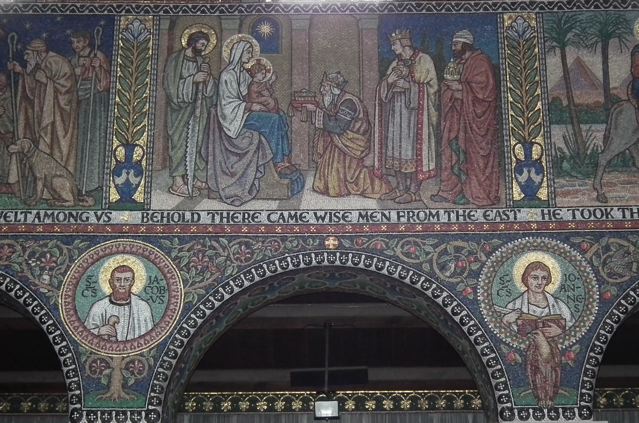
Christmas, though, is a time when surprises come in traditional packaging. This fact came into my mind when I was looking at a building that combines tradition with surprise: a 20th-century Byzantine-style church…in Droitwich. The Catholic Church of the Sacred Heart and St Catherine of Alexandria, designed by Barry Peacock, is based on the form of early Christian basilicas. The long nave, with its rows of seven arches, its small apse housing the high altar, its carved capitals, and, above all, its mosaic decoration, shows the influence of the great early churches of Constantinople and, especially, Ravenna.

Most of the mosaics were designed by Gabriel Pippet and executed by mosaicist Maurice Josey. Their subjects are various – one group tells the story of St Richard de Wyche, Droitwich’s saint; another depicts scenes from the life of the Virgin, including the Annunciation, the Nativity, and the Flight into Egypt. There are also portraits of saints and fathers of the Church – St Catherine’s mosaic in the apse of her little chapel is especially good. The details in these mosaics are beautiful. Interweaving plants and little groups of birds fill the gaps between the figures and narrative panels. Gold tesserae glitter. Even on a dull day in Droitwich, this lovely work of the 1920s catches the light like the mosaics of Ravenna in the Italian sunshine.

Season's Greetings to all my readers.


St Catherine, Church of the Sacred Heart and St Catherine of Alexandria, Droitwich