Showing posts with label mosaics. Show all posts

Thursday, March 26, 2020

National Gallery, London


‘You’re the National Gallery, You’re Garbo’s salary…

…You’re cellophane…’ says Cole Porter in the song ‘You’re the top’,* rustling up superlatives, but keeping part of his tongue in his cheek.§ One of the superlative stars of the Boris Anrep mosaics in the National Gallery foyer is Melpomene, the muse of tragedy, whose face – and hairstyle – are based on those of Greta Garbo. Garbo was so famous for being famous, so well known for being able to name her price when it came to a starring role in a movie, so notorious for wanting to reject the trappings of fame (‘I want to be let alone’†), that it’s easy to forget how good an actress she was. Boris Anrep, who had an eye for female beauty, must have found her face captivating but, an artist himself,. no doubt responded to her art too.

A couple of weeks before the virus made travel unwise, let alone proscribed, I spent a short while in the National Gallery looking at some Dutch paintings, and made what has become a habitual stop to look at the mosaics on my way out. They have become for me one of the symbols of what this blog is about. That’s to say, they’re not architecture, but one of the adjuncts to or enhancements of architecture; they’re fun and a bit whacky (people playing cricket and Christmas puddings sit near Apollo and the Muses), and they’re not much noticed.

Now the gallery routes visitors in via another entrance, the mosaics are on the way out and people think as they leave that they are done with art and are making singlemindedly for the door. When people did come in this way, they were heading singlemindedly for the galleries, so didn’t notice the mosaics then either. Now of course the gallery is closed to visitors, no one sees them at all and Garbo, along with Anrep’s other models (Virginia Woolf, Anna Akhmatova, Edith Sitwell, Bertrand Russell, and the rest), are let alone at last.

- - - - -

* From the musical Anything Goes, 1934.

§ Cellophane? Well, although it was invented in 1908, Cellophane was only licensed for US distribution in 1923. An enhanced version of 1927 made it waterproof and suitable for wrapping food. So in 1934, when the Porter song appeared, it was still a modern wonder-material.

† Which everyone remembers as ‘I want to be alone,’ because the actress was later given this line in the film Grand Hotel. Thanks to the Resident Wise Woman, my go-to authority on Garbo (and much else) for helping me get that straight.

Monday, February 6, 2017

Tottenham Court Road, London


Murals on the move

One would have to be unobservant (or very lucky) to have spent any time in Central London over the last few years and not come across the Crossrail development. This enormous underground engineering project has disrupted the capital in all sorts of ways, and one of the centres of this disruption is the complete rebuilding and massive expansion of Tottenham Court Road underground station.

One thing that I’ve been aware of for some time is that the unique and very special tiled decoration by Eduardo Paolozzi is being altered in the process. These murals are perhaps the greatest work of public art by this pioneer of Pop Art, a riot of colour* in the sometimes dull world of the underground, and, at about 23 years old, part of our history already. Some parts of the station with Paolozzi tiles are being demolished or rebuilt, so some sections of the mural have been removed to Edinburgh, where the National Galleries already have a large Paolozzi collection and where Paolozzi was a student and, later in life, a teacher. The rest of the tiles are being cleaned, restored, and in some cases moved from one part of the station to another.

This has been done with great care, and the video to which I link below, produced by Transport for London, shows something of the enormous effort in planning, engineering, and work involved. True, part of the intention of the video is PR for TfL. But it shows that the professionals who have worked on the project are just that, professionals, and their devotion to the project, their commitment to the murals, and the pains they have taken shine through. What’s more, the video gives a better impression of this enormous work of art than I can in one or two photographs. The artist’s feel for colour, his sense of musical and visual rhythm and syncopation, his inspiration from all kinds of places and things from jazz to sweetshops, is vividly caught. This station is going to be impressive and the Paolozzi murals will play their part. And that will be some recompense for the inconvenience that, as they say, this work may have caused.


- - - - -

*And a feast of monochrome pattern on the Northern Line platforms.

Sunday, April 28, 2013

Buckland, Berkshire*


'Oh ye whales…

…and all that move in the Waters, bless ye the Lord: praise him and magnify him for ever.' The words of the Benedicite (and also those of the Te Deum) are inscribed around the walls of the south transept of St Mary's church, Buckland, forming a key element in a striking decorative scheme. The transept was redecorated in the early 1890s  with a stunning mixture of mosaic and opus sectile work (the latter a technique of building up designs or pictures using larger pieces of inlay that the tiny tesserae employed for mosaic). The scheme was paid for by William West of nearby Barcote Manor as a memorial to his wife. The decorations were designed by Henry Holliday, a painter, designer, socialist, women's suffragist, and associate of the Pre-Raphaelites who continued to work in the Pre-Raphaelite vein well after the heyday of the movement.


High up on the walls are mosaics of saints beneath ornate canopies, but at least as eye catching are these diamond-shaped panels illustrating those beings and phenomena – the lightning and clouds, the fowls of the air, the beasts and cattle, and, of course, the whales, that are exhorted to praise and magnify the Lord. Each small picture combines pale stone laid out in opus sectile with glittering mosaic used for the sky. The earth and its creatures are lovingly and carefully delineated, and the heavens are filled in in dazzling gold.

- - -

*Buckland is now in Oxfordshire, but I use the traditional English counties because they reflect the usage in Pevsner's invaluable Buildings of England books – and because I like them.

Wednesday, December 28, 2011

Droitwich, Worcestershire


One more from Mr Pippet

I wanted to show you one more mosaic from the church of the Sacred Heart and St Catherine of Alexandria, Droitwich, the building that featured in the previous post. This image of St Philip shows the Apostle carrying bread, having been present at the miracle of the multiplication of loaves and fishes (the “feeding of the five thousand”). According to St John's Gospel, Philip remarked of Jesus’ five thousand followers that, “Two hundred pennyworth of bread is not sufficient for them, that every one of them may take a little.” The mosaic is also remarkable for the surrounding leaves and fruit, plus the charming population of birds with which the designer, Gabriel Pippet, enlivened the areas around the saint’s portrait.

Happy New Year to you all.

Friday, December 23, 2011

Droitwich, Worcestershire


Peacock and Pippet

I hope this blog has brought some interest and pleasure to my readers this year and that some at least of the pleasure has come from unexpected sources. I like to think that quite a lot of what I bring you is out-of-the-way stuff, buildings that are little known outside their immediate neighbourhood and passed over by the standard architectural histories. My subjects interest me for all sorts of reasons but the ones I like best are notable aesthetically while also throwing some light on the past – on social, industrial, or commercial history.

So this year we’ve had, among other things, village lockups, in which quirky architectural form embodies past notions of crime and punishment; factories, in which low-cost, utilitarian architecture survives (sometimes by the skin of its teeth) to tell the stories of past industries; and shop fronts, in which former fashions in display reveal something about the ways in which retailers liked to catch the attention of customers. All very revealing and often surprising too.

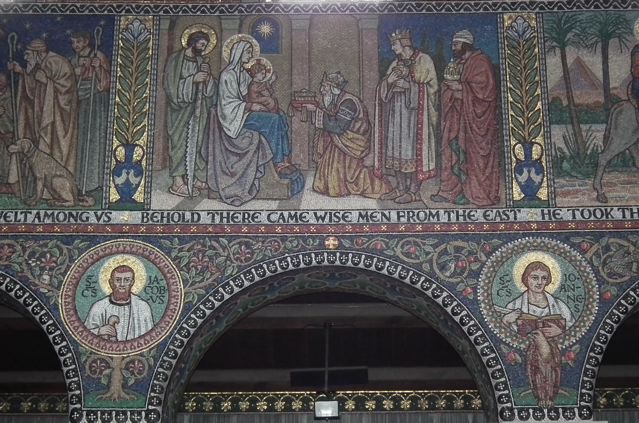
Christmas, though, is a time when surprises come in traditional packaging. This fact came into my mind when I was looking at a building that combines tradition with surprise: a 20th-century Byzantine-style church…in Droitwich. The Catholic Church of the Sacred Heart and St Catherine of Alexandria, designed by Barry Peacock, is based on the form of early Christian basilicas. The long nave, with its rows of seven arches, its small apse housing the high altar, its carved capitals, and, above all, its mosaic decoration, shows the influence of the great early churches of Constantinople and, especially, Ravenna.

Most of the mosaics were designed by Gabriel Pippet and executed by mosaicist Maurice Josey. Their subjects are various – one group tells the story of St Richard de Wyche, Droitwich’s saint; another depicts scenes from the life of the Virgin, including the Annunciation, the Nativity, and the Flight into Egypt. There are also portraits of saints and fathers of the Church – St Catherine’s mosaic in the apse of her little chapel is especially good. The details in these mosaics are beautiful. Interweaving plants and little groups of birds fill the gaps between the figures and narrative panels. Gold tesserae glitter. Even on a dull day in Droitwich, this lovely work of the 1920s catches the light like the mosaics of Ravenna in the Italian sunshine.

Season's Greetings to all my readers.


St Catherine, Church of the Sacred Heart and St Catherine of Alexandria, Droitwich