Showing posts with label Lower Brockhampton. Show all posts

Tuesday, August 6, 2024

Lower Brockhampton, Herefordshire

Belt and braces

Looking at the timber-framed late-medieval gatehouse at Lower Brockhampton (see previous post), I was struck by the number of burn marks on the framework. These marks, variously described as tear-shaped or tadpole-shaped, were once said to have arisen from candles or tapers used for lighting. These lights, held on brackets or ‘prickets’ (spiked fittings stuck into the wood), scorched the timber, so it was said. Recent researchers question this. Putting a candle near a piece of timber does not seem to produce a mark of this shape.* There are no holes made by prickets, no fittings for missing shelves or brackets near these marks. What’s more, many burn marks are in places where you’d be unlikely to place a light – on the back of a door, the outside of a wooden shutter, on roof timbers, and so on. In addition, to make a mark of this shape, so experimental archaeologists have found, it’s necessary to hold the taper at a 45-degree angle to the wall. All of these reasons make it unlikely that these burn marks were the accidental side-effects of lighting, and more likely that they were deliberately made.

A convincing explanation is that burn marks are protective – some sources describe such marks as ways of protecting a place from fire. There are also traditions that fire can ward off evil spirits. The frequent location of burn marks near fireplaces and hearths, or adjacent to doors and windows, seems to align with these ideas. We are, once again, in the realm of ritual protection marks, as we are with incised ‘daisywheel’ designs and other motifs. A gatehouse, as at Brockhampton, is just the kind of place where you’d expect to find such protective marks. Whereas the water of the moat might be used in attempts to put out a fire if one broke out, protective burn marks might, if was believed, prevent one starting in the first place. Belt and braces.

- - - - -

* In this very brief account I’m indebted to the excellent recent book by James Wright, Historic Building Mythbusting, which I hope to review here very soon.

Burn marks on timber, Lower Brockhampton

Thursday, August 1, 2024

Lower Brockhampton, Herefordshire


Good manors

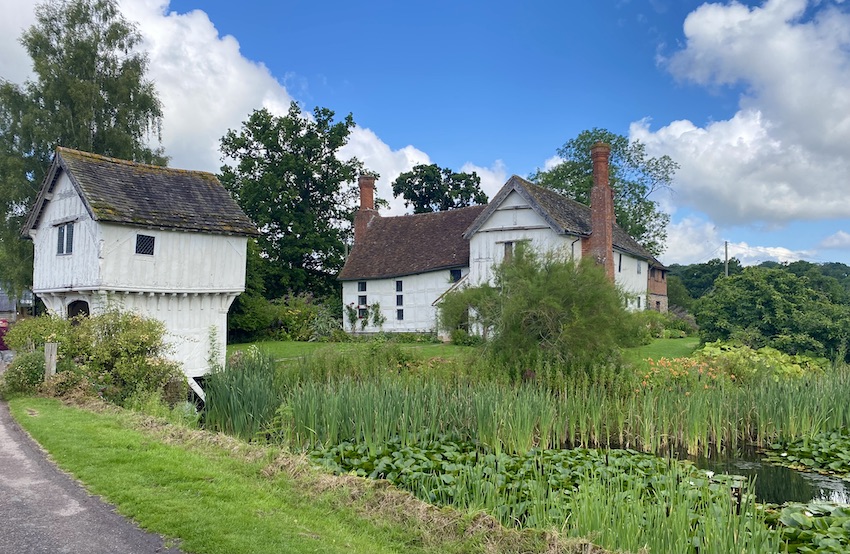
The other day the Resident Wise Woman and I visited the Brockhampton estate, the National Trust property near Bromyard in Herefordshire, to look at the delightful 15th- and 16th-century timber-framed manor house. Few late-medieval houses are as picturesque or enjoy such a beautiful setting, as this one. It’s not a large building by manor house standards, but it’s full of interest. From the outside, the house is almost completely surrounded by a moat lush with plants. The moat must originally have completely surrounded the house, but now, just beyond the point where the gatehouse bridges the water, the moat ends. It would never have been able to withstand much of an attack, since the wooden gatehouse would have been easy for an enemy to take. But the watery barrier and gatehouse did presumably form a barrier to burglars. Perhaps more importantly, moats and gatehouses were marks of lordship, rather like the battlements sometimes seen on stone manor houses that were never intended to withstand a siege. A moat, in other words, was a status symbol.

The left-hand part of the main house contains the double-height hall, the heart of any medieval dwelling. To its right is a cross-wing, which would have contained a private room (known as the solar) for the owners on the upper floor, with service rooms below. In the 17th century the service wing was extended to the rear in a mixture of materials – stone below, timber frame with brick infill above. This extension is just visible in my photograph. Other modifications include the two substantial brick chimneys, also dating to the 17th century,.

How to furnish and display an old house is a recurrent question for custodians such as the National Trust. Sometimes there’s an obvious heyday, as with a great house like Hardwick Hall, where the story of its remarkable and charismatic builder, Elizabeth, Countess of Shrewsbury (aka Bess of Hardwick), demands to be told. Sometimes the emphasis is more likely to fall on a later period in a house that evolved over centuries. In the case of Lower Brockhampton, the decision has been made to make different rooms evoke different periods in the long history of the house. The historical spread extends from a 17th-century bedroom, through the Georgian and Victorian periods, to a living room arranged as it was in the 1950s, when the last private owners stayed on as tenants after giving the estate to the Trust. To my mind the success of this is mixed, but it does bring to our attention some of the people who have lived at Brockhampton. Particularly poignant are a room furnished as the bedroom of a young man about to set off for the trenches of World War I and, in another room, a 20th-century owner’s diary, open at a page where he records news from Europe of the gathering storm that would result in World War II – a protest to the League of Nations about Germany’s remilitarisation of the Rhineland is noted. It’s an obvious point, but it doesn’t hurt to be reminded that old houses of beauty and architectural interest could not exist without people, and that without some of those people some of us might very well not be here.