Showing posts with label Aldeburgh. Show all posts

Thursday, November 27, 2025

Aldeburgh, Suffolk

Tower of strength

In the Napoleonic era, Britain feared a French invasion and between 1796 and 1815, a string of 103 towers were built along England’s south and east coasts, to house soldiers and guns to help protect the country from attackers. These fortified structures were known as Martello towers, a name that derives from a defensive tower on Punta Mortella in Corsica – the name of the original got misspelled and the misspelling stuck.* Martello Towers are generally elliptical in plan and brick built. The total height was 33 feet and diameters varied from 45 to 55 feet. The walls were up to 13 feet thick and it has been estimated that around 700,000 bricks were used in each tower. One or more cannon were mounted on a rotating platform on the roof. The two floors below provided accommodation for soldiers and stores.

I was reminded of all this the other day when in Aldeburgh. I’d not visited its Martello tower, the most northerly of the British network, since my first visit to the town, years ago. decided to walk south along the beach to the tower, which when it was built was not thought of as being in Aldeburgh at all, but in the lost village of Slaughden, which later succumbed to the coastal erosion that is such a challenge to life on many parts of the East Anglian coast. I wanted to have a look at the tower again because it’s unique in England’s series of such towers, being built on a quatrefoil (or four-leaf clover) plan.¶ This gives it a different look from the other towers and also allows a different set-up for the guns on the roof – there were at first two, then four guns, one for each ‘lobe’ of the quatrefoil. Inside, the upper floor provided accommodation (for eight soldiers, five NCOs and a commanding officer), while the lower floor was for stores containing food, fuel, and gunpowder, the latter kept on the landward side and reached from a separate stair.

When, in the 1930s, the Ministry of Defence decided the tower no longer had any military use, they sold it to private owners who converted it to a dwelling by adding a studio on top. This, however, fell out of use and both the addition and the tower deteriorated. The Landmark Trust acquired the tower in 1971 and converted it for use as holiday accommodation. The Trust have made their usual good job of restoring the building carefully and fitting it out to provide a comfortable (if, on this occasion, unconventional) holiday let.† Whether you want to stay in it, or just admire it from the outside, it’s an impressive testament to the efforts of both the original builders and those who saved it from its slide into decay.

- - - - -

* The Corsican tower, manned with a garrison of 38 and just three guns, withstood an attack by two British naval ships (with a total of 106 guns). The British clearly thought they could learn something from this.

¶ This larger and more complex plan suggests that the structure may contain at least one million bricks.

† I am indebted to the Landmark Trust’s website for information about the tower’s history.

Thursday, March 18, 2021

Aldeburgh, Suffolk


Clothes from the Butcher

This is a special sort of shop in Aldeburgh, a business that has been in the town since the 19th century with a fine shop front dating to the 1930s. It’s an old-fashioned Ladies and Gentlemen’s outfitters. Not a clothes shop, or a boutique, or a purveyor of leisure wear: an outfitters. The sort of place where you could buy a proper waxed jacket, or a tweed overcoat, or just a pair of braces. Traditional clothes that will last for years – and when they do start to wear out, you can mend them, or even send them to be mended. There’s much to be said for such places although it also has to be said that these days, they’re mainly the preserve not simply of the old, but of the rich.

But, to the architecture. I like this shop front because it exemplifies something that was once the latest trend in retailing: the deep lobby. The idea was that there would be a broad opening along which you can walk, but instead of reaching the front door immediately, you’d pass more display windows, showing yet more goods to tempt you. There might even be a central island display, fully glazed, in the middle of the lobby, around which you’d be forced to walk, seeing yet more tempting goods as you went. All of which meant that the further you went in, the more likely you were to push the door and enter the shop proper and spend money.

Marvellously, at O. and C. Butcher’s of Aldeburgh all this is still here, and it culminates in separate doors for Ladies and Gentlemen, so that the former can cut straight to the chase without getting tangled up in shirts and braces, while the gents can avoid thinking about ‘foundation garments’ and find what they want with ease. The lettering in stained glass above the doors is Art Deco and very characterful, both the slightly stretched capitals of ‘Shoes’ and the pleasant mixture of ramrod-straight uprights and generous curves on display in ‘Gentlemen’s Outfitting’. It really was almost enough to make me blow my savings on a tweed overcoat.


Monday, March 15, 2021

Aldeburgh, Suffolk


 A convenient place of refuge

I was born in Lincolnshire, and therefore know what it’s like to walk along a beach in winter in a howling easterly wind, when you have mixed feelings if the top of your ice cream is blown away because the weather was really too cold for you to be grazing on such delights. A cup of good hot strong tea is more to the point. East-coast seasides need some shelters, so you can drink your tea or just get out of the wind, and they know this just as well at Aldeburgh, Suffolk as they do in Skegness, Lincs (famously ‘so bracing’) or anywhere else.

This shelter is not far from the Moot Hall in my previous post and that bit of patterned brick nogging, low down between the timber uprights, is a sort of homage to genuinely old buildings like the Moot Hall. I suppose this shelter is 20th-century – maybe it was built in the interwar period, although the nogging, with its pristine pointing, looks like a recent repair, and the whole thing could be post-war.* But its age doesn’t matter. It’s not unsightly, incorporates public lavatories, and provides a useful refuge. Good enough for me.

- - - - -

* However, looking at old photographs, there doesn’t seem to be anything on the site of the shelter in 1910. Another image labelled ‘interwar’ includes it.


Thursday, March 11, 2021

Aldeburgh, Suffolk


Being moved in Aldeburgh

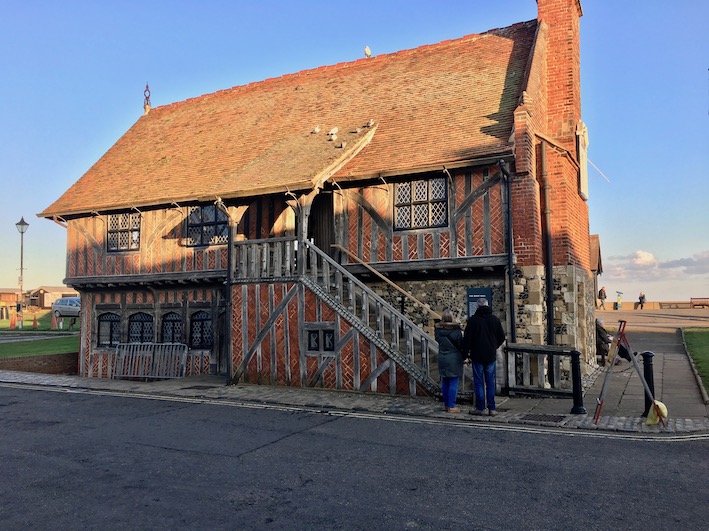
The couple of times I have been in Aldeburgh, I’ve wished the sun was on this side of the Moot Hall, better to show off the beautiful timberwork of the staircase – and I’ve resolved to return another time, earlier in the day, when this west-facing wall would be in better light. The next time was to have been November 2020, but Covid put paid to that. So when I look back at my Aldeburgh photographs, they have a special poignancy and bring with them thoughts of ‘maybe later this year…maybe next’.

The Moot Hall has other resonances for me. First, built in c. 1520 and altered in 1654, it’s a glowing example of Tudor and Stuart timber-framing, stonework and brickwork. There was a restoration in the 1850s, when a lot of the brick nogging* was replaced (the lower floor nogging and the gable end are mostly Victorian, the upper floor 17th century). The external staircase was restored in the 19th century too – but very much as it would have been. It’s not hard to imagine the people of Tudor or Stuart times holding their market downstairs and having town meetings in the upper room. Back then it would also have been even more of a local landmark than it is now, a village hub right on the beach, as close to the sea as the lives of nearly every Aldeburgh citizen would have been.

The Moot Hall is also one of the settings of Benjamin Britten’s opera Peter Grimes, the work that marked his comeback to Britain after a spell in the USA – and which changed the direction, decisively and beneficially, of English opera. The opera’s Prologue is set in the Moot Hall and the work’s plot and music are soaked with the sea – the fate of Peter Grimes and his doomed apprentices is bound up in the sea, and Britten’s music resonates with it, evoking storms and calms alike.† The composer himself, an Aldeburgh resident for much of his life, must have seen the sea most days, looked at it, listened to it, swam in it – and it shows in his music.

A building like this must have many meanings for those who look at it. I’ve simply described what it means – personally, architecturally, musically – to me. They’re the reasons, if you like, why it moves me. Ian Nairn, one of England’s greatest writers about buildings and places, said that in writing his book about London he wanted simply to record, ‘what has moved me, from Uxbridge to Dagenham’.§ That’s one of my aims, when I write this blog, though one can only dream of matching Nairn’s aim with his insight.

- - - - -

* Nogging is the architectural term for brickwork that is used to fill the spaces between the wooden posts and beams of a timber frame. The bricks are sometimes laid in an ornamental pattern, as they are here.

† One way to appreciate this sea-music, especially if you don’t like opera, is to listen to the four orchestral Sea Interludes (‘Dawn’, ‘Sunday Morning’, ‘Moonlight’, and ‘Storm’) that are played during the opera and can be performed separately from it. There are performances on YouTube, including this one.

§ One of my blog posts on Nairn is here.


Thursday, June 25, 2020

Aldeburgh, Suffolk


Kinematic

What does a cinema look like? If you have an image of a ‘typical’ cinema in your mind’s eye, it might look like something from the interwar period, maybe an Art Deco monster cinema like the one in Balham that I posted not long ago, or a structure adorned with decoration evocation the glamour of the cinema, such as the pair of naked women circled in strips of celluloid that once signposted a cinema in Cheltenham. Or, these days, it might be one of the anonymous town centre multiplexes of which only the front door and a panel of posters is visible.

But there is no ‘standard’ cinema design. People project films in all kinds of settings. In the small Cotswold town where I live, there was once a cinema in the Town Hall, whereas Woodhall Spa, a small town in Lincolnshire, is home to the Kiinema in the Woods, a surprising and picturesque former sports pavilion. The cinema in Aldeburgh is similarly surprising, a half-timbered building, small enough not to look at all out of scale in the town’s lovely main street. But it’s not exactly discreet – the half-timbering means it’s easy to find and gives it that touch of whimsy that has seen its larger cousins dressed up in a 1930s version of ancient Egyptian or Grecian garb.

The building is also one of the oldest cinemas in continuous operation. It began in 1919,* when an existing shop was extended to house the auditorium, and, like many an early cinema, has also hosted live theatre shows. The cinema has kept going with a mix of feature films, ‘art house’ screenings, and even, recently, a documentary festival. It also caught on early to the recent trend for offering ‘live’ screenings of major theatre and opera productions. So, what do you think of when someone mentions Aldeburgh? Benjamin Britten? Maggi Hambling? Fish and chips? Festivals of music or poetry or comedy? Perhaps film should be on the list too. Although I didn’t make it inside when I visited Aldeburgh late last year, the cinema still seemed to be thriving, with the very active support of the local community. And I hope, when normal conditions eventually resume, it will thrive again.

- - - - -

* The Lumières’ first public screening was in 1895.

Tuesday, January 28, 2020

Aldeburgh, Suffolk


Sea views
I suppose I'm not the first person to notice that there have evolved, over the years, certain styles of house that seem especially at home at the seaside. I’ve noticed before the pastel shades that people like to paint buildings and beach huts in towns like Lyme Regis, and how resorts such as Brighton favour houses with big bow windows to let in plenty of light and offer good views – sea views preferably, but any view of a pleasant street or a garden is better than none. At Aldeburgh and other towns on the east coast, there seems to be a preponderance of bay windows and white-painted wooden balconies.

In a house like this you can sit out and watch the sea, or the comings and goings on the path below, or if you don’t want to sit out, you can safely throw the French windows open to let in fresh air, the sounds of people enjoying themselves on the sea front, and the salty smell that pervades the atmosphere. There may be no front garden, but you can enjoy a sense that the whole sea front is your garden. Places like Aldeburgh have been the scene of such enjoyable idling since the early-19th century. There is much, of course, for the architectural idler to admire. I was struck, when taking in these houses, by the curvaceous gable revealed when you look from this angle. If that seems a little Dutch, this coast has long had contact with the Low Countries, and both bricks and some of the architectural styles that went with them across the sea were imported to East Anglia before local brick-making was reestablished on a large scale.

Nowadays most people come to Aldeburgh for recreation, and most of the town’s businesses seem connected one way or another with tourism. But as you walk along the beach, notice boats pulled up on the shingle and see a tarred and weatherboarded shop selling fresh fish,* you’re reminded that this was once a thriving fishing port and there is still some fishing here. So sea views must once have been useful to those looking out for the arrival of boats with their catches. If I mourn the decline of these local fishing industries (as I also do of those in my native Lincolnshire), I’m grateful that towns like Aldeburgh still thrive.

- - - - -

* Or enjoy some of the excellent fish and chips available here.

Friday, January 24, 2020

Aldeburgh, Suffolk


Upstairs

Watching my aged mother-in-law, a few months before the end of her life, bravely tackling the two steps up to our front door, and seeing the immense effort this entailed, has made me think a little differently about steps. I’ve lived places four or five floors up without a lift, and thought little of it, but now I’m grateful that there are only two steps at our door and, although there are stairs up to our bedroom floor, they’re shallow and kind to the legs. The entrance to the house in my photograph is very different, and unusual. Those eight steps lead up to a front door that seems to be midway between the upper and lower floors, an eccentric arrangement for a house, but not uncommon in a public building such as a custom house, which this once was.

Aldeburgh, by the sea, would once have had use for a custom house, and this one is on the main street and not very far from the waterfront. Apart from those steps, the architecture of this early-19th century structure is very plain – just a panelled central door and those four large multi-pane windows, the one on the lower right provided with a second front door at a more practical level. Pantiles, typical of this region, make a roof that looks very much at home. But the simplicity, with that touch of the grandiose provided by the steps, must make for an agreeable house. And although it’s plain it’s easy to recognise: long live individualism!

Friday, November 29, 2019

Snape, Suffolk


Was it for this the clay grew tall?

Another memorable visit we made when in Aldeburgh for the poetry festival was to Snape Maltings, five miles up the road from Aldeburgh itself. We went to Snape not for the music for which it is now so famous but for the architecture, for a coffee, and for an exhibition which made a deep impression on us both. The architecture is on such a large scale that I managed to drive past the entrance, in anticipation of yet more wonders of brick, slate, and weatherboarding. But I soon managed to turn round, park, and take in this complex site – there are about seven acres of buildings, apparently.

The place owes its scale to Newson Garrett, son of the Garrett engineers of my previous post. Newson Garrett bought the site in part because of its position on the Alde estuary: there was a port of some significance in the Victorian period. By the early 1850s he was in the business of malting, and was shipping huge tonnages of malt to breweries around the country, especially to those in London. Garrett throve, and the business continued for just over 100 years, finally running out of steam in the 1960s. That left a large group of vacant buildings – maltings, storage buildings, offices, and so on – in the middle of what was a mainly agricultural area of Suffolk. A local farmer, George Gooderham, bought the site and began to find uses and users for the buildings, and then Benjamin Britten turned up.

Britten lived at Aldeburgh and had been running the Aldeburgh Festival since 1948. The festival’s concerts took place in local churches and halls, but such was the quality of the events – featuring a galaxy of Britten’s starry colleagues from all over the world, as well as premiers of many Britten pieces – that these venues were often far from ideal. Britten and his partner Peter Pears quickly saw the potential of the big malthouse at the heart of the site: it would make an ideal concert hall. The maltings was converted by Derek Sugden of Arup Associates, who kept as much of the building as he could and refrained from embellishing what was left. The structure is visible inside in the form of bare brick walls and the framework of the enormous roof. Outside it’s also all about the roof, which sweeps dramatically down almost to the ground in a manner that would take my breath away if it wasn’t so familiar from Britten record sleeves. As is well known, the triumph of the concert hall turned quickly to a disaster when the structure caught fire in 1969, but the work of restoration was redone and one of the most successful concert halls of its time has continued to flourish.

Also apparently flourishing are numerous shops, eateries, and art galleries dotted around the Maltings site. We visited quite a few of these, and what stuck in our mind was the exhibition War Requiem by Maggi Hambling, in the Dovecote Gallery. This compact installation, in a single room plus mezzanine, consists of a couple of dozen paintings by Hambling portraying human heads (the victims of war) and devastated landscapes, done in oils with Hambling's characteristic thick impasto. These are hung in the most spartan of settings – a windowless room with walls lined with plywood. The Lacrimosa movement of Britten’s War Requiem* plays through concealed loudspeakers. This is bleak stuff, which I’ll not attempt to describe further. I merely want to add that we found it utterly compelling. The exhibition has closed now, but has been shown before in other venues, and may reappear: if you have the chance to see it, here or elsewhere, go.†

- - - - -

* Containing a setting of Wilfred Owen’s poem ‘Futility’, from which my heading is a quotation.

† There’s more on the exhibition here.

Monday, September 19, 2016

Aldeburgh, Suffolk


More light!

Along the Suffolk coast I noticed them, but they are everywhere in coastal towns in England: houses with bay windows and balconies. The balconies are an obvious asset: a place to sit and enjoy the view if your energy, and the weather, discourage you from making it all the way to the beach. Here at Aldeburgh, on houses only a few yards from the shore, there seems little excuse for them – but people like their own private sitting space, so why not?

The bay windows, of course, need no excuse. They add another dimension to a room and, above all, they let in extra light. And in England, where the sky is often cloudy, we need as much light as we can get. In this location they’re especially effective, and bay windows have been popular in seaside towns since the Regency period – and pretty popular in other places too.* The coast hereabouts runs roughly north-south, meaning that these houses have a view roughly eastwards. That makes them wonderfully sunny in the morning. But with simple flush windows they’d be a bit dingy the rest of the time. The canted bay windows catch the sun as it moves round to the south through the middle of the day admitting more light. You can see where the light is coming from in my picture, taken at around 2 pm on a summer’s day.

Add a nice coat of plaster to protect the walls from salt spray and a pastel shade of paint to cheer everything up and you have as good a coastal house as you could want. Just the thing to contemplate before turning one’s gaze eastwards on the endless blue of the sea and sky.

- - - - -

* Actually some Tudor buildings, especially grand houses, have them, but they became widely used in the Regency period.

Friday, December 20, 2013

Aldeburgh, Suffolk, and Oxford


A memory

On December 4, 1976, as the nights drew in after that memorable summer, E, a much-loved mentor, came to visit me in the room I was occupying in my last undergraduate year at university. She wanted to make sure I was settled, I think, in this important final year. Once we'd drunk the ritual tea and exchanged the expected gossip, the conversation turned to music, which had been at the centre of much of E's life. I wanted to play her a few tracks from a recording I'd just bought, of Britten's Les illuminations, and once E had got over the shock that the singer was a soprano and not the expected Peter Pears, we sat back and enjoyed the whole disc. It felt like a true connection between listeners, performers, and composer. As E pointed out, the work had been premiered by a female singer, after all, even if Pears had made the work his own in the subsequent decades. Further reflections followed. We recalled a performance of Les illuminations that we'd both attended in which the singer's pronunciation of Rimbaud's French text undermined the final bars – his parting 'Assez eu' sounded impure and guttural, more like 'assez eugh'. If we laughed about that, over our second cup of tea, I was also told that Britten was very ill now and it was likely that the stream of music that had been steadily flowing for so long would be stayed. Then E went home, and I turned back to whatever it was I was supposed to be reading.

And we would no doubt have forgotten our quiet listening to Britten's song cycle had it not been for the fact that a few days later we opened our respective newspapers and learned that Britten had died that very day. A coincidence of course, but coincidences are patterns, and they stick in the memory, and haunt us, rather like the patterns of music. The patterns mean that I remember that afternoon, that I have a clearer image in my mind than I would otherwise have of the rather dingy North Oxford room I was living in then, and that I recall a shared experience with someone who meant lot to me.

As far as the steady flow of music went, we learned that the tide was not quite out. The composer's third string quartet was premiered at Aldeburgh about two weeks after Britten's death. Its distinctive musical textures – often described as 'spare' because frequently only one or two instruments are playing at once – may in part be due to the composer's partly paralysed right hand. But however they got there, the sounds he produces are a distillation of his late style, deeply absorbing, and a profound example of creativity triumphant in the face of illness and death. The long last movement, entitled 'La serenissima', has been seen as death-defying. Taking a cue from its title I also see in its glittering sounds a reflection of Turner's late Venetian paintings, as if the composer, his inspiration illuminated one final time, is looking towards the light.

* * *


'Assez vu….assez eu….assez connu….' Estonian soprano Aile Asszonyi in 'Départ', the final movement of Britten's Les illuminations.