Showing posts with label Malvern. Show all posts

Monday, January 19, 2026

Great Malvern, Worcestershire

Health resort

To Malvern (again) for coffee, book browsing, exercise, and architectural appreciation. Malvern is one of my favourite nearby places, and not just for its magnificent hilly scenery. It keeps on giving me food for thought architecturally, with everything from medieval tiles to a rare Bini dome. It is, as they say in the trade, ‘well bookshopped’, boasting shops selling new books, a good vendor of second hand books, and a couple of charity bookshops. And its hilly terrain means getting around gives me good exercise.

It was ever thus, or has at least been thus for a long time. Malvern is, famously, a spa town. The health-giving qualities of the water at Malvern Wells were discovered in the 16th century, but the place really began to grow in the period around 1810, in part at least as a result of the great success of the spa at Cheltenham. Various wells were exploited, hotels were built – and more. Those who came to take the waters needed other things to do to. Cheltenham offered circulating libraries, a harp and pianoforte warehouse, assembly rooms, and so on. So in Malvern, next to the pump room and baths, the grand Royal Library was built.

The library is on a corner site, and turns the corner with some style. This corner is actually a junction at which two side roads meet the main Worcester Road towards the summit of the town centre’s hill. The setting gives the end of the library great prominence, and the architect, John Deykes, exploited this to the full with a full height semi-circular bow in the classical style of 1818, when he drew up his plans. The main ground floor, actually raised slightly above the ground because the land falls away so sharply, is particularly splendid. Tall, 9-over-9 sash windows are separated by Ionic columns that support a balcony above with a balustrade of pump uprights. Above this, the upper-floor windows are set back, but echo the semi-circular shape. It’s a striking composition, and must have impressed visitors as they slogged their way up the hill.

The library building was part of the same structure as the assembly rooms, so inside it was not all about the books. As well as a reading room and an extensive lending library there was also a music library, a billiards room, and a room for card playing. The building also contained a bazaar where, according to an information board down the street, ‘anything from a Bible to a firescreen could be purchased’. All this, together with increasing numbers of shops, gave the spa visitors plenty to do, and served the town well through the Regency and Victorian heyday of the spa. When I visit today, walking, browsing, and imbibing, not to mention admiring the architecture, I feel I’m following in those 19th-century footsteps.

Wednesday, December 31, 2025

Great Malvern, Worcestershire


Top of the year

It’s my habit at this time of year to look back through my posts of the last twelve months and see which have been popular with my readers – in the sense of gathering the most page views. Top of the pile for 2025 was a post I did back in September about some medieval tiles in the priory church at Great Malvern. I’m aware that various accidents and coincidences can lead to a post’s having many views – someone with lots of followers might have linked to it, for example, or it might have been used as an illustration in a school or university history course. Whatever the reason on this occasion, the tiles are so beautiful in themselves that I thought they were worth posting again, together with what I wrote about them in September:

To Malvern, to browse in the secondhand bookshops, to look around, and to pay a visit to the Priory. It’s a terrific building with a tower resembling the one at Gloucester cathedral, some outstanding stained glass (both medieval and recent), and a superb collection of medieval tiles. The examples in my photograph began life as floor tiles in the 15th century, but during restoration work in the 19th century they were taken off the floor and mounted on the wall that separates the sanctuary from the ambulatory. This has protected them from further wear and makes them very easy to see and admire.

The selection in the photograph shows the delicacy of the designs that the makers (who apparently were based on site and also supplied tiles to other churches, including Gloucester cathedral) could achieve by combining red and buff clay. Many of the patterns contain flower or leaf motifs arranged in quatrefoil frames or in circles subdivided with designs that are similar to medieval window tracery. Yet more like tracery is an abstract design (the second tile in the top row, and another in the third row) that is reminiscent of a rose window. Other tiles bear inscriptions or heraldry. These were in a sense humble objects, designed to be walked on every day, but their sophisticated decoration marks them out as high-status items, of the sort you’d seen mainly in large churches and the houses of the royal family or aristocracy. Monasteries, according to tile expert Hans van Lemmen,* were some of the best customers of the medieval tile-makers.

The influence of these craftsmen lived on for centuries. When Malvern Priory was being restored in the 19th century, the tile manufacturer Maw & Co were commissioned to make copies of some of the church’s ancient tiles, so that part of the building could be paved as it had been 400 years before. Contemporary tile companies, such as Craven Dunhill use the same technique of combining colours to make tiles today.


I wish all my readers a happy new year.

- - - - -

*See Hans van Lemmen, Medieval Tiles (Shire, 2004)

Thursday, September 18, 2025

Great Malvern, Worcestershire

An enduring tradition

To Malvern, to browse in the secondhand bookshops, to look around, and to pay a visit to the Priory. It’s a terrific building with a tower resembling the one at Gloucester cathedral, some outstanding stained glass (both medieval and recent), and a superb collection of medieval tiles. The examples in my photograph began life as floor tiles in the 15th century, but during restoration work in the 19th century they were taken off the floor and mounted on the wall that separates the sanctuary from the ambulatory. This has protected them from further wear and makes them very easy to see and admire.

The selection in the photograph shows the delicacy of the designs that the makers (who apparently were based on site and also supplied tiles to other churches, including Gloucester cathedral) could achieve by combining red and buff clay. Many of the patterns contain flower or leaf motifs arranged in quatrefoil frames or in circles subdivided with designs that are similar to medieval window tracery. Yet more like tracery is an abstract design (the second tile in the top row, and another in the third row) that is reminiscent of a rose window. Other tiles bear inscriptions or heraldry. These were in a sense humble objects, designed to be walked on every day, but their sophisticated decoration marks them out as high-status items, of the sort you’d seen mainly in large churches and the houses of the royal family or aristocracy. Monasteries, according to tile expert Hans van Lemmen,* were some of the best customers of the medieval tile-makers.

The influence of these craftsmen lived on for centuries. When Malvern Priory was being restored in the 19th century, the tile manufacturer Maw & Co were commissioned to make copies of some of the church’s ancient tiles, so that part of the building could be paved as it had been 400 years before. Contemporary tile companies, such as Craven Dunhill use the same technique of combining colours to make tiles today.

- - - - -

*See Hans van Lemmen, Medieval Tiles (Shire, 2004)

Friday, April 2, 2021

Malvern Link, Worcestershire


Art and nature

Malvern Link is an area to the north and east of Great Malvern, adjoining a swathe of land called Link Common. Development began after the railway arrived in the 1850s, and continued through the second half of the 19th century into the 20th. Along the main artery, Worcester Road, many of the houses , especially those near or overlooking the common, were built as substantial middle-class homes; there were also several hotels catering for Malvern’s role as a fashionable spa.

This is an example of the former, an attractive house of the very late-19th or early-20th century, glimpsed through the trees and bushes fringing the front garden. Attracted by the winning combination of red brick, white woodwork, tiles, and windows with small panes in the upper sashes, I began to think of Bedford Park, the west London garden suburb that was a product of the 1880s and hugely influential. I think, from looking at old Ordnance Survey maps, that these are slightly later, but in a similar mode.

My eye was drawn especially to the ornamental panels running across the middle of the bay. The subject is stylised foliage and flowers of a fairly standard sort, of course: just what you’d expect on a house of some pretension in a prosperous area. Often such panels are in terracotta, a material popular during the fashion for ‘Queen Anne’ architecture from the 1870s onwards. Architectural ceramics companies had a repertoire of foliage, flowers, curlicues, and various other ornamental details, and builders drew on them widely. Terracotta was usually brick-red but was also available in a less common buff shade that resembled stone. Often it is hard to tell the difference between stone and terracotta, and I am having this difficulty with these Malvern Link examples. But whatever their material, they provide a pleasing touch, now complemented by the living greenery, which, having arrived more recently than the house, seems to be imitating art.

Thursday, November 19, 2020

Great Malvern, Worcestershire


What shall we do at quarter to two…


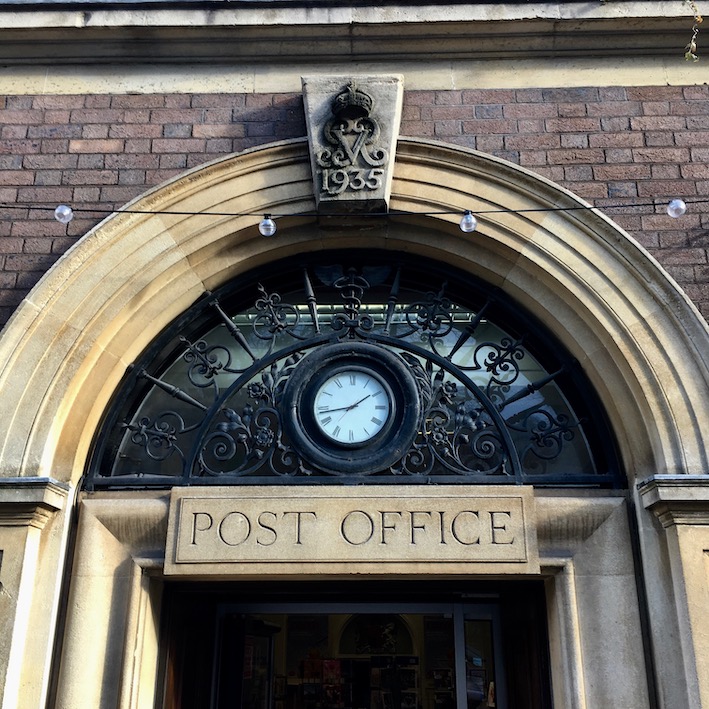
Although I’ve passed it dozens of times, I’ve never photographed the front of the Post Office in Great Malvern. That’s surprising in a way, because it’s a memorable neo-Georgian building, mostly of brick, with a big hipped roof and a central section with three large stone semicircular arches that breaks forward on the ground floor. The contrast between the grand arches – two with windows, one with the doorway – of the central section and the modest remainder of the building makes it all look a bit awkward. But there’s something civic and satisfying about it nonetheless, as there often is with the many neo-Georgian Post Offices built in the 1930s.

As I was passing a few weeks ago, it occurred to me that, even if the front was too cluttered with cars to make a photograph worthwhile, I could at least take a detail of an arch or two. Above the doorway, the classical lettering (not the usual Post Office letterform, but still effective), the big keystone with date and royal monogram, the ironwork, even the little clock all work together. Maybe the clock is too small – I’d guess there was one with a slightly larger face there originally. Maybe the lettering would be clearer with a broader stroke width. But it’s all better than the plastic signage – or, worse, a Post Office stuck in a corner of a high street shop – that we get today. And look at the window arches: little reliefs of Mercury to signify in another way the building’s purpose and to delight the eye.


A quick web search yielded a decent photograph of the whole building. There are still cars outside, true, but the photographer struck lucky with the middle one. It’s a Morgan, a beautiful hand-made English sports car with a classic design. And it was made in Malvern, in a factory that still produces cars with a similar traditional design – it’s the car to see in this town. Meanwhile, as I sit indoors (where I am too often these days) I offer my thanks to the Post Office for its part in keeping the mail coming. This year, mail deliveries have been bringing a rich and strange assortment of goods – from printer paper to teabags, secondhand books to cleaning products – to our door. Such deliveries are just as much a lifeline now as when this Post Office was built in 1935.

Photograph below of Great Malvern Post Office by Bob Embleton CC BY-SA 2.0


Thursday, April 27, 2017

Malvern, Worcestershire


Mobile architecture (2): Ancient

I'm stepping outside my comfort zone because I want to share the reconstruction of a medieval tent that I saw at the Malvern Heritage Festival shortly after admiring the café-in-a-caravan featured in my previous post

I don't know much about the history of tents, but I was attracted to the look of this one. Its owner, who was sitting outside making metal mail armour, told me that plain red had been chosen for the top because of the historical evidence. Illuminated manuscripts from most of the medieval period tend to show plain-coloured tents; the striped tents familiar from films and television dramas tend to be a bit later – from the end of the Middle Ages or just afterwards.

The other thing he pointed out about the tent was the structure, which is supported both by hemp guy ropes and by a wooden framework – the latter has a series of spokes like an umbrella which you can see inside the tent. This dual structure makes the tent very stable, and this was demonstrated in practice when maybe about a year ago it was pitched on the rise near Raglan Castle and stood firm during a gale while other tents nearby were blowing down. It was also very warm and snug inside. I've never been an enthusiast for camping, but in something like this, I could maybe take to life under canvas.

Sunday, April 23, 2017

Malvern, Worcestershire


Mobile architecture (1): Modern

Spotted in Malvern during the heritage festival this weekend was this memorable caravan, which I think of as a piece of mobile architecture. When I first saw it across the abbey churchyard I thought it must be an American Airstream, but it's actually British, and made by a company called Rocket, based in Stourport-on-Severn, who build aluminium caravans (both touring and, like this one, for businesses) to customers' specifications. It's shiny, eye-catching, looks very well made, and contains a mobile café that was doing good business. The cheerful person behind the counter, just visible in the shadows in my photograph, dispensed me an excellent cup of tea. She told me that Café Eight Three is available for all kinds of events, parties, festivals, weddings, etc, etc – you can find out more about the café here.

Please note A deadline approaches, so my posts will probably be shorter over the next few weeks. My apologies, and with them my hopes that brevity will be if not the soul, at least the occasional embodiment, of wit.

Monday, November 2, 2015

Great Malvern, Worestershire


Postcards from England

I’m fascinated by the way in which shop designers used tiles to make a colourful splash on street frontages, a type of decoration that enlivened many a shop front from the Victorian period until well into the 1930s. One of my favourite examples of this is on the front of a branch of W H Smith in Malvern, and one of its tile panels came to mind the other day when, in my previous post, I used the phrase ‘postcards from England’ to describe my blogging activities. This is a building I’ve posted before but one of its tile panels* is so beautiful, and, I think, so mysterious, that’s worth sharing once more.

This panel, set into a narrow reveal to one side of the shop window and so very easy to miss, advertises postcards – clearly, in a much visited spa town like Malvern, postcards were an important thing to stock. The view it depicts is a bit of fantasy architecture by moonlight. A medieval stone bridge leads across a river towards a gatehouse in what looks like a town wall. In the background is a looming tower, that seems to exist in a space that’s separate from the rest of the picture. Or not quite. In the foreground, the corner of this tower seems to grow out of the bridge, but in the background it appears to be behind the city wall. It’s also drawn, to seems to me, to a much larger scale than the bridge or gatehouse.

None of this matters very much, because the image, with its varied shades of blue and purple and its eery moonlight is a lovely confection that seems to invite us into a world of night-time mystery and make-believe. It certainly draws you in, although a postcard with a run-of-mill photographic view on it might be a bit of a come down after seeing it.

The other wonderful thing about the tile panel of course is that (together with another opposite it advertising maps) is still there. It must have been installed in the 1920s or 1930s and it takes us back to a time when shop fronts were designed for a life of decades rather than a year or two, when businesses weren’t expected to reinvent themselves every six months, but traded on their history and reputation. My readers can decide for themselves whether or not the change to a less long-term outlook is a good thing. But I’m glad at least that the old ways produced bits of occasional art like this.
- - -
*Made by Carter's of Poole, as one of my fastest-off-the-mark readers has reminded me.

Friday, October 10, 2014

Rhydd, Worcestershire


Pumpery

By the side of a road a few miles outside elegant, hilly Malvern, in the flat country between the villages of Guarlford and Rhydd, is this small corrugated-iron building, now partly surrounded by grass, weeds, and elderberries. Driving past many times, I took it to be a farm outbuilding, but then I noticed the way it faces right on to the road and the presence of a very old petrol pump at one corner. There’s an enamel warning sign about the dangers of petroleum spirit too, its red lettering still clear against a white background, now partly obscured by the elder. I assume, then, that this was once a small garage, supplying fuel to cars on the way to and from Malvern and also to vehicles associated with the neighbouring farm.* Like so many early garages and pumps, it is right by the roadside (the tarmac is just out of shot), so that the motorist had just to stop and refuel. Since Malvern is the home of the Morgan Motor Company, I have mental images of early three-wheelers and 4/4s pulling up…

In 1927, as car ownership increased in Britain, the Roadside Petrol Pumps Act was passed, giving local councils the power to licence petrol pumps. To start with, these pumps were hand-cranked, but by 1930, electric pumps were being installed on roadsides. World War II brought petrol rationing and the demise of many rural garages, but once the post-war period of austerity was over, there was a steady increase in car ownership again and many new purpose-built garages and filling stations were built. More and more, these were substantial buildings with proper forecourts, on to which one pulled, and eventually safety considerations meant that the old roadside pumps disappeared. The occasional survivor, either rusty like this one or more consciously preserved, remains to remind us of a very different era of motoring.

- - -

*And since this is an assumption, I’d be very interested to hear from anyone who knows more about the history of this building.


Friday, July 18, 2008

Great Malvern, Worcestershire


Quite a lot of Malvern is built in local reddish stone laid in a ‘rock-faced’ fashion. If this rather rustic finish seems a trifle wild and woolly for this somewhat buttoned 19th-century town, the crazy-paving effect is reined in by contrasting pale stone dressing. That’s the approach adopted by E W Elmslie for Malvern’s 1860s railway station, where the details are French-influenced Gothic with lots of gables, pointed windows, trefoils, tall chimneys, and niches.

None of this, though, prepares one for what’s inside, especially the decoration on the columns that support the platform awnings. Here are just three:
They’re ironwork foliage, created by William Forsyth, and they’re exactly right for Malvern, a town of trees and laurel bushes and shrubberies. The idea, apparently, was to feature species that can be found in Malvern’s streets and gardens. They’re also a splendid re-working of a medieval idea. Gothic cathedrals have capitals carved in stone; this Victorian station has capitals made of iron. All change!

- - - - -

Postscript 2018 I have done a post about the outstanding late-13th century carved capitals in the chapter house at Southwell Minster, here. These stunning carvings, full of life-like portrayals of the foliage of trees, must be among the ancestors of Forsyth’s capitals at Great Malvern. 

Monday, January 14, 2008

Great Malvern, Worcestershire


This surprise is in the Barnard’s Green area of Malvern, standing proudly at a road junction from where you take your choice of Malvern’s attractions – the lovely Victorian railway station, the town centre, the stately and all-commanding hills. The little building is not the thing one expects in this elegant English town, a place in so many ways redolent of the age of Queen Victoria or of Edward Elgar. Malvern is all wells, Victorian hotels, and opulent villas behind conifers and laurel bushes.

But not quite all. Meet the modernist war memorial bus shelter and clock tower of Barnard’s Green. I don’t know much about this building. It has a British Legion plaque on it and is in a 1930s modernist style that recalls seaside pavilions. There’s a neat clock, some masonry fins, an overhanging flat roof typical of the style, and seats inside, occupied the day I was there by a group of gentlemen somewhat the worse for drink who shuffled into the shadows when I got my camera out.
Best of all are the war memorial poppies that adorn the end panels around the outside of the little building. Buildings in this idiom aren’t normally allowed floral ornament, but this is different, of course. The poppies give us all the message we need.